


Page 40 - 80 YEARS OF VOLUNTEER IMPACT WITH FAO
P. 40
Climate resilience     Adaptation in action: Responding to climate change


                       Théo Martin


                       SUPPORTING SENEGALESE FARMERS

                       THROUGH FIELD SCHOOLS


                                                                                                      Senegal is particularly affected by declining rainfall and rising
                                                                                                      temperatures. Seasons are shifting, with increasingly irregular
                                                                                                      rainfall patterns, which adds to the challenge of meeting the
                                                                                                      needs of a growing population.

                                                                                                      As a trained agronomist, I worked with FAO in Senegal to help
                                                                                                      reduce farmers’ vulnerability to climate change. I contributed
      36                                                                                              to the Global Environment Facility project, which promotes
                                                                                                      the "farmer-field-school" approach, an outdoor learning model
                                                                                                      where farmers receive hands-on, practical training to adapt to
                                                                                                      changing climate conditions. I regularly joined field visits and
                                                                                                      trainings in peanut-growing areas and cotton fields, gaining
                                                                                                      deeper insights into sylvo-pastoral agriculture and participatory
                                                                                                      training methods.

                                                                                                      My main role focused on monitoring and evaluation, developing
                                                                                                      a method to assess whether the project was being implemented
                                                                                                      effectively. Using tools such as geomatics, rural sociology
                                                                                                      and statistics, I worked to understand the living conditions of
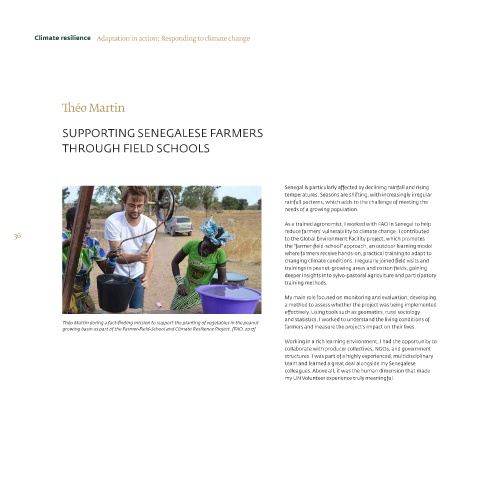
                       Théo Martin during a fact-finding mission to support the planting of vegetables in the peanut
                       growing basin as part of the Farmer-Field-School and Climate Resilience Project. [FAO, 2017]  farmers and measure the project’s impact on their lives.

                                                                                                      Working in a rich learning environment, I had the opportunity to
                                                                                                      collaborate with producer collectives, NGOs, and government
                                                                                                      structures. I was part of a highly experienced, multidisciplinary
                                                                                                      team and learned a great deal alongside my Senegalese
                                                                                                      colleagues. Above all, it was the human dimension that made
                                                                                                      my UN Volunteer experience truly meaningful.

