



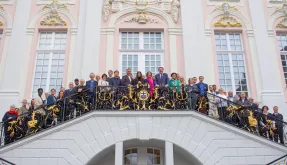
Toily Kurbanov, Executive Coordinator of the United Nations Volunteers (UNV) spoke on the occasion of the United Nations Day in Bonn. His remarks emphasized the UN’s relevance, the need for reform, and Bonn’s symbolic importance as a hub for global solidarity and action.
Staatsministerin Güler,
Landesminister Liminski,
Ladies and gentlemen,
Dear friends,
Thank you for giving me the honour to say a few words on behalf of the United Nations in Bonn.
Before coming here, I asked ChatGPT what would be the best speech about the UN to deliver to a German audience. It gave me a very good one—except the first sentence which went: “The UN is the only place where you can sit for hours and listen to a hundred speeches, and not one of them answers the question you asked.
I wasn’t sure it was the best opening for celebrating the UN’s 80th anniversary.
So instead, let me start with this:
Eighty years ago, the world turned a page and began a new chapter in human history.
And for the rest of my remarks, I’ll borrow five quotes that seem right for the occasion.
The first is from Kofi Annan: “If the UN didn’t exist, we’d have to invent it — but I’m not sure anyone would agree on how.”
He was right. It took the catastrophe of the Second World War for countries to create the United Nations — to save succeeding generations from the scourge of war.
Since then, through many ups and downs — from the Cold War to countless crises — the UN era has been the longest period of relative peace and prosperity in modern history. And Germany has been among its greatest beneficiaries of this period.
The second quote is from Dag Hammarskjold: “Constant attention by a good nurse may be just as important as a major operation by a surgeon.
When I first read that, I thought of Germany. Because Germany is both the beneficiary and one of the strong supporters of multilateralism. But it is the constancy of Germany’s attention that impresses most: not following fashion or headlines, but steady responsibility and quiet, hard work. That’s what makes Germany’s contributions so remarkable — in peace and security, in development, and in human rights.
And yet, the UN must keep improving — both in how countries work together, and in how UN delivers results. Hence the reforms now being discussed in New York.
Which brings me to the third quote: “Trying to reform the UN is like performing heart surgery on a patient who is awake — and arguing.”
And indeed, with six main committees in the General Assembly multiplied by 193 Member States, the patient does argue — a lot. Add to that today’s climate, where not only temperatures but also tempers are rising, and you get the picture.
The fourth quote comes from Paul-Henri Spaak, the first President of the General Assembly: “I prefer to go to the United Nations and hear speeches, rather than go to war and hear guns.”
True in the 1940s. Still true in the 2020s.
For us, the UN is not just somewhere in New York. You don’t need to fly to New York to go to the United Nations. Here, on the banks of the Rhine, the UN Bonn Campus gives both symbol and substance to Germany’s commitment to multilateralism.
Platz der Vereinten Nationen 1 is the global headquarters of climate action, the fight against desertification, and the United Nations Volunteers — alongside key work in health, education, gender equality and environmental protection.
Thank you, Bonn, for giving global cooperation a beautiful local address.
And finally — not a quote, but a headline I saw recently: “Meanwhile, at the UN: unanimous agreement to schedule another meeting.”
So let’s agree — unanimously — to meet again: one year from now, on UN Day 2026.
Vielen Dank.