



“Nobody tells you that one of the hardest parts of international work isn't the workload. It's learning how to be comfortable in a foreign country. I think that's why this work means so much to me,” says Rose Lagrotte. “The limitations force you to be deliberate. To find other ways to communicate, to lean on colleagues, to earn a place at the table.”
For many people, working overseas brings images of exciting projects, international travel, and new opportunities. For Rose, it also meant arriving in a country where she could barely understand the conversations happening around her.
Rose is an international UN Volunteer Climate Change Associate with the United Nations Resident Coordinator’s Office in Turkmenistan. Her assignment, funded by France, focuses on climate. But long before she arrived in Ashgabat in October 2025 on a two-year assignment, her journey had already taken her across continents and through very different areas of work.
“My journey here wasn't direct. I studied conflict resolution with a focus on climate-induced migration, which led me to an internship in Senegal working on community resilience. I saw firsthand how climate change isn't just about the environment; it’s about livelihoods, stability, and people being forced to move."
She adds, "Later, I interned at the UN Headquarters in New York on preventing sexual exploitation and abuse (PSEA). It seemed unrelated at first, but it taught me that all these issues are intertwined. Climate migrants are vulnerable to abuse. A people-centered approach means seeing all the risks they face. When I saw this UNV role, funded by France, in the UN Resident Coordinator’s Office, it felt like the perfect fit. By working with other UN agencies in Turkmenistan, this role brings all these different threads together. Since I started, I’ve been able to take on additional roles like becoming the focal point for PSEA and promoting a culture of accountability within our UN Country Team.”
Yet the biggest challenge she encountered had little to do with climate policy or UN coordination.
Rose does not speak Russian or Turkmen. “Every challenge motivates me to rethink my value. Maybe I can’t join every conversation, but when I am given the platform to speak, I make it count.” She continues: “I don’t speak the local languages and this barrier is very real. I’m left out of conversations I would benefit from being in; I sit in meetings conducted in Russian and only understand one word out of every six."
For some people, that might feel isolating. For Rose, it became an opportunity to listen more carefully, adapt, and find new ways to contribute.
The experience also changed how she thinks about impact. “I'm the type of person who likes seeing the finish line. But this job has taught me that some of the most important work happens long before the results become visible. Sometimes you spend months building something that someone else will eventually complete."
And that's fine, says Rose.
“There are moments when I feel the weight of expectations. Being on a fully funded international assignment is an incredible opportunity, and I often ask myself whether I'm doing enough. Then I remember that no one changes a system alone. We're all just adding our piece.”
Much of Rose’s work focuses on helping people understand climate change in ways that feel relevant to their lives. Rather than relying on technical presentations, she often turns to games and interactive learning tools.
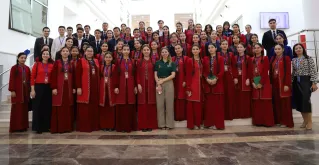
“Finding the right way to communicate also means finding the right audience, which is why a lot of my work focuses on youth and communities. I frequently conduct learning sessions using interactive tools like the 'Climate Fresk'—a French climate-related gamified tool—and the UNDP's 'Climate Box.' These climate quizzes and games help bridge the language gap, making complex environmental issues understandable to everyone from young children to teenagers," she shares.
"The young people here are already so aware of climate change, but playing these games helps them connect the dots between environmental shifts and societal impacts. Engaging with these bright minds gives my words a completely different kind of weight.”
Rose arrived as a young UN Volunteer expecting to listen and learn. Then she began finding herself in meeting rooms she had never imagined entering, sitting alongside heads of UN agencies and government ministers. At first, she questioned what she could possibly add. With encouragement from colleagues, she began to see that her outside perspective was precisely what made her voice worth hearing. Those moments have taught her that contributing is not always about being the most experienced person in the room.
Sometimes it is about asking a different question, sharing a new perspective, or helping others see an issue differently.
When Rose reflects on what has mattered most during her time in Turkmenistan, she does not begin with projects or policies. She talks about people.
“What keeps me going are the people. The colleagues who share their knowledge generously. The young people actively participating in bringing positive change to their societies. The students whose eyes light up when they realize they can be part of the solution. Those moments remind me why I came here.”
In a country where she arrived without the language, Rose discovered something else: communication is not only about the words you speak. Sometimes it comes from listening, learning, and showing up, day after day, until you find your place at the table.
Perhaps that is what volunteers do best. They do not wait until they have all the answers. They show up anyway. And piece by piece, something bigger begins to take shape.
This story was also published on the UNRCO Turkmenistan website.