



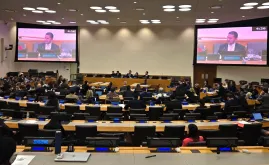
Toily Kurbanov, Executive Coordinator of United Nations Volunteers (UNV) presented the Strategic Framework 2026-2029 to the Executive Board in New York on 5 February 2026. The Executive Board consists of the United Nations Development Programme (UNDP), the United Nations Population Fund (UNFPA) and the United Nations Office for Project Services (UNOPS).
I thank you, Mr. Chair and the Associate Administrator, for the invitation to present the UNV Strategic Framework. Before I begin, I would like to request the Secretariat to introduce a short video for the delegates, please.
I thank the Secretariat, Mr. Chair, distinguished delegates.
What you have just seen captures the essence of this Strategic Framework.
It is about people—people who arrive before others, and who remain long after the headlines fade. People who are not merely the extra hands of the United Nations, but often its first presence—and its last remaining one.
And it is about enabling the United Nations to draw strength from volunteers:
A power that comes not from the rank, but from presence.
This Strategic Framework is built around that simple reality.
As the document has already been discussed in depth—including in our exchanges with the Board—today I will focus on three overarching questions:
- Why does this Strategic Framework matters?
- What does it retain from the previous cycle?
- What’s new?
First: Why it matters?
Ladies and gentlemen,
Much has been said this week about multilateralism being under pressure.
That phrase resonates—but it has also become a cliché. And like many clichés, it obscures as much as it explains.
What we see on the ground tells a more nuanced story.
People-to-people multilateralism—citizens choosing to engage, to serve, and to connect with the United Nations—is not declining.
It is growing.
If multilateralism was truly in retreat, 17,000 people would not be knocking on the UN’s door asking how they can help.
Last year alone, UNV mobilized more than 17,000 volunteers worldwide—twice as many as when I had first presented UNV’s annual report to this Board in 2021.
This Strategic Framework matters because it seeks to protect and strengthen that human face of multilateral action—and to ensure that people-centered multilateralism remains credible and confident in a time of pressure.
Second question: What we will carry forward from the previous cycle?
Mr Chair, ladies and gentlemen, our ambition remains unchanged.
To mobilize volunteers for peace and development, and to make the United Nations more people-centered.
This laser-sharp focus on the mandate entrusted to us by you, the Member States, has served UNV well—and will continue to do so.
From 2022 to 2025, UNV expanded its client base, enabling more UN entities to engage UN Volunteers—from UNDP to UNOPS, and from the World Bank to WHO.
UNV cherishes its unique role as a system-wide service. This role will also continue—and be further refined—in the years ahead.
During the previous cycle, ladies and gentlemen, UNV advanced its digital and data capabilities and optimized business processes. We prioritized agility—and delivered better services to the UN and to the volunteers, while achieving demonstrable efficiency gains. This unrelenting focus on agility will also carry forward.
And third: What's new?
Under the previous Strategic Framework, UNV focused on scale—and achieved it. Under the proposed Framework, the keyword is consolidation.
Yes, we will continue to make the Organization more people-centered by mobilizing as many UN Volunteers as possible.
But no—we will not pursue numbers for their own sake.
Grounded in its core mandate, UNV will adapt to the evolving needs of the UN system by tailoring its existing volunteer modalities—associate, specialist, expert, community volunteers, and refugee volunteers—and at the same time, we will introduce more flexible categories, including part-time, short-term, and remote volunteer assignments.
In addition, we will work to:
- Increase participation from developing countries, as called for in the Quadrennial Comprehensive Policy Review (QCPR);
- Engage youth and senior citizens alike, recognizing that volunteerism is a life-cycle activity;
- Support UN country teams in integrating volunteerism more meaningfully into cooperation frameworks.
In short, this Framework is less about doing more—and more about doing better, across the entire UN system.
Mr. Chair, ladies and gentlemen,
The Framework’s implementation will face strong headwinds: Geopolitical uncertainty, operational volatility, and funding constraints across the UN system.
But it also benefits from strong tailwinds: First and foremost are innovative and indomitable UNV staff, and second, not to forget, the fact that we begin this cycle in 2026, which is the International Year of Volunteers, which brings more momentum to our mandate.
Mr. Chair, this concludes my presentation.
I submit to you, and to the delegations, the new Strategic Framework—
- Anchored in our mandate,
- Enabled by our agility and
- Centered on people.
And I look forward to the Board’s guidance.
Thank you.
To read the UNV Strategic Framework 2026-2029, please click here.
To watch the Executive Coordinator's speech along with the full event on UN Web TV, please click here.
To watch the UNV short video broadcast at the Executive Board, please click the YouTube link below.
To read the Member States' support to UNV and volunteerism during the Executive Board, please click the following: Czechia, Germany (delivered a statement on behalf of a group of States: Finland, Germany, Ireland, the Kingdom of the Netherlands, Norway, Luxembourg, Sweden, Switzerland, and Türkiye), Japan, Kazakhstan, Luxembourg, Russian Federation, Rwanda (delivered a statement on behalf of Chad, Côte d’Ivoire, Madagascar, Mozambique, Nigeria, Rwanda, Tunisia, and Zambia), Tanzania, Thailand, Türkiye and Zambia.
The Executive Board of UNDP, UNFPA and UNOPS is made up of representatives from 36 countries around the world who serve on a rotating basis. Through its Bureau, consisting of representatives from five regional groups, the Board oversees and supports the activities of UNDP, UNFPA and UNOPS, ensuring that the organizations remain responsive to the evolving needs of programme countries.