



Every morning, I wake up with a sense of purpose, knowing that the work I do helps build a safer, fairer world. A world where people are protected from the harms of drugs, crime, corruption and terrorism. It’s not always easy work. It challenges me, stretches me and reminds me daily why I chose this path. But my journey to this point began long before the titles and responsibilities. It began with a desire to make a difference.
Finding my calling
As a young girl, I often questioned the inequalities I saw around me. I watched girls my age held back by barriers such as exclusion and lack of opportunity, and I knew something had to change. I felt drawn to act. That curiosity grew into a calling.
I sought spaces where I could contribute meaningfully, helping others overcome the obstacles in their way. What started as compassion became a lifelong mission to expand opportunity for those too often left behind.
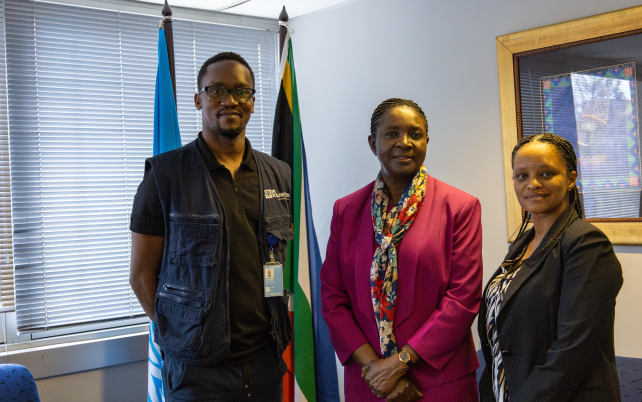
My professional path has taken me across government institutions, NGOs and international organisations. Before joining the United Nations Office on Drugs and Crime (UNODC), I led the Division of Social Welfare at the African Union Commission, working on drug control and crime prevention. Each role and each challenge reaffirmed my purpose in service, especially to the people of Africa.
The gift of giving back
Volunteerism has always been at the heart of that purpose. Long before I knew the word, I was living it. After high school, I spent my university breaks teaching in a rural school. I wanted those girls to see that university was not beyond reach, and that dreams could be real.
That experience changed me. I saw how giving even a little of yourself could spark hope in others. Since then, volunteering has remained a constant thread in my life through community projects, mentorship and church work. Even today, no matter how busy my schedule is, I make time for it. Volunteering fills me with perspective and gratitude. It reminds me why I do what I do.
The power of collective effort
At UNODC, our work tackles some of the most complex issues of our time–organized crime, corruption, terrorism and drug trafficking. These are not just policy issues, they are human issues that affect lives, families and communities.
One of the most inspiring parts of my work is seeing how volunteers contribute to this mission. UN Volunteers bring energy, innovation and fresh ideas to challenges that demand both courage and compassion. Whether addressing gender-based violence, countering terrorism or promoting justice, they help us reach people and places we couldn’t reach on our own. Many are young professionals full of
optimism and drive. Their passion reminds me that meaningful change often begins with a simple decision to serve.
The spirit of service
In my native language, there’s a word—Chiwruok. It translates to “commitment,” but it literally means giving yourself in service to others. Growing up, I saw that spirit everywhere. We called it Harambee, meaning "pulling together"—communities came together to build schools, support neighbours and care for those in need.
That spirit still guides me. It’s what fuels my work at UNODC and my belief in volunteerism. It’s what makes me certain that, even in the face of enormous challenges, we can make a difference when we choose to act together.
Lessons in service
There’s a saying I hold close: “Never say die until you die.” It means there’s always an opportunity to do good no matter how tough the road ahead.
If my journey has taught me anything, it is to always stay true to my core values: to always know who I am, what I stand for and why I do what I do. Volunteerism offers that space. It allows anyone, anywhere, to contribute, to grow and to discover purpose through service.
We all have something to give and when we give our time, our voice and our care, we light the way for others. This way, we can build a world rooted in peace, dignity and opportunity for all.
This blog is part of Journeys of Inspiration, a photobook. Many of the leaders whose stories are captured in this book began their journeys not in positions of authority, but in service—as UN Volunteers, as community activists, as individuals determined to make a difference.