


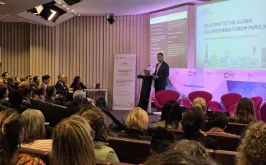
The United Nations Volunteers (UNV) Executive Coordinator, Toily Kurbanov, spoke at the Global Volunteering Forum in Paris on 20 October 2026.
Good morning, everyone.
Honestly, I didn’t expect this morning’s attendance to rival last night’s reception. So I haven’t prepared a special speech for this session. But I do have a few thoughts I’d like to share as we embark on the substantive dialogue.
First, let me thank the organizers—not just for bringing us together, but for an exceptionally well-crafted agenda. Yesterday, we thanked them for hosting us. Today, I want to recognize the care with which they have selected the topics and structured the discussions across three levels: plenaries, strategy sessions, and how-to workshops.
From youth to artificial intelligence to partnerships, there is plenty to discuss. So my first invitation is simple: contribute. Challenge assumptions, share your experience, and bring your own perspective. Every point of view matters, and our discussions will be richer for it.
I won’t attempt to preview the entire programme. But if I had to pick just three sessions—one plenary, one strategy session, and one workshop—I would highlight these:
Plenary: Reaffirming values and principles.
Strategy session: Building partnerships.
How-to workshop: Integrating the SDGs.
Let me explain why these three deserve particular attention.
First, values and principles.
Before we reaffirm our values, can we agree on what we mean by volunteering?
When a young person cares for an elderly neighbour, is that volunteering—or simply being a good neighbour? Where does volunteering end and civic engagement begin? And, in one of the most common areas of volunteering, social services: where is the line between celebrating volunteers and quietly subsidizing the state’s retreat from public services?
The UN definition of volunteering dates back to General Assembly Resolution 56/38, adopted in 2002. It describes volunteering as “a wide range of activities, from mutual aid and self-help to formal service delivery and civic participation, undertaken freely, for the public good, and without monetary reward as the principal motivation”.
Broadly speaking, this definition remains valid. Yet, why shouldn’t volunteer-involving organizations develop a more modern, more precise definition of volunteering—which the Member States will consider when updating its own definition of volunteering in one of the next General Assembly resolutions?
Values and principles anchored in a clear understanding of volunteering will carry far more weight than aspirations built around a term whose meaning we have never fully settled.
Second, partnerships and capacity building.
We have been around long enough to know that “capacity building” often means teaching another organization how to become more like us.
I hope I’m not upsetting anyone, but this is an inconvenient truth. Whether a donor country builds the capacity of an aid-recipient government, or UNV builds the capacity of a local volunteer network, the underlying assumption is the same: we have the model, please learn it.
True reciprocity requires more. Organizations in the Global North must not only share their standards but also recognize—and adopt—standards and practices from the Global South.
Let’s ask some concrete questions. Would a French organization accept shared decision-making with a Fijian counterpart about volunteering in France? Would Swedish NGOs invite their Senegalese partners to co-design volunteering programmes in Sweden?
To me, this is what “sustainable and balanced partnerships beyond capacity building”’ will mean.
Third, better integrating the SDGs into volunteering.
Let’s assume that what is said in Paris will stay in Paris.
If 12 years of the 2030 Agenda have not been enough to integrate the SDGs into volunteering, what exactly do we expect to achieve by making this a priority now, with only three years remaining?
What will better integration actually deliver for volunteer programmes? Will it change what they do—or will it simply mean borrowing SDG vocabulary and, worse, adding another compliance requirement?
And for programmes that have already integrated the Goals, what happens when the SDGs expire in 2030? Will their work suddenly make any less sense?
Rather than over-investing in better integration—to me, yesterday’s priority—shouldn’t we use the momentum of the International Volunteer Year to make a stronger case for volunteering in the post-2030 development agenda? Or, are we content with it being merely recognized as “means of implementation”?
As someone said, the answers we obtain will never be better than the questions we ask. At UNV, we are here not only to pose questions, but to work with you on the answers.
My colleague Julie Park, from the Secretariat of the International Volunteer Year at UNV, will share a progress update on Day Three. My other distinguished colleague, Emiliya Asadova, will join you in three sessions: on data, measuring the impact of volunteering, and UNV’s latest and forthcoming knowledge products.
I cannot think of a better time—the International Volunteer Year—or a better gathering than this one to discuss these questions.
And now, before I close, I would like to mark a special moment.
To commemorate the International Volunteer Year, the United Nations Postal Administration has issued a set of IVY 2026 commemorative stamps. They are a tribute to the millions of volunteers whose time, skills, and compassion strengthen communities around the world every day.
A stamp is a small thing. Light enough to carry in a pocket, yet capable of crossing borders. It carries a message to someone in a place its sender may never visit.
In a way, that is what volunteers do. They connect people, cross boundaries, and carry solidarity into places it might not otherwise reach.
It is my pleasure to officially launch the IVY 2026 commemorative stamps here in Paris, during IVCO 2026.
Thank you.