



Daria Sergeeva didn’t grow up planning to leave home at twenty to live and work in another country. But sometimes a life-changing decision doesn’t announce itself with certainty—it slips in quietly, disguised as a vacancy notice. When she saw the words: UN Volunteer. Belarus. Something clicked. It wasn’t just a job. It was a thread connecting a fifteen-year-old girl who once crossed a border for a training programme, a student organizing Model UN while dreaming out loud, and a young woman suddenly forced to ask herself: What if I actually go?
Daria still remembers the moment it all came together. “When I saw the UN Volunteer vacancy in 2022, it felt like everything aligned—the personal connection, the long‑held dream of working with the United Nations.” She applied, got the offer, said her goodbyes—and soon after, was on a flight to Minsk. Originally from the Russian Federation, Daria joined the United Nations Development Programme (UNDP) in Belarus as a UN Volunteer. Her volunteer assignment was also funded by the Russian Federation. Since 2022, she has worked across knowledge management, results-based management and evaluation. Now in the final stretch of her second assignment, which began in 2024, she serves as a Knowledge Management and Monitoring and Evaluation Specialist. Along the way, she has also supported UNDP on project performance monitoring and digital climate infrastructure.
This is Daria’s story, in her own words.
From idea to best practice
“A couple of months in, I realized something important about volunteering with the UN. It gives you room to take initiative. You're not locked into a narrow role. You can look around, see what could work better, and propose a solution.
Over the years, the office had built up a rich archive of project documents—evaluations, budget reports and concept notes. But like many UN offices, the knowledge was stored across different systems and formats, making it difficult to search and retrieve. It was an opportunity for me to propose solutions.
I spent months studying how other country offices managed their knowledge: in Kazakhstan, the Philippines and Serbia. Building on their example, I designed an internal knowledge platform where a colleague could search for any document the office had ever produced, find updates from across the organization, and access guides and learning materials—all in one place.
I organized years of paper and electronic archives into the platform, created a step-by-step manual with screenshots, and trained 80 colleagues through group sessions and individual support. We started building a collective memory with accessible knowledge from every colleague.
The results came quickly. A colleague found a previous project evaluation that described which solutions worked best with local partners. Without the platform, that knowledge would have taken days to find. The team used it to rewrite a project proposal, secured funding, and that project now helps Belarusian emergency responders adapt to climate change.
Upon review of the country office’s work, it was recommended that the platform be rolled out to other country offices in the region. UNDP Belarus was also recognized as a front‑runner in knowledge management, and I was termed "digital savvy" by my peers in the office.
From local solution to global platform
My country-level experience soon led to a larger opportunity. UNDP's team was building the Performance App—the first daily performance platform in the UN system, consolidating data on 23,000 projects across 170 countries into a single view. Until then, this information had been managed through separate specialised systems.
I reached out to the team, shared my experience with the local knowledge platform, and was invited to contribute to the work alongside my country office role. It was both exciting and daunting, as the scale was far beyond anything I had done before. I took on business analysis work—translating user needs into technical specs, shaping the dashboard, building performance indicators, and coordinating with colleagues across regions to align data. Each country office recorded data differently, so making it work required constant cross-time-zone collaboration.
Making our team's work visible and valued
Every five years, UNDP evaluates its entire programme in a country and the results of the evaluation determine the organization's future presence and shape the next strategy to work with our partners. For Belarus, that meant over a hundred participants: ministries, civil society, donors, and beneficiaries.
I compiled years of programme data into a clear story for the evaluation and worked with colleagues across five regions so every conversation reflected the team’s best work.
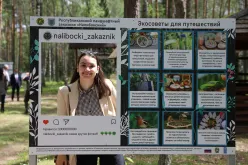
One of the projects that the team evaluated was in Naliboksky Nature Reserve. When I visited, the sun was filtering through the trees as I walked the eco-trail, newly rebuilt with accessible ramps, wildlife information boards, and QR codes linking to virtual reality tours. Electric bicycles and kayaks stood ready for safari routes. Local children from the Young Ecologists' club were already using the trail. This was a project I had only known through documents and budgets. Seeing it alive, open, and accessible to everyone gave me a sense of accomplishment and I thought to myself that this is the legacy of the UN.
What volunteering actually teaches you
Each part of my journey was connected. A local knowledge platform grew into a global performance app. Every step opened the next door: not because I planned it that way but because I kept looking where I could be most useful. It also made me realize the purpose in my UN Volunteer assignment—my job is making sure the impact of our team’s work is visible and valued.
And if there's one thing I would tell anyone considering this path, I’d say that UN Volunteers have more freedom to make a difference than they realize. Volunteering isn't just about filling a role; it's about having the freedom to rewrite your role."
Daria participated in the Russian edition of UNV's Voices of Change webinar, please click here to view the recording on YouTube.