



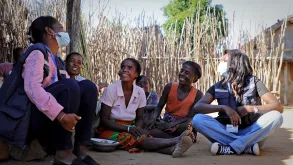
Working at the United Nations Volunteers (UNV), alongside humanitarian partners, has made one thing clear to me: when responses need to be fast, flexible, and rooted in local reality, volunteerism is not an add‑on. It is essential. Many real‑life examples support this argument. In 2025, Zahra Vaziri, a UN Volunteer, worked with the United Nations High Commissioner for Refugees in Malawi, providing on‑the‑ground support to refugees and Malawian host communities at Dzaleka Refugee Camp. Her work focused on strengthening livelihoods and building climate resilience within the camp. Zahra’s story is not an exception. It reflects the everyday reality of thousands of UN Volunteers working alongside communities, often out of the spotlight, to meet urgent needs. Yet too often, this role remains overlooked in humanitarian response.
I saw this gap up close, when I attended this year's Humanitarian Network and Partnerships Week in March 2026 in Geneva, a global forum for all humanitarian actors, including volunteer-involving organizations. Across discussions, one message came through clearly: business as usual will not work. This year, the focus was on humanitarian reset and what it means for the people affected by the humanitarian crisis.
We don’t have the luxury of taking several days to deploy responders to emergencies, while people on the ground are losing their lives. Concrete discussions with clear actions to support people in need are not just important; they are a must.
In 2026, over 239 million people require urgent humanitarian assistance as a result of conflicts, climate-induced disasters, and funding constraints. Forecasts for 2027 already show a need for a shift towards local, digital, and climate-adaptive responses to address humanitarian challenges. Against this backdrop, volunteerism becomes central. And this is where UN Volunteers come in. I work with UN partners at the global level to support the mobilization of UN Volunteers on the ground, responding to the needs of people affected by humanitarian crises.
What I have seen over the years is a clear shift: UNV has become faster and more agile in deploying its cadre of volunteers—whether responding to the crisis in Ukraine or the conflict in Sudan.
Increasingly, UNV has embraced resource‑efficiency as a mantra. This is not just an internal shift; it is a strength that partners should tap into more deliberately as humanitarian needs grow and resources remain constrained.
Last year, almost 5,200 UN Volunteers (55 percent women) supported crisis and emergency response globally, volunteering their time in the most complex situations and often far away from family and loved ones, putting their lives at risk. From assisting the internally displaced by partnering with the International Organization of Migration to delivering life-saving supplies during emergencies with the World Food Programme, the UN Volunteers have been quick to hit the ground running by working closely with the local actors and communities.
Meanwhile, studies point to the often overlooked role of volunteers in humanitarian response. Some research has also revealed that volunteerism is insignificantly reflected in humanitarian planning instruments. With 2026 termed as the International Volunteer Year, it’s the perfect time to get our acts together and make volunteerism a part of our call to action.
In a world where crises are growing more complex, the answer lies in better systems that can support and provide respite. It is what humanitarian action looks like today—and volunteerism is at the heart of it.