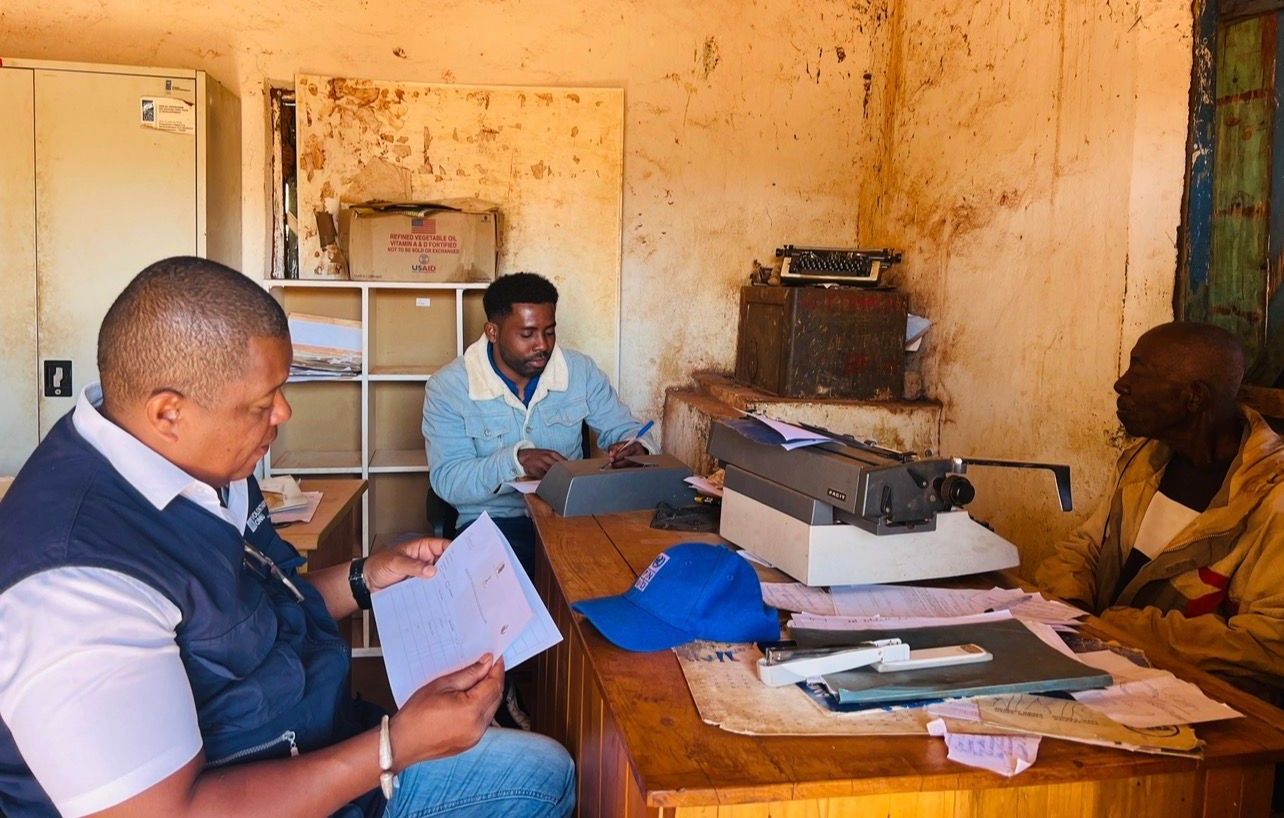
In Madagascar’s Deep South, where drought and food shortages have become part of everyday life, every decision matters. Families live through uncertain harvests and limited resources, while local authorities work to respond to growing needs. For UN Volunteer, Falimanantsoa Rasolofomanana, finding solutions begins not behind a desk, but in conversation with the people living the reality every day.
A national UN Volunteer, Falimanantsoa, serves with the United Nations Development Programme (UNDP) in Madagascar as a Humanitarian–Development–Peace Nexus and Local Governance Specialist.
His volunteer assignment is about bringing different groups together so they can listen to communities, agree on priorities and work towards the same goals. Looking at various perspectives—humanitarian, development and peace—is also part of the role, helping build a shared understanding and plan a response together.
“What inspired me to join the United Nations Volunteers (UNV) was being able to turn my compassion into concrete action,” says Falimanantsoa. “Seeing the resilience of communities in Madagascar's Deep South in the face of drought and food insecurity touched me deeply.”
On some days, the work happens in meetings with regional teams and local authorities. On other days, it takes him to rural communes and districts, where he listens to community concerns and helps connect those realities to planning processes. The aim is not only to respond to immediate needs but also to support longer-term governance.
One area of work that stands out is the Pacte Vert project, which focuses on strengthening food security, improving the management of natural resources, and supporting communities in their adaptation to climate change. Through the project, Falimanantsoa contributes to the technical side of coordination in the Androy region using the Humanitarian–Development–Peace Nexus approach.
When speaking about field work, he says, “What makes me most proud is to be at the side of the most vulnerable populations who benefit from our support: to share with them, to listen to them and to prepare analysis to the best of my ability.”
Behind the technical terms is a very human process. It means sitting with communities, listening to different perspectives and comparing what people are seeing on the ground. Much of this work happens before projects begin and before decisions are made. But when it is done well, communities and local authorities have a clearer picture of their needs and priorities.
The assignment also comes with challenges. One of the biggest, Falimanantsoa says, has been “to effectively coordinate multiple regional actors and structures.” He met this challenge by working “actively and in tandem with regional officials,” encouraging dialogue and building trust. In the process, he came away with a simple but important lesson: people need to listen to one another if they want to solve problems together.
His commitment to volunteering goes beyond his UNV assignment. He has helped plant trees, supported communities after disasters and raised awareness among young people about drug use and HIV/AIDS.
Reflecting on volunteering, Falimanantsoa shares, “Volunteering means being directly with communities, listening to their needs, understanding their realities and bringing my skills to where they have the most impact.”
Volunteering is as much about learning from others as it is about helping, he adds. His advice to future volunteers is simple: come with curiosity, humility and a willingness to listen. “Being a volunteer is not only about bringing your skills, but it's about understanding the context and taking concrete action.”
As he looks ahead, Falimanantsoa hopes to build on the foundation his UN Volunteer assignment has given him and continue serving communities where support is needed most—one conversation at a time.