



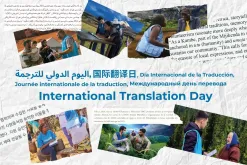
On International Translation Day, we look at the role of translators and editors who shape volunteer stories—from Africa to Asia to Europe and Latin America. Beyond linguistic accuracy, they are entrusted with preserving the soul of a story. When acts of service are rooted in cultural values, literal translation can dilute meaning. Word-for-word translation is rarely effective. Grammar, expressions, and sentence structures vary, so translators must reshape language while preserving the original’s authenticity. This work demands sensitivity, cultural understanding, and ethical responsibility.
At every step, we must ask: Does this translation honour the intent and emotion of the original thought?
Voices from the UNV editorial team in 12 languages—Arabic, English, French, Luo, Nepali, Portuguese, Quechua, Russian, Spanish, Swahili, Ukrainian, and Urdu—in this video celebrate the cultural richness of each region.
From utu and umoja in Kenya to ayni in Bolivia, and sewa in Nepal, to asar or ashar in Central Asia to servir in Latin America—acts of service, humanity, humility, care, duty—are deeply rooted in local traditions and bear nuances that can be difficult to translate.
In a world shaped by AI, human insight remains essential to ensure that translation conveys not just words, but the spirit behind them.
For more information about UN Volunteer assignments, click here and to read our stories, click here.
Animation/Multimedia concept and creation: Gabriela Coka.