



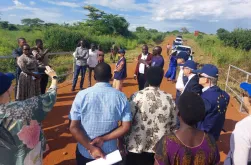
I am Decimon Anywar from Uganda, currently serving as a UN Volunteer with the United Nations Capital Development Fund (UNCDF) as a Local and Community Development Specialist on Climate Change. I am based in Gulu City in Northern Uganda. I joined the United Nations Volunteers (UNV) with a clear purpose: to serve my community where it truly matters—not in theory, but on the ground, where needs are real and immediate. To that end, I remained active on the UNV portal, continuously refined my profile, and applied for a role that genuinely aligned with my training and professional experience.
With both a Bachelor’s and a Master’s degree, alongside more than three years of field experience, I brought more than formal qualifications—I brought context. The role required strong local knowledge, and that is where I stood out.
My work centers on climate change. Through the Local Climate Adaptive Living Facility—LoCAL—I coordinate its implementation across four districts in Acholi and parts of Karamoja. Here, climate change isn’t a concept. It’s a flood that takes the road overnight. A drought that empties water points. A storm that flattens crops and cracks homes. And all of it lands on local governments already stretched thin.
No two days look the same. Some days I’m in the field, listening as communities map their risks and vulnerabilities. Other days I’m across the table from district planners, turning those realities into climate investments that make sense—and can be funded.
I support districts to integrate these priorities into development plans and budgets, then follow them through: implementation, safeguards, risk management. I track results, document progress, and keep the work moving forward—because here, delay has consequences.
Communities are not passive in this process. They choose priorities themselves. We make sure women, youth, elders, and other vulnerable groups are heard. Many selected investments focus on water access, roads, and environmental protection.
So far, I have coordinated more than twenty climate adaptation investments—but numbers only tell part of the story. These projects show up culverts in road bottlenecks, energy-saving stoves in institutions, tree planting, riverbank protection, food storage facilities, rainwater harvesting systems, and solar-powered water systems.
I’ve seen the difference firsthand. Places where children once missed school every rainy season are now passable year‑round. Health facilities that struggled for water now have safer, dependable sources. This is change at the last mile—quiet, practical, and deeply felt.
As a district engineer shared: “These projects are small in size but big in effect. They solve the exact problem people complain about every season.” That feedback stays with me—because it confirms that when adaptation is done right, it doesn’t just respond to climate change. It restores daily life.
I work within UN and government rules and systems. That requires discipline and patience. I rely on collaboration and trust. I stay informed and keep learning. I also volunteer beyond my assignment. I have supported national UN Day and other international day events. I also join local government community activities when needed. My supervisor, Justine Audrain, wrote in my midterm appraisal: “Decimon has excelled these past six months in providing technical inputs to the programme beyond his scope of work. He has proactively expanded his knowledge through targeted training and used it to benefit programme implementation. Decimon is set to achieve the highest results.” That recognition motivates me.
There are challenges. Resources are limited. Systems can be slow. Sometimes the needs on the ground move faster than approvals and funding. I manage this by setting realistic steps and staying patient. UNV field support visits and host institution training have helped me grow. Acceptance by local authorities has made field work easier.
I’ll carry forward strong, practical skills—working with communities, aligning partners, and turning climate challenges into action. I’ve learned how to respect local culture, manage expectations honestly, and stay steady even when resources are tight.
My long‑term goal is simple and focused: to deliver programmes that work and to grow into a specialist in climate adaptation and finance. I want to support rural and community development and make sure marginalized voices are heard where decisions are made. This assignment isn’t just experience—it’s the foundation.
Volunteerism, to me, means putting humanity at the center of work and decisions. It creates space for people from all walks of life to shape real change, where it matters most: in local communities.
Large institutions like the UN can feel distant—until you see how deeply their work lives in local hands: in roads that hold, water systems that last, schools that stay open, and community water points that keep running.