



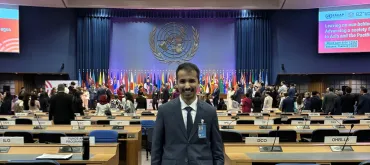
It's a week before a major UN commission session, and Mutlaq Alsubaie sits at the back of a crowded hall in Bangkok. Delegations from across Asia and the Pacific fill the seats around him. Then, young delegates take the floor—not just as participants but as contributors. They build on the work of those who came before them, while bringing new ideas to governments across the region. "It reframed the whole thing for me," Mutlaq says. "This isn't a one-time relationship between an institution and young people. It's ongoing."
Thousands of kilometres away, Abdullah Alrebdi sits across from government officials from the Forum of Small States (FOSS) in Singapore. The group is grappling with a live question: should a proposed AI data centre be approved, and what would it mean for the country’s energy use and environment?
Mutlaq and Abdullah are Saudi UN Volunteers on parallel journeys, turning national expertise into global experience through the fully funded partnership between UNV and Saudi Arabia’s Ministry of Economy and Planning.
For Saudi Arabia, the partnership builds professional capacity tied to its development goals. Volunteering itself sits at the centre of that vision: by the end of 2025, more than 1.7 million people across the Kingdom were registered as volunteers, well past Vision 2030's original target of one million, years ahead of schedule. And for UNV, partnerships like this extend its work beyond any single country, turning one government's investment in volunteerism into benefits well beyond its own borders.
UN Volunteer Mutlaq Alsubaie, Junior Sustainable Development Officer with ESCAP, Thailand
Mutlaq's journey began at the Conference of the Parties COP16 in Riyadh in late 2024, where he helped organize the conference alongside other young Saudis. Today, as a volunteer in the Office of the Executive Secretary at the Economic and Social Commission for Asia and the Pacific (ESCAP), he brings young people’s voices into ESCAP’s work and serves as its Youth2030 focal point for the UN Youth Townhall.
It did not take long for that commitment to become visible in his work.
"Mutlaq represents a new generation of hard working, tech-savvy, and fast learning professionals," says Lin Yang, Deputy Executive Secretary for Programme at ESCAP. "He has helped transform data into meaningful insights that will inform ESCAP's future direction on intergenerational engagement."
Part of that work meant understanding the region he now represents. "There are more than 700 million young people across Asia and the Pacific," says Mutlaq. "That's a number that should be counted too."
When he arrived, he went through five years of ESCAP data and reporting on the role of young people in its work. The trajectory was clear: young people were no longer simply on the sidelines of these meetings, but increasingly at the centre of them.
"In the earlier years, youth were more often attending events," he says. "Now they take part in the discussions and processes themselves."
Asked what he would tell a Saudi thinking about becoming a UN Volunteer, he says: "If I were to go back in time and see myself hesitating, I'd say: just do it. It's an opportunity to be seized, not feared."
UN Volunteer Abdullah Alrebdi, Programme Associate AI Trust and Safety Collaboration with UNDP, Singapore
Abdullah's background was in infrastructure and Artificial Intelligence (AI), not policy. The Saudi-funded assignment gave him the opportunity to join the United Nations Development Programme (UNDP)'s Global Centre as an AI Trust and Safety Associate. A question had been on his mind for a while: What's the effect of a given technology?
"Many countries don't have the capabilities to address the challenges that they have," he says, describing the gap his work at the Global Centre is meant to close.
This is where Abdullah’s day-to-day work begins and where the FOSS exercise put it to the test. Working alongside officials, he helped weigh what the facility could offer the country against the physical and environmental costs if the terms were wrong. It is precisely this kind of scenario that his assignment is helping small states prepare for and navigate.
Abdullah's proudest moment came through an international scientific exchange on AI safety, whose findings fed directly into the UN General Assembly’s Global Dialogue on Artificial Intelligence Governance. He recalls, "Knowing that I actively helped to make AI safer and more accountable is an indescribable feeling." For Jayant Narayan, Lead for Digital, AI and Innovation at the Global Centre, Abdullah’s contribution has made a clear difference: “Abdullah has been a highly impactful UN Volunteer, driving critical progress in global AI governance and digital policy.”
"Abdullah has consistently proven how dedicated volunteerism can influence international policy." Carla Gomez Briones, Officer-in-Charge of the Global Centre, connects that impact directly back to the partnership that brought him there. "Moving from Saudi Arabia to Singapore to serve as a UN Volunteer takes real initiative," she says. "He has made the most of every part of it."
Abdullah's advice to other young Saudis has little to do with AI. "Leaving your comfort zone and getting exposure through a volunteering experience with the UN could be one of the most rewarding experiences you will have."
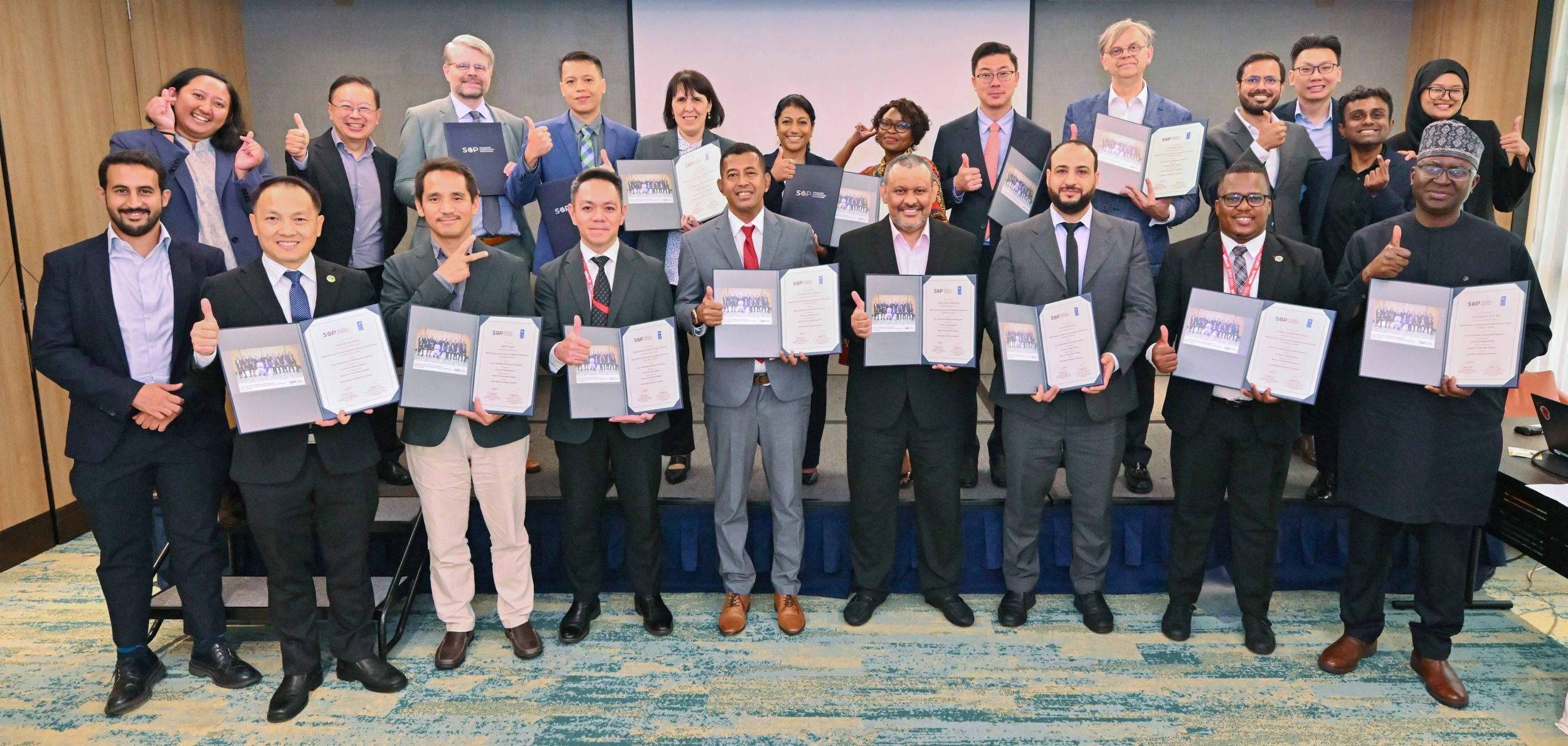
Two different questions: who makes sure young people are involved and who takes part in the conversations on AI policy.
Both trace back to the same response—the partnership. For Saudi Arabia, the partnership builds toward its economic and development ambitions. For UNV, it is proof of what these partnerships are meant to do: turn one country's investment in volunteerism into contributions the whole UN system can draw on.
For Mutlaq and Abdullah, it meant leaving home to do work whose impact reaches far beyond it.