



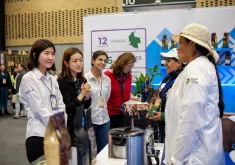
In Colombia’s rural heartlands, where women make up nearly half the agricultural workforce, the Raíces, mujeres sembradoras del cambio project is helping them grow—not just crops, but confidence, leadership, and independence. Led by UN Women with support from the United Nations Population Fund (UNFPA), Korea International Cooperation Agency (KOICA), and Colombia’s Ministry of Equality, the initiative equips women with the tools to earn more, lead their communities, and rebuild lives shaped by hardship and conflict. Ae Young Jung is a Korean national who completed a six-month assignment with UN Women Colombia through a fully funded volunteering opportunity from September 2024 to March 2025.
Growing up in Ecuador, Ae Young saw Latin America’s social struggles up close—and they stayed with her. She’s driven by a commitment to support vulnerable communities and promote gender equality. This opportunity didn’t just connect her to a cause—it brought together her Korean roots and the place that shaped her worldview.
What stood out most to Ae Young was the project’s focus on women’s needs and leadership. “The idea was to offer tailored training—whether practical skills like using equipment and managing production, or motivational support to help women take on leadership roles,” she explained. Raíces wasn’t just about participation; it was about preparing women to lead and make decisions in their communities.
During her assignment, Ae Young witnessed how UN Women gradually earned the trust of the women they served. “From what colleagues told me, many women were initially hesitant to participate in the initiative—even to travel to the capital, Bogotá. Many leaders and key representatives were invited, but these spaces felt unfamiliar. For many, participating in fairs, training sessions, or showcasing their products was a once-in-a-lifetime experience.”
But over time, the transformation became undeniable. “My team observed their growing confidence at these events. Attending two fairs myself, I saw how proud they were—not just of their products, but of being part of a movement designed for women.” The training focused on practical skills—from marketing and customer engagement to digital payments and mobile app use—creating new opportunities for women-led businesses. Ae Young supported this work by preparing training materials and presentations, particularly those related to marketing.
“For the women producing cacao and chocolate, I created promotional materials to help them showcase their products at fairs,” she explained. Ae Young also contributed to the administrative side, assisting with research and reporting.
Beyond her training role, Ae Young took on responsibilities in organizing internal coordination meetings. “Each department, like Nariño or Cauca, had its own small team. When they traveled to Bogotá, I managed the planning and logistics for their coordination sessions, which often ran over two or three days.”
Yet, Ae Young's challenge was defining her role as a UN Volunteer. “The difficulty wasn’t about the work itself,” she reflected, “but in discovering where my skills could lead to proactive contributions.” Unlike specialized staff with clearly defined responsibilities, she had to actively assess where she could be most useful. “The real test was learning to recognize both my strengths and having the initiative to act on them.”
Ae Young highlighted a key strength of the UN system: “It’s very open to hearing your ideas and letting you step in where you can add value.” Beyond her personal growth, she recognized that Colombia’s unstable security conditions posed one of the greatest challenges for the project. Many of the women’s groups they worked with were based in areas vulnerable to conflict. “Areas like Cauca saw renewed armed group activity toward the end of my assignment,” she said. “Projects that had been moving forward were suddenly put on hold due to safety concerns.”
These developments led to complex internal discussions within the project team. “We talked about how the renewed conflict could delay programme activities,” Ae Young explained, “but direct intervention often posed safety risks for staff.” In response, the team took a proactive approach—redirecting funds initially set aside for workshops and equipment toward urgent humanitarian needs, including support for participants relocating to safer areas.
Ae Young was especially impressed by KOICA’s flexibility and understanding as a donor. “When we shared the security challenges, they quickly acknowledged the importance of adapting the project—sometimes resilience means changing course to keep the women we support safe. The donor support isn’t just about individual communities,” she emphasized. “It helps maintain stability.”
She recalled how, in regions where USAID withdrew support, previously stable communities quickly experienced renewed insecurity and disrupted progress. “That example illustrates what’s at stake—without sustained support from donors like KOICA, hard-earned progress may quickly erode,” she warned. “It wouldn’t merely slow us down—it could actively reverse it.”
In places where there is conflict and recovery, long-term support isn’t a luxury—it’s a lifeline. It protects lives, restores dignity, and keeps hope alive.
Ae Young is now working as a Spanish AI dubbing producer for a technology company in Seoul that specializes in artificial intelligence.
This story is part of a special feature marking twenty years of KOICA and UNV partnership. For more information about UN Volunteer assignments and how you can get involved, click here. To read our stories, click here.