



I still remember the smell of smoke.
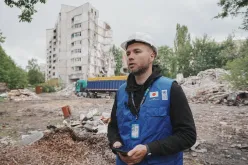
In 2014, shortly after I graduated from university, my hometown of Lysychansk in eastern Ukraine became a frontline. One day, I saw photos on social media: my apartment building had been hit several times and burned for two days before the flames were extinguished. Part of the building collapsed. I did not know how badly our apartment had been damaged. I recall my helplessness, emptiness. The future I had planned suddenly felt irrelevant. Almost three years later, we received government compensation. The building was eventually demolished. We stayed in the region. Many people asked why. The answer was simple: this was my home.
Four Years of Resilience
In 2022, when the war started, Lysychansk was occupied. Like millions of Ukrainians, I became an internally displaced person. “IDP” is a term often used in reports and briefings. For me, it means leaving behind familiar streets, memories, and any sense of permanence.
It means rebuilding stability while knowing the place you belong is no longer accessible.
Before joining the United Nations Volunteers (UNV), I worked as a human rights lawyer with the Norwegian Refugee Council in the Luhansk region. Every day, I met people whose lives had been interrupted by war: displaced families, elderly people, individuals who had lost documents, property, and stability.
They came to us with practical problems: suspended pensions, missing identity papers, damaged homes, employment disputes. But behind every case was fear of the unknown.
I remember an older couple who left their house at 3 a.m. to cross checkpoints and stand in line just to resolve pension issues. Their pension was their only income. They were exhausted, yet determined. The husband told me, “It is quieter now. It is possible to live. But sometimes it is very scary.”
When you experience war and displacement yourself, you do not just hear such stories; you understand them. You know what it means to check security updates before planning your day. You know how fragile normality can be. Maybe that is why I chose this path.
I may not be on the front lines myself, but I work to make sure others can be there, that volunteers are placed where they are needed most, safely and effectively. If I can help create the conditions for someone else to support a community in crisis, then that is my way of standing with them.
2025 has become the deadliest year for civilians in Ukraine since 2022. But they are not statistics. Each person was someone’s child, parent, friend—a life with dreams, memories, and a future.
And yet, amid destruction, there has also been extraordinary resilience.
We stay because our communities need us. We show up because we know that, in another moment, they would show up for us too. That sense of mutual care of not leaving each other alone is what keeps me awake at night and keeps me going.
When I look back, I see more than 1300 UN Volunteers who stepped forward in Ukraine and beyond. Some were directly affected by the war themselves. Others came in solidarity from abroad. It is not easy to help when you are hurting. And yet, again and again, people find the strength to do exactly that.
They are not numbers. Each one represents commitment. Each one carries hope.
Volunteers support UN agencies in restoring energy systems, strengthening communications, protecting cultural heritage, analyzing data, advancing digital solutions for children, and preventing gender-based violence.
Serhii, a UN Volunteer serving as a 3D Scanning Engineer with UNESCO Ukraine, puts it simply: “Scanning tools help restore damaged cultural heritage sites faster.” Behind that is more. Each scan preserves memory. Each digital model protects identity. When so much has been destroyed, documenting what remains is both care and continuity.
This work is grounded in a simple belief: collective action still matters, even in war. Solidarity is not abstract—it is practiced daily, through service.
Pavlo, an Explosive Ordnance Victim Assistance Coordinator with UNDP, supports survivors of landmines and explosive remnants of war—helping them access medical care, rehabilitation, and rebuild their lives. For many, this work is personal. It is not separate from the context they live in. Yulia, a UN Volunteer with UNFPA, says: “Being part of this means knowing that our efforts truly reach people across Ukraine.”
There is no routine. Days begin with security checks: shelling, road access, water, electricity, internet. Work continues from corridors, cars, unstable connections. Winter brings outages; summer brings uncertainty. Many have relocated multiple times. Some are rebuilding homes while continuing their assignments. Yet they show up.
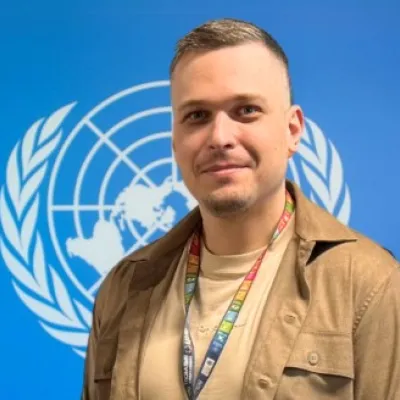
As UN Volunteers Country Coordinator in Ukraine, I witness the determination behind the numbers. UN Volunteers sustain operations, strengthen partnerships, and ensure access to rights and essential services in an active war setting—contributing not only to the response, but also to recovery.
After sleepless nights, colleagues log in and simply say, “We continue.” The war changed my plans. Displacement reshaped my sense of home. When our apartment burned in 2014, I felt powerless. When Lysychansk was occupied in 2022, I felt that loss again. Today, even as an IDP, my work has meaning.
We cannot stop the shelling. We cannot rebuild every destroyed house. But witnessing the impact of volunteers—their determination to try—means more than words can express.
I hope the war will end soon. I hope one day we will speak about rebuilding without fear of new destruction, including in my hometown.
Until then, we continue.
Seeing volunteerism at its core changed me. It reminded me that even when homes are lost, we are not alone. We are, in many ways, one family under one shared home.
This blog is part of the editorial for World Refugee Day.