



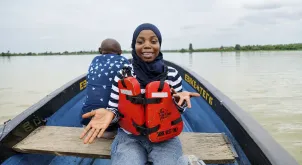
As the waters flow through Bayelsa and a boat sails along its winding creeks, the story of a community unfolds. Long before the documentary began, Rafiat Atanda was already part of that story. A UN Volunteer Communications Specialist with the United Nations Office on Drugs and Crime (UNODC) in Nigeria, she supported the Youth Peace Champions in the Niger Delta. Having contributed to the initiative's development in Borno State, she later led its first rollout in Bayelsa, building a connection to the community long before the camera started rolling.
Let's hear more in her own words.
"As our boat moved through the creeks of Bayelsa State, I found myself confronting my own assumptions. Before I began visiting Bayelsa regularly, most of the stories I encountered about the state focused on militancy, oil, insecurity and environmental degradation. These issues are real, but they are not the whole story. I rarely heard about communities preserving their Ijaw heritage, young people creating opportunities, or families sustaining generations through fishing and farming. The Bayelsa I encountered was far more layered than the one often portrayed in the headlines.
As part of my volunteer assignment, I travelled to five communities—Otuan, Ayamasa, Ikebiri 1, Ekowe and Ekeremor—to help produce a documentary about UNODC’s work. Some require hours of travel by road, while others are accessible only by water. Ikebiri 1, I was told, lies close to the Atlantic Ocean.
My connection to Bayelsa began before this documentary. Through my communications role, I became involved in designing and implementing the Youth Peace Champions in the Niger Delta. I had contributed to developing the initiative in Borno State and later led its first rollout in Bayelsa.
Over the years, I had seen young people invited into discussions without being given real ownership. I promised myself that, if I ever had the opportunity, I would do things differently. The Youth Peace Champions became that opportunity. Twenty-five young people—five from each community—were selected. They came from different educational backgrounds and life experiences. Some had completed tertiary education, while others had limited formal schooling. That mix was deliberate. We were not just talking about inclusion; we were practicing it.
Nine months later, they had mobilized resources, organized awareness campaigns, engaged community leaders and mentored their peers. They addressed issues including drug use, cultism, teenage pregnancy and youth violence. UNODC provided training, mentoring and support, but what they did with those opportunities was their own. The greatest change was in their confidence. Young people who once struggled to speak before their peers now address crowds and encourage others to reject crime and violence. They are no longer simply participating in a programme; they are helping shape their communities.
The visit also allowed me to experience everyday life in Bayelsa. I met “Mama,” an elderly woman who knits and sells her work. When I greeted her with a cheerful “Dooo”—hello in Ijaw—she smiled warmly. I bought one of her knitted pieces and carried a small part of her story home with me.
I watched young women frying garri and fishermen working from makeshift shelters along the waterways. Community members organized football matches and other activities where children and young people could build friendships and avoid harmful influences. These moments may never make national headlines, but they also tell Bayelsa’s story.
Then there was Madiga.
Wherever I went, someone pointed me towards this local bread. Many insisted that the best—and perhaps the original—Madiga came from Ekeremor. I had missed the opportunity to try it during my first visit, so this time I deliberately waited until I reached Ekeremor. It was worth the wait. Slightly sweet, filling and comforting, it has the potential to become known far beyond Bayelsa, much like the popular “Ghana bread” sold in parts of Lagos.
Beyond the scenery and waterways, Bayelsa reminded me that humanity comes first. As a visibly Muslim woman in a predominantly Christian state, I stood out. Yet nowhere did I feel unwelcome. What I experienced was warmth, hospitality and kindness. Up the creeks of Bayelsa, I found more than communities facing challenges. I found young people determined to shape their futures, people proud of their culture and heritage, and communities filled with everyday stories that deserve to be told."
What changed in Bayelsa was not the landscape. It was Rafiat Atanda's understanding of it. The communities had always been there, carrying richer, more complex stories than the headlines ever allowed. She simply learned to listen—such as when she sat with a group of Youth Peace Champions in Ekeremor.
As the boat made its final journey down the creek, she realized that Bayelsa's greatest challenge might not be the story people tell about it. It might be that too few people have stayed long enough to hear the rest.