



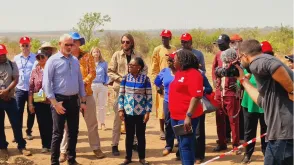
The lead deminer raised his hand—and silence swept across Amadi. A dog stepped forward, nose trained to detect danger buried deep in the soil. Children watched from a distance, eyes wide with fear, hope, and curiosity. We were in Durupi, Central Equatoria State—a community that had long abandoned its fields due to explosive remnants of war. Farming had stopped. Life had paused. But on this morning, the United Nations Mine Action Service, the National Mine Action Authority, and their partners showed what reclaiming safety looks like. With protective gear, precise steps, and canine partners, they turned fear into farmland.
I stood among the community and colleagues from the Mission and across the UN agencies, watching hope return. My work often happens behind a desk—drafting reports, shaping data, telling South Sudan’s story. But moments like this remind me: the words I write carry the weight of real lives. And this is why the work matters.
Who am I? I am an international UN Volunteer from the United Kingdom, serving as an Associate Reporting Officer in the Protection, Transition and Reintegration Section, directly under the Deputy Special Representative of the Secretary General’s office of the United Nations Mission in South Sudan (UNMISS). But I am not the protagonist here—the people I support are. At my desk in the UNMISS Reporting Office, among the notes about families fleeing Sudan, Ethiopia, the Democratic Republic of Congo and within South, I don’t just see statistics—I see stories—villages returning to farming, women launching businesses in crowded settlements, and more. Reporting here isn’t about numbers; it’s about documenting the human side of peace. Each day, I gather, verify, and cross-check data to ensure every detail reflects reality and supports recovery.
The reports we produce, daily and weekly, are snapshots of progress and struggle. They help the Mission understand where peace is fragile, where tensions may rise, and where communities are recovering.
There are days when information pours in from every direction. Deadlines press. Priorities shift without warning. It is easy to feel overwhelmed. I have learned to stay calm. To prioritize what matters most. To deliver on time even when the work feels impossible. I have also learned that peace is collective work. It grows from trust and listening. My colleagues in the field risk much to gather information. My role is to support them, give credit where it is due, and make sure their insights inform real decisions.
When I wonder if my work here helps the protagonists—the communities rebuilding their lives—the words of my supervisor at UNMISS, Ronald Mayanja, remind me that it does: "Premdeep’s self-management and planning skills are commendable. She has not allowed deadlines to slip by and has shown great flexibility in responding to last-minute requests. She has observed conduct consistent with the Mission’s values of integrity and diversity when working with staff from different backgrounds."
Since October 2022, South Sudan has seen large numbers of people displaced by conflict in Sudan and Ethiopia. Host communities, already facing hardship, continue to welcome and support them. Our reports help ensure their stories are not lost. The reports show where help is reaching, where gaps remain, and where solidarity is holding communities together.
For me, volunteering is about selflessness. It is showing up with skills and compassion, without expectation. This UN Volunteer assignment has given me more than I imagined. I have built friendships across cultures. I have learned humility by seeing the struggles others face. I have gained new skills and, more importantly, a deeper empathy. I know my reports will never capture every detail of life here. But they will make sure that lives here aren't reduced to only numbers.
Through my work penning the realities of finding peace in South Sudan, I have discovered that peace is not built in a single moment. It grows through steady acts of solidarity, repeated over time. Peace is not only the absence of war. It is the return of everyday life—the planting of seeds, the sound of children laughing, the courage of communities welcoming newcomers despite their own struggles.
Peace is patient work. It is lived in daily choices. It grows when we stand beside one another. And it takes root when hope, like seeds in cleared soil, is given space to rise again. Through bridging distances between communities, volunteering is one way of finding such peace between societies.
For more information about UN Volunteer assignments and how you can get involved, click here. To read our stories, click here.