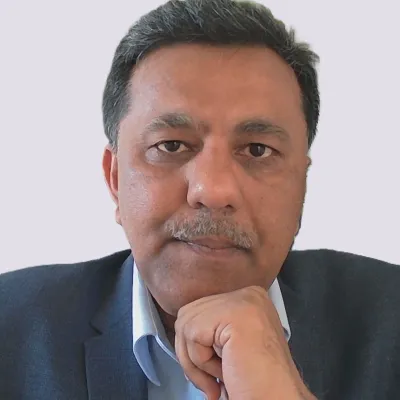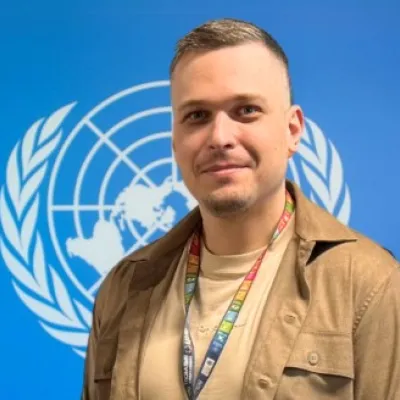
Reflections from my home—Ukraine

Author

  • Maksym Solovey
    Maksym Solovey Country Coordinator UNV Ukraine

I still remember the smell of smoke.
In 2014, shortly after I graduated from university, my hometown of Lysychansk in eastern Ukraine became a frontline. One day, I saw photos on social media: my apartment building had been hit several times and burned for two days before the flames were extinguished. Part of the building collapsed. I did not know how badly our apartment had been damaged. I recall my helplessness, emptiness. The future I had planned suddenly felt irrelevant. Almost three years later, we received government compensation. The building was eventually demolished. We stayed in the region. Many people asked why. The answer was simple: this was my home.

Four Years of Resilience

In 2022, when the war started, Lysychansk was occupied. Like millions of Ukrainians, I became an internally displaced person. “IDP” is a term often used in reports and briefings. For me, it means leaving behind familiar streets, memories, and any sense of permanence.
It means rebuilding stability while knowing the place you belong is no longer accessible.
Refugee at 15, Community Builder Years Later

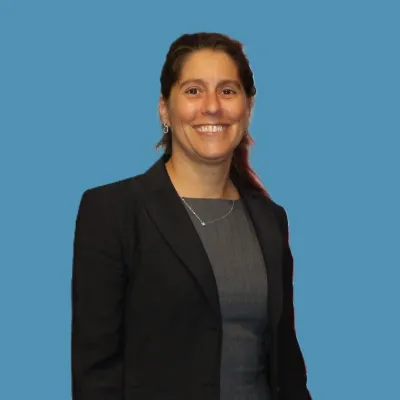
“I left Namibia at 15 years old and went into exile. We were refugees during those years.” Kirsti Mukwiilongo was a teenager when she left her home in Namibia. It was the height of the liberation struggle, and safety lay beyond the border. Like many others, she moved between countries—Angola, then Zambia—finishing secondary school as a refugee. Those years marked her for life. “We were assisted by other countries, by other people,” she recalls. The experience stayed with her—shaping how she responds and what matters to her. “That gave me compassion. It gave me purpose.”

Years later, she did something few people do. She returned—not to her own safety, but to instability. This time, not as someone needing help, but as someone ready to carry weight.

Asian partners meet at UNV Headquarters to shape the next chapter of collaboration

Held during International Volunteer Year 2026, the Roundtable will focus on how volunteer action can strengthen solidarity and practical cooperation in the region and globally.

Partners will review results from UNV’s Full Funding and Special Voluntary Fund, exchange lessons, and explore new ways to work together as priorities evolve across Asia and in the UN system.

Loudly or Quietly? The Choice That Will Decide Solidarity’s Reach

Authors

  • Geraldine Becchi
    Geraldine Becchi Team Lead, Partnerships UNV
  • Sukhrob Khoshmukhamedov
    Sukhrob Khoshmukhamedov Chief, External Relations & Communications Section UNV

For more than half a century, several traditional development partners have been among the most consistent backers of global solidarity through the United Nations Volunteers (UNV), quietly supporting, funding and sustaining it. Since UNV’s creation in 1970, traditional development partners have remained among its most consistent supporters. For example, Europe’s imprint on UNV is visible in leadership, participation, and policy influence. Four of UNV’s ten Executive Coordinators have come from European countries. Between 2007 and 2025, around eleven per cent of all UN Volunteers originated from the European Union or traditional European donor countries. European governments have also consistently spoken in support of volunteerism at the UNDP Executive Board and backed global commitments such as the declaration of 2026 as the International Volunteer Year.

The contribution of traditional partners to UNV is not symbolic. It is practical and strategic. 

Connecting Refugees to Jobs and Income

When Kei Tanaka arrived at the UN Refugee Agency (UNHCR) field office in Uganda as an Associate Livelihood and Economic Inclusion Officer, there was no confirmed budget for livelihood activities. Her task was clear: expand economic opportunities for refugees and host communities.

I proactively engaged external stakeholders, including the Japan International Cooperation Agency (JICA) and private sector partners, to explore collaboration,” 

Olé, Olé, Olé—FIFA joins UN in support of IVY 2026

Volunteering is not a footnote—It belongs in the Plan

Author

  • Narendra Mishra
    Narendra Mishra Policy Specialist UNV

As we approach 2030, the global community is at a critical juncture in the 2030 Agenda for Sustainable Development. While progress on many Sustainable Development Goals has been uneven, a powerful "means of implementation" is often hiding in plain sight: volunteerism. According to the  2026 State of the World's Volunteerism Report (SWVR), an estimated 2.1 billion people—34.5 percent of the global working-age population—volunteer every single month.

That is not only a statistic to admire. It is a development asset of extraordinary scale. Yet for too long, volunteerism has been treated as a backdrop to national development, invisible in plans, budgets, and policies. My team at UNV has spent last four years working to change that. 

We have provided technical support to governments across Africa, Asia, the Pacific, Latin America, the Arab States, and Europe to formally embed volunteerism into their national plans and sectoral strategies.