

Sometimes, one experience can bring us to a crossroads and change the direction of a life. For Ayako Maruyama, Lima Tokumori and Makie Yoshida, volunteering took them into communities, across borders and closer to the realities of climate change, disasters, conflict and questions of belonging. What they learned at those crossroads continues to shape the work they do today.
Just weeks before Ayako Maruyama was due to leave Japan as a volunteer, disaster struck at home.
In 2011, shortly after completing her pre-departure training with the Japan Overseas Cooperation Volunteers (JOCV), Ayako witnessed the Great East Japan Earthquake. As people across the country mobilized their skills to help affected communities, one lesson stayed with her. “I strongly felt the high level of disaster preparedness awareness among Japanese people.”
Several weeks later, Ayako left for a small fishing community in the Philippines as a Community Development Volunteer. Living alongside residents in an area frequently exposed to typhoons and other hazards, she supported livelihood activities and, when requested, drew on her own experience of the earthquake and tsunami to help organize evacuation drills and disaster preparedness activities.
“The experience and knowledge gained in Japan can help protect the lives of people in other countries.” That conviction would eventually take Ayako from one community in the Philippines to disaster preparedness work spanning Asia and the Pacific.
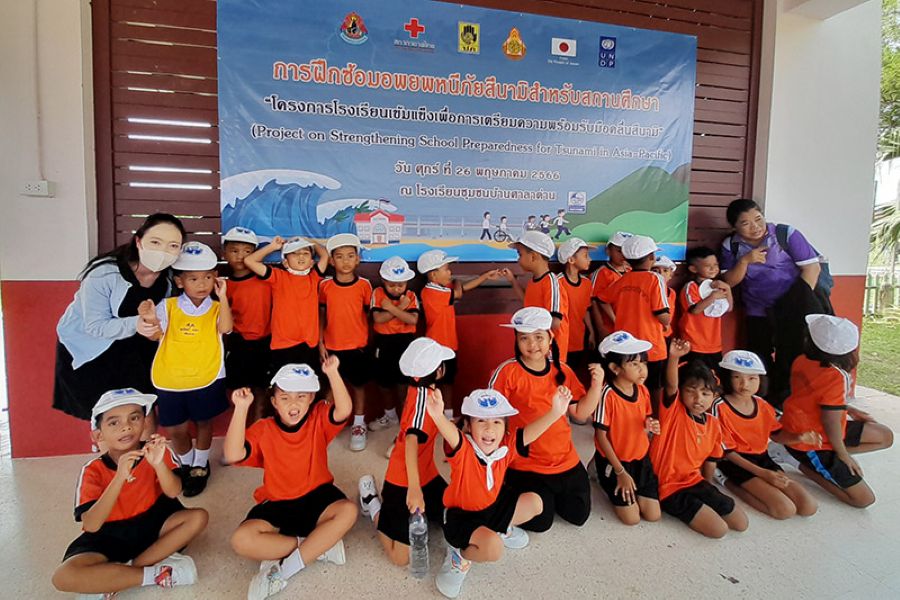
In December 2021, she joined the United Nations Development Programme (UNDP) through the JOCV-UNV scheme, serving as a UN Volunteer Specialist and Disaster Risk Management Officer at the UNDP Regional Hub in Bangkok. There, Ayako contributed to the Asia-Pacific School Tsunami Preparedness Project, which strengthened preparedness in schools across 24 countries and reached approximately 150,000 students, teachers and school administrators through evacuation exercises and related activities.
Working across more than 20 countries also meant exploring different cultures, circumstances and ways of working. At first, Ayako struggled to understand her place within such a large regional initiative. A conversation with her supervisor changed her perspective. "I always introduced myself as 'Ayako Maruyama, a UN Volunteer'. One day, my supervisor told me, 'You do not need to worry about your contract modality. You are managing this project and must say what needs to be said as the person responsible for it." It was a lesson in ownership she says, responsibility is not defined by a contract, but by the role.
Her earlier experience living alongside communities in the Philippines also shaped how she worked with colleagues across the region. "For example, when a colleague told me they could not join an online meeting because of a power outage, I could accept that these things happen. My experience living with local communities in the Philippines helped me respect local circumstances and ways of working instead of focusing only on quick results. The skills I developed as a JOCV volunteer were valuable in my work with UNDP."
Today, Ayako works as a Programme Assistant with the United Nations Industrial Development Organization (UNIDO) in Tokyo, supporting initiatives that connect Japanese disaster prevention and environmental technologies with developing countries. Her journey has taken her from learning about preparedness in Japan, to living its realities alongside communities in the Philippines, to supporting disaster risk reduction across Asia-Pacific. And she believes that experience can open doors for others too.
"Working as a UN Volunteer is not only for some people, it's for everyone. If you have volunteer experience, especially like JOCV, you already have first-hand understanding of a country's realities and challenges. That becomes a strength regardless of the position you hold within a UN organisation. I encourage those who are uncertain to take on the challenge."
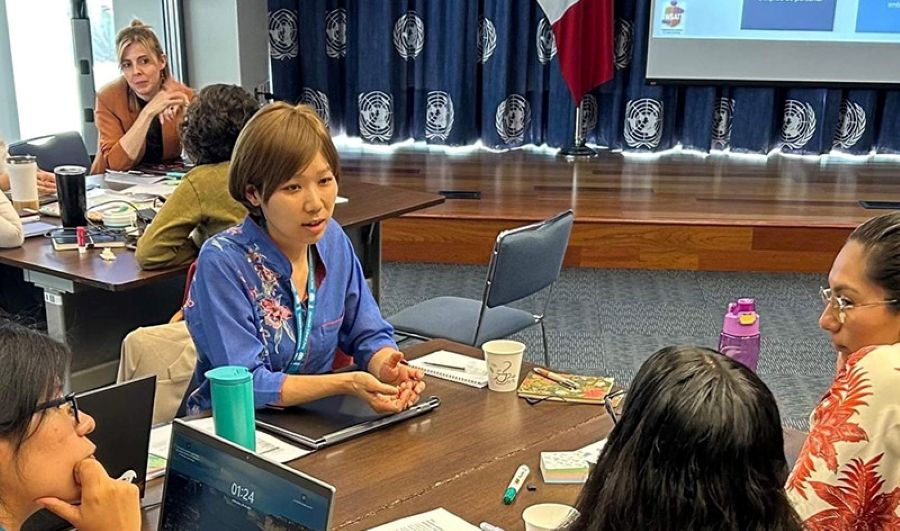
Growing up in Okinawa, Japan, Lima Tokumori learned early what it meant to be asked where she belonged.
Her father is a third-generation Japanese Peruvian, and Lima spent part of her childhood in Uruguay and Brazil before returning to Okinawa at the age of eight. There, as a child in a family with overseas roots, she sometimes heard harsh words from classmates: “Go back to your country.” Those words left her wrestling with questions of identity. But they also helped shape an ambition that would follow her across countries and careers: to create a world without sadness.
As she grew older, encounters with Nikkei students from South America and her own travels helped Lima see her Peruvian roots differently, not as something that set her apart, but as an essential part of who she was.
In 2016, that evolving sense of identity took her to Colombia as a Community Development Volunteer with the Japan Overseas Cooperation Volunteers. Assigned to Granada, a municipality scarred by decades of armed conflict, Lima supported conflict-affected communities and shared experiences from Okinawa’s peace education programmes.
She arrived expecting to share lessons about peace. Instead, she found herself learning them.
“I was surprised to see systems and approaches that had not yet been introduced in Japan. I had gone there thinking I would teach about peace, but in reality, I learned much more than I taught.”
When the security situation deteriorated, Lima continued her volunteer service in Peru, this time supporting educational and personal development activities for children at a residential care facility. After returning to Japan, she worked with local governments in Okinawa and contributed to Japan’s international peace cooperation efforts. Then, after applying a few times to the JOCV-UNV scheme, she was selected in 2022.
As a UN Volunteer Peacebuilding and Community Resilience Specialist with UNDP in Mexico, Lima worked across governance and democracy, supporting peacebuilding initiatives, projects with young people and farming communities, gender research, and training on business and human rights.
The work demanded more than technical expertise. It demanded trust.
“The coordination skills and ability to build relationships that I developed as a JOCV were very useful. At first, some organisations were reluctant to discuss topics such as human rights. I focused on building relationships first and earning trust. The process of gradually creating the right environment, identifying challenges and moving work forward was something I had learned during my volunteer service.”
Working within the UN system also exposed Lima to different approaches to wellbeing and inclusion. “There was strong support for work-life balance through leave policies and counselling services. I was also impressed that behaviours which might be dismissed as harassment or bullying in Japan were discussed as gender-based violence.”
Her UN Volunteer assignment brought another lesson: sometimes, looking too far ahead can distract from the relationships that matter in the present.
“After I secured my next position, I felt more at ease and was able to work better with colleagues. Looking back, I should have focused less on the future and paid more attention to the relationships in front of me.”
In January 2025, Lima returned to Okinawa. Today, she works as an International Cooperation Promotion Officer with JICA Okinawa, focusing on multicultural inclusion and supporting children with international backgrounds. In many ways, her journey has brought her back to where it began.
“I have experienced life as a minority in Okinawa and faced challenges myself. Because of that, I want to support children in similar situations. I feel that all of my experiences are connected, and my work is rewarding every day.”
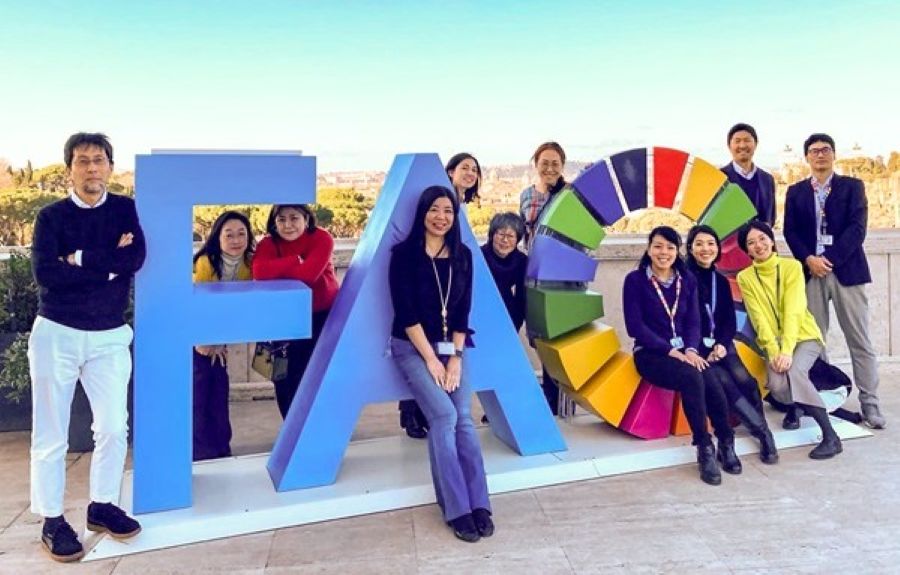
“I used to think that working for an international organisation was something only people far beyond my reach could do,” says Makie Yoshida.
Today, Makie is a Climate Change Specialist at the headquarters of the Food and Agriculture Organization of the United Nations (FAO) in Rome. But her path to the United Nations began far from headquarters, in rural communities in Bolivia.
After studying English at university, Makie joined the Japan Overseas Cooperation Volunteers and was assigned to an NGO in Cochabamba. There, she worked alongside rural communities on food security, health, women’s empowerment and literacy, supporting initiatives ranging from home gardens and nutrition workshops to improved cooking stoves. "The Indigenous communities valued the gifts of the land and maintained their belief in Pachamama, the Andean Mother Earth. But living closely with nature also meant being highly vulnerable to natural disasters such as droughts and hailstorms," shared Makie.
"I experienced times when families in rural communities had little to eat beyond potatoes. Climate change is one of the major causes of these natural disasters. Yet it was people in Indigenous communities who were suffering the consequences, even though much of the greenhouse gas emissions driving climate change come from cities and developed countries.
She began to question this imbalance and said, " Although I wanted to change the situation, I was merely one volunteer.”
That sense of powerlessness became a turning point.
After completing her assignment, Makie moved to the United Kingdom to study climate change, development and policy. As graduation approached, she came across an opportunity to serve as a UN Volunteer, which would take her to El Salvador as a Sustainable Development Specialist with UNDP.
But accepting the assignment was not an easy decision. “At the time, El Salvador was known for having one of the highest murder rates in the world, and I wondered whether working as a UN Volunteer would really help my career. I spoke to the head of a UN agency's Japan office, where I was working as an intern. She encouraged me to choose the UN Volunteer opportunity. That advice gave me the confidence to choose the path of a UN Volunteer.”
The move changed the scale of Makie’s work. In Bolivia, she had experienced climate change through the lives of communities. At UNDP in El Salvador, she began working on the policies and systems that could shape what happened to those communities. “Unlike my previous volunteer experience, which focused mainly on communities, my work at UNDP involved national-level policy development. At first, I found it challenging. I needed to understand the political situation in El Salvador and think carefully about how I could contribute. At the same time, it was an incredible learning experience, where I had the opportunity to contribute to the development of national climate change policies and to work on a wetland conservation project involving a site registered under the Ramsar Convention. I also had the opportunity to work directly with the Minister of Environment. Every day brought something dynamic.”
After her UN Volunteer assignment, Makie joined FAO through Japan’s Junior Professional Officer Programme. Today, she continues to work across climate change, environment and biodiversity. Yet as her work has moved from communities to national policy and onto the global stage, she has not forgotten where it began.
“My strength is that I can picture the people who will ultimately benefit from the work I do. Because of my experience as a volunteer, I can imagine what will happen when a policy is implemented and reaches a local community. Working for an international organization often means bringing together countries with different perspectives and finding common ground. But when things get difficult, I remind myself that I am doing this work for the people I lived with in the rural communities. That gives me the strength to keep going.”
The volunteer assignments of Ayako Maruyama, Lima Tokumori and Makie Yoshida were part of a UNV partnership, which enables former Japan Overseas Cooperation Volunteers to serve with the United Nations system as UN Volunteers. Their assignments may have ended, but what began at those crossroads continues through the lives they touch and the work they carry forward.
The stories were originally published in Japanese for Crossroads, the Japan International Cooperation Agency newsletter. They have been edited for brevity.

Sustainable Development Goals