



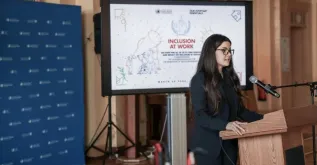
Most people will never read the reports that shape decisions at the United Nations. Fewer still will know who helped produce them. Yet behind nearly every recommendation, policy adjustment, or programme improvement lies a simple question: Did it work?
For Liza Al Bag, a UN Volunteer from the Kurdistan Region of Iraq serving with the Office of the United Nations High Commissioner for Human Rights (OHCHR) in Geneva, answering that question has become her daily mission.
As part of OHCHR's Strategic Planning, Programme Management, Evaluation and Change Service (SPECS), she works on evaluations that examine some of today's most urgent human rights issues, from civic space and digital rights to business and human rights, technical cooperation, and the protection of human rights defenders and journalists.
"We are not evaluating for the sake of accountability alone," Liza explains. "Evaluation is also a tool for learning and adaptation."
This year alone, Liza has helped support OHCHR's 2026 Evaluation Plan, which includes 47 evaluations covering different regions and themes. Her role ranges from developing terms of reference and selecting consultants to analyzing data, producing knowledge products, and transforming complex findings into insights that decision-makers can use.
For Liza, the real value of an evaluation is not the report itself. It is what happens next. By examining what works and what does not, she helps ensure that programmes better serve the people they are designed to reach.
"By systematically gathering evidence and reflecting on results, programme teams can identify lessons, strengthen future interventions, and better understand what meaningful engagement with people in vulnerable situations looks like in practice," she says.
One of the most exciting parts of Liza's work has been exploring how emerging technologies can strengthen evaluation. Artificial Intelligence, data analysis, and visualization tools are helping teams process large volumes of information and present findings in ways that are easier to understand and use.
But for Liza, evidence is only part of the story.
People are the other half.
As a young woman from a minority community in the Global South, she brings a perspective that is still underrepresented in many international spaces. Her journey to the United Nations has shown her the importance of ensuring that those most affected by decisions have a voice in shaping them. At the 2026 Youth in Evaluation Forum, she joined other young professionals in calling for a stronger role for youth in evaluation and accountability processes.
"Youth engagement is not intended to replace existing expertise," she says. "It enriches evaluation by bringing additional knowledge, perspectives and lived experience to the table."
Her message challenges the idea that young people should wait their turn. "When youth perspectives are systematically included, organizations gain richer evidence, stronger accountability mechanisms and a deeper understanding of the realities faced by those they serve."
Liza is part of a programme for young professionals under the age of 35. The programme, a partnership of the United Nations Evaluation Group (UNEG) and the United Nations Volunteers (UNV), supports participants in building their skills, supporting national efforts, and growing as future leaders in evaluation. It was initiated by UNEG Young and Emerging Evaluators Working Group to provide learning and career growth for youth keen to join the UN, while also ensuring their voices are included in UN evaluation processes.
The first cohort of this programme began their volunteer assignments in 2024 with 10 evaluators placed with six UN entities (UNESCO, UNDP, UNFPA, UNICEF, UNU and WHO) across eight cities: Bangkok, Budapest, Dakar, Doha, Montevideo, Nairobi, Panama and Tokyo. The 2026 cohort includes Liza, based in Geneva with OHCHR.
The UN Volunteer assignment has a limited time period—which leaves only a short time to make an impact, shares Liza. Yet she focuses less on this constraint and more on the opportunities the role provides.
The opportunity to learn from evaluation managers, human rights experts, and colleagues from around the world.
The opportunity to contribute ideas shaped by her own experiences.
And the opportunity to demonstrate that talent exists everywhere, including in places and communities that are often overlooked. "UNV is a great opportunity and facilitator for people coming from the Global South," she says.
Sabas Monroy is the Evaluation Programme Management Officer at OHCHR and former convener of the UNEG Working Group on Gender Equality, Disability Inclusion and Human Rights. He is also Liza's supervisor and shared: "The UNEG–UNV partnership offers a timely opportunity to strengthen capacity while bringing in the diversity, creativity and fresh perspectives of young evaluation professionals from the Global South."
Sabas continues, "In early 2026, we recruited UN Volunteer Liza Al Bag, who brought academic knowledge and practical experience in programmatic, thematic and geographic areas of human rights work, helping make evaluation more relevant and useful to colleagues across the Office. Through her expertise in data visualization, information technology, artificial intelligence and human rights research, Liza has developed knowledge-sharing and data-analysis products that make evaluation findings more accessible and user-friendly. These help us prepare new programmes, develop project proposals and report to donors, while strengthening accountability to stakeholders. Liza's perspective as a young woman from the Kurdistan Region of Iraq has also enriched our work on diversity, inclusion and the mainstreaming of the perspectives of groups in situations of vulnerability in evaluation in the OHCHR Geneva office, UNEG and beyond."
For young people looking to follow a similar path, Liza's advice is simple. "Take the first step and reach out." Because behind every evaluation, every recommendation, and every policy adjustment are people willing to ask difficult questions in pursuit of better answers.
And sometimes, those answers come from a young volunteer determined to ensure that evidence serves people, not the other way around.
You can read more about UN Volunteers' evaluation assignment with UNESCO in Thailand and WHO in Hungary.