



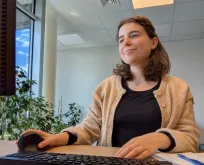
Lisa Weber didn’t set out to change the world. While finishing her graduate studies, she spent time tutoring refugee children in Erfurt, Germany. What began as a simple act of kindness opened her eyes to the power of empathy, solidarity, and understanding—and set her on a path that would lead to a global career in evaluation as a UN Volunteer. An Evaluation Specialist with the World Health Organization, Lisa focuses on how the organization learns from its work and improves how it serves communities worldwide. She is based at the WHO Budapest Center, while her team operates from Geneva.
“No textbook could have shown me what those days revealed about cultural gaps and systemic failures,” Lisa recalls. In the homes, where she tutored children from refugee families, she found laughter, connection, and proof that even small acts can spark meaningful change.
Lisa is part of a programme for young professionals under the age of 35. The programme, a partnership of the United Nations Evaluation Group (UNEG) and the United Nations Volunteers (UNV), supports participants in building their skills, supporting national efforts, and growing as future leaders in evaluation. It was initiated by UNEG Young and Emerging Evaluators Working Group to provide learning and career growth for youth keen to join the UN, while also ensuring their voices are included in UN evaluation processes.
The first cohort of this programme began their volunteer assignments in 2024 with 10 evaluators placed with six UN entities (UNESCO, UNDP, UNFPA, UNICEF, UNU and WHO) across eight cities: Bangkok, Budapest, Dakar, Doha, Montevideo, Nairobi, Panama and Tokyo—including Lisa in Budapest.
Before joining WHO, Lisa worked in monitoring and evaluation at the World Wide Fund for Nature in Berlin. She was a Carlo Schmid Fellow at the International Organization for Migration in Lao People's Democratic Republic. Her background in communication and political science, and a passion for data, got her interested in evaluation.
“Evaluations generate lessons on what works, what doesn’t and why,” Lisa explains. “They help adapt programmes, inform future strategies, and strengthen accountability and learning.”
She is coordinating WHO’s first self-paced training course to help staff understand how evaluation drives smarter decisions—and how it enhances capacities across the organization. Another major project is a synthesis of six years of WHO evaluations. Lisa contributed to the scoping, designed the method, and tested AI tools to sift through thousands of pages. Together with a consultant, she is currently coding reports and interviewing key experts. The final report will include findings, recommendations to address root causes of inefficiencies, and a map of evidence gaps to guide WHO’s next evaluation work plan for 2026–27.
Lisa also helps manage and review evaluations to make sure they meet quality standards. She’s worked on evaluations like the mid-term review of the Global Task Force on Cholera Control, the WHO Policy on Disability, and WHO’s work on water, sanitation, hygiene, and health. She’s also helping to develop a database to make this work easier to find and use. Working remotely from Budapest has taught her the value of strong communication and trust. “A supportive team environment enables collaboration—even across borders. Mastering this work mode is a great asset for the future of modern work,” she reflects.
Lisa sees evaluation as a cornerstone of the UN’s peace and development pillars. “Development is complex, especially in an increasingly volatile world. Organizations have to go from checking evaluation off as a task to wanting to learn from experience to improve.”
Yet, she acknowledges the challenges. “It’s hard to witness the impact of funding cuts and to navigate uncertainty within the organization,” she shares. Lisa remains optimistic and feels evaluations can help answer some of the questions that current processes across the UN system are trying to address.
Volunteering continues to shape her worldview. “It’s a powerful use of your time—not just for others, but for yourself. I’ve benefited from amazing voluntary initiatives in Budapest that helped me connect with communities. Volunteering makes every place richer.”
On her experience as a UN Volunteer, Lisa shares: “It’s rare to gain this level of exposure early in your career. Integrating youth perspectives across organizations is a two-way learning street. We (young evaluators) bring curiosity, technical skills, and the drive to test and learn.”
“This space has allowed me to exchange ideas and collaborate with inspiring colleagues.” Lisa's story is a reminder of the UN’s promise to young people: when they are trusted, empowered, and included, they don’t just contribute—they lead. Evaluation isn’t just about data; it’s about people, progress, and the courage to keep learning. And it all started with a simple act of volunteering.
Read another story of a UN Volunteer Evaluator under the UNEG-UNV partnership.
For more information about UN Volunteer assignments, click here. To read our stories, click here.