



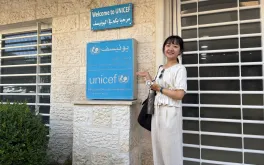
In the Middle East and North Africa (MENA) region—where conflict, displacement, and environmental challenges intersect, Korean researcher Sihyun Park volunteered for sustainable development with support from Korea International Cooperation Agency (KOICA). As a fully funded UN Volunteer based in Jordan, she relied on research to develop practical solutions. Her assignment, which lasted a year and concluded in September 2025, offers insights into the impact of volunteerism in complex settings. Let’s take a closer look at her journey.
Sihyun's volunteer journey began after earning a degree in Science Education in the Republic of Korea. She volunteered through a KOICA project at a youth center in Takeo, Cambodia. Witnessing the health gaps faced by young people inspired her to pursue a Master of Public Health in the United Kingdom. Immediately after graduating, she joined the United Nations Children's Fund (UNICEF) MENA Regional Office in Amman as a UN Volunteer Health Officer.
"When I applied, there were only two openings: one in Bangladesh and one in Jordan. I chose Amman because it operated at the regional level—I wanted to understand the bigger picture."
Her first assignment was contributing to the 5th MENA Region Adolescent Wellness Conference in Alexandria. She prepared a presentation and designed a youth-friendly flyer addressing the health challenges facing 140 million adolescents across the region—issues like mental health, gender inequality, conflict, and climate change. Countries such as Sudan, Syria, and Yemen were particularly highlighted. "My participation and interaction with the young people at the conference helped me better understand their health priorities and the importance of youth engagement and community support."
Sihyun designed visual materials, including infographics. "I included a map of the MENA region, but was advised not to show country borders due to political sensitivities. We revised it to a generalized map without borders. That experience taught me that even visual elements must be culturally and politically neutral in international development."
One of her most significant contributions was supporting the development of Closing the Gap: The Pivotal Role of Community Health in the Middle East and North Africa Region—a publication led by UNICEF’s Health Section with the support of KOICA. The report examines how community health workers are trained, paid, and integrated into national health systems across the region. Sihyun helped shape the final product by refining how data was presented, creating accessible visualizations, and aligning technical insights with a compelling narrative. "It was a challenging process," she recalls, "especially ensuring that we didn’t present any country as 'better' or 'worse.' We focused on transparency and respectful comparison—so the data could speak for itself." This work revealed a marked disparity: while some countries have robust community health systems and curricula, others lack standardized training or institutional support.
Sihyun finds that diversity is one of the most complex aspects of working in the MENA region. “I learned that it’s essential to be highly sensitive with language and deeply respectful of cultural and religious contexts—especially when addressing health issues." In some countries, even using terms like “adolescents” proved problematic due to their association with sexuality, a subject often considered taboo.
Even before officially joining UNV, she made it clear in her interview, “If there’s ever a chance to work on environmental health, I’d love to be involved.” That passion is now her purpose. With each passing season, the MENA region reveals deeper environmental pressures—worsening air pollution, diminishing water sources, and intensifying heatwaves. "These issues are urgent, but too often overlooked," Sihyun reflects. "Someone needs to keep them on the agenda."
Sihyun also worked on UNICEF MENA Regional Office’s Climate and Health Report—developed in alignment with the Children’s Climate Risk Index—where she examined how environmental threats impact the region’s most vulnerable, particularly women and children. For her, the project goes beyond a professional assignment; it represents the intersection of her academic background, personal conviction, and commitment to health equity.
Her research looked at how water scarcity in Yemen and Sudan raises the risk of cholera and malnutrition, while heatwaves and air pollution in Egypt and Iraq impact children's respiratory and cognitive development. In Djibouti, the effects of climate change on maternal and newborn health are evident—particularly where WASH (Water, Sanitation, and Hygiene) infrastructure is lacking. For example, although most health facilities report access to utilities and supplies, less than a quarter have funding for WASH services, increasing risks of infection and unsafe deliveries.
Although her work was office-based, she led the report through meticulous secondary research, literature reviews, and cross-sectoral coordination. "I hope the report helps identify data gaps and encourages stronger, child-centered environmental health policies."
Sihyun reflected, “I feel that the Korean government—through KOICA—is genuinely investing in the next generation of global leaders. They’re actively working to lower the barriers for young people who want to work internationally, and creating more pathways for us to gain that experience.”
Looking ahead, she hopes to take on more direct fieldwork and engage closely with communities. “Office work taught me how UN systems and policies function,” she says. “But I want to be on the ground—collecting data, speaking with people face to face, and learning not just from reports, but from lived experience.”
Her story—marked by a sense of responsibility—reflects KOICA’s broader vision of cultivating the next generation of global leaders. In every line of a report, every cultural exchange, and every respectful inquiry into local realities, she looks ahead through data—working to protect communities from future health and climate risks.
This story is part of a special feature marking twenty years of KOICA and UNV partnership. For more information about UN Volunteer assignments and how you can get involved, click here. To read our stories, click here.