



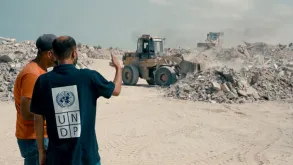
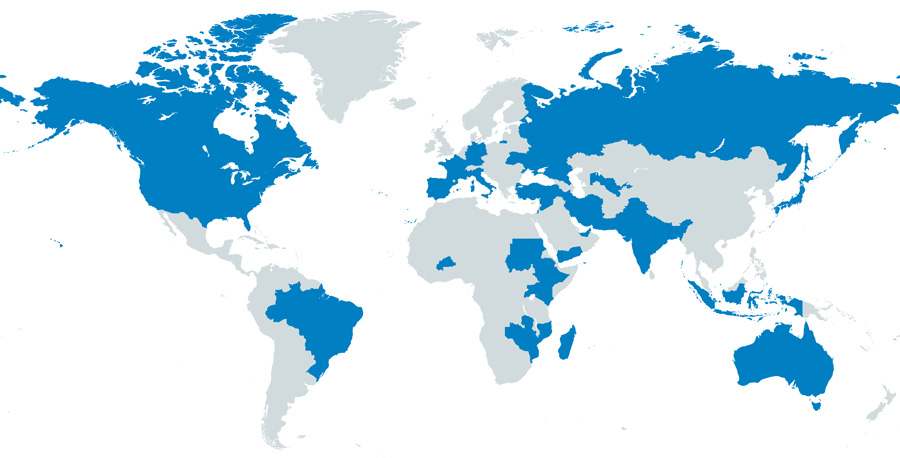
The war in Gaza sees a breakthrough: a ceasefire after two years. But the streets still tell a different story—blocked by debris, weighed down by loss. From February to August, a team of five UN Volunteers stepped in alongside the United Nations Development Programme (UNDP)’s Programme of Assistance to the Palestinian People to work on the ground in Gaza. Joined by 61 Online Volunteers from 35 countries, they were part of debris management with a mission to clear rubble—each stone lifted, a step towards Gaza's recovery.
UN Volunteer with UNDP, Ahmed Al-Mdalal is on the ground in Gaza. He is an engineer and monitors the distribution of fuel making sure debris removal machines keep operating and the blocked roads for ambulances and aid remain open. While another counterpart, Maysaa Al-Ajrami, an architect, gathers detailed data from four debris removal projects, documenting rubble volumes, machinery, fuel consumption, and workforce numbers, which she then uploads to the project’s dashboards. Mohammed Alghouti, a civil engineer, coordinates field operations with the United Nations Mine Action Service (UNMAS) and leads hazard mapping efforts, exploring sustainable recycling solutions.
Besides the work that happens on the ground, there is a substantial amount of work that goes on behind screens via Online Volunteers. And this is where barriers of time and location hardly matter.
How did these innovators contribute? From Canada and Brazil, Roger Widmer and Victor Leite used artificial intelligence and Geographic Information Systems to conduct damage assessments and estimate debris using remote sensing technologies. Anita Lombardo from Italy and Khuloud Al-Blooshi from the United Arab Emirates explored scalable recycling solutions to guide long-term recovery strategies. Others focused on donor engagement: Risa Yamamoto from Japan and Şahım Touma from Türkiye strengthened reporting on results, while Cosmas Rupiya from Zimbabwe and Kamilla Temushoeva from the Russian Federation helped identify and cultivate future donor partnerships to support reconstruction.
The blend of on-the-ground and digital allowed UNDP to build accurate databases, interactive dashboards, and forward-looking strategies that no single team could have produced alone.
Recovery isn’t just about buildings—it’s about dignity
Clearing Gaza’s debris came with challenges as well—also mental anguish. On-site UN Volunteer Ahmed remembers the moment he uncovered human remains beneath a collapsed home. “It was a stark reminder of the human cost,” he says. For Maysaa, the most powerful moment came when families walked back along newly cleared roads. “They were grateful just to reach their homes again,” she recalls. Mohammed mentored young volunteers from a devastated neighbourhood. At first, they were shy. But over time, they stepped up. One told him, “I finally feel part of the solution.”
Every day brought new challenges. Fuel ran low. Tools broke. Volunteers worked without clean water or medical care. Some lost their homes. But they kept going—sharing what little they had, leaning on each other, and finding creative ways to move forward.
When medicine ran out, volunteers used traditional remedies. When supplies fell short, they turned rubble into building blocks. As Mohammed put it: “Every map we draw, every building we assess, every volunteer we mentor contributes to recovery and hope.”
The Results
The combined efforts of on-site and online UN Volunteers delivered sharp results: a solid action plan, accurate debris estimates, interactive dashboards, and clear donor reports. This gave UNDP the tools to act faster, stay transparent, and think creatively. Mohammad Mezyad, UNDP’s Chief Technical Specialist for Debris Management, said the team’s contributions went far beyond routine support.
On-site UN Volunteers brought real-time insights and field coordination, while Online Volunteers contributed specialized skills and fresh perspectives across time zones. Together, they enhanced the quality, accuracy, and timeliness of our work in ways neither could have achieved alone.”
From the streets of Gaza to 35 countries, volunteers came together to help communities rise from the rubble with the message—borders don’t limit solidarity, and even in crisis, creativity and teamwork can help recovery efforts. With the ceasefire now in place, clearing debris has become more than cleanup—it’s a first step toward rebuilding lives.
For more information about UN Volunteer and Online Volunteer assignments, click here. To read our stories, click here.