



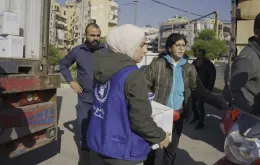
I interviewed Yeran Kejijian while bombs were falling and large areas of the country, including the South, parts of the East, and Beirut were being heavily targeted. She is the UNV Country Coordinator for the Multi-Country Field Unit covering Lebanon and Syria. Four international UN Volunteers have been evacuated so far, while few national UN Volunteers have been relocated to safer areas. Of them, some are working remotely. “It does not happen with warning. It happens under the bombs,” Yeran says while speaking of relocations. One of the UN Volunteers told her, “I had to leave my home at 3 a.m. I didn’t take my laptop. My concern was my family.” She continues, “People do not know when they will be able to return or whether they will find anything to return to. And this is ongoing. There is no clear sense of when it will end.”
The recent conflict in Lebanon started on 2 March 2026. According to UN reports, more than 1,200 people have been killed, including humanitarians, paramedics, and journalists, and more than 3,400 have been injured.
Even in the darkest hour, Yeran speaks of solidarity, empathy and the quiet strength that emerges when people choose to stand together. “It’s not just volunteering anymore—it has the heart in it. You are supporting your neighbour, your people, anyone who is suffering from what’s happening.”
Let’s hear from Yeran on what endures when bombs fall.
“Volunteering in Lebanon during conflict
Volunteering in Lebanon right now is not about signing up, wearing a badge, or ticking a box. It is about grabbing a bag at 3 a.m. and running. It is about cooking food for strangers during Ramadan while your own home may no longer exist. It is about opening public schools as shelters, entertaining displaced children in classrooms that no longer function as schools and finding ways to keep people human when everything else is falling apart.
Presently, there are over 1.2 million displaced people. Some have lost their homes. Some do not know if they will ever return. The crisis does not come in waves—it is constant. There is no “after.” And yet, volunteering has not stopped. It has multiplied. Much of this happens informally. People are feeling each other’s pain.
When the airstrikes do not pause, neither do volunteers
For UN Volunteers, the context is brutal. International volunteers evacuated early. National volunteers remain in the country, some were forced to relocate. Often without notice. Not with preparation. Under bombs. One volunteer fled his home without his laptop. Not because he forgot it, but because he chose his family instead. This is the reality.
The Internet cuts out. Homes disappear. Safety is never guaranteed. And still, volunteers keep working—from safer areas, from borrowed spaces, from wherever they can.
Volunteering continues to be a unifying force, helping hold the country together in challenging times.
Lebanon is fragmented—politically, socially, economically. Trust in institutions is fragile, and uncertainty quickly gives rise to tension. The risk is not only external violence; it is a loss of infrastructure, livelihoods, homes, basic services, and more. These dynamics are particularly visible in the targeted areas, with the South bearing a significant share of the impact.
For example, many farmers in the South are unable to return to land contaminated by bombardment. Fields that once sustained families are now unsafe to cultivate, severing livelihoods rooted in agriculture. Even if the fighting were to cease, recovery would not be immediate. The damage to land, livelihoods, and community networks will require sustained support and long-term recovery efforts. It might take a very long time to restore agricultural land, to restore livelihoods, to rebuild damaged homes, and regain a sense of stability—leaving communities caught between displacement and return, between survival and uncertainty.
Volunteering matters here because it does something quietly radical: It reminds people that they belong to the same country. This is why volunteering is not a “nice to have” in Lebanon. It is a stabilizing force. It is why informal volunteering—often invisible, rarely measured—remains at the heart of some the most important work in the country today.
The loss you can’t see
When we talk about loss, we usually mean what’s visible: homes, belongings, places left behind. But many people are carrying a quieter, heavier loss—the psychological toll that rarely gets named.
It’s the loss of safety beyond the physical sense; the loss of meaning, predictability, and the feeling that life holds together. It’s the erosion of everyday normalcy—routines, plans, futures once taken for granted—paired with the constant fear of losing what still remains.
In conversations with UN Volunteers, this shows up not just as sadness, but as grief: for what was, for what might have been, and for what still feels fragile. Research suggests that around one in five people exposed to conflict will develop a mental health disorder, and many more experience ongoing psychological distress.
This kind of prolonged uncertainty leaves marks—even when they’re invisible. Trouble sleeping, constant tension, irritability, difficulty concentrating, a feeling of being on edge. Which is why, especially in times like these, it matters to remember: mental well-being is not secondary. It is essential—and it deserves care.
UN Volunteers: Capacity you can mobilize—when it matters most
If I had to explain UN Volunteers in Lebanon to someone who has never heard of UNV, I would say they are highly skilled and experienced professionals. UN Volunteers in Lebanon embody a rare combination of expertise and courage. They work across the full spectrum of UN mandates—supporting protection, livelihoods, health, education, social stability, youth engagement, and crisis response. They do so with humility, compassion, and a deep connection to the people they serve.
Even now, as airstrikes continue and uncertainty defines daily life, UN Volunteer engagement in Lebanon has not come to a halt. As of late March, more than sixty national UN Volunteers are still serving across the country. On 1 April, new volunteers are due to arrive on site. Deployments for UNICEF, WHO and OCHA are already underway, with additional requests expected.
Across UN entities, there is a growing reliance on UN Volunteers—each for its own reasons. Some agencies are navigating recruitment freezes, others seek to attract highly motivated and committed individuals, and many turn to UN Volunteers because of the speed, flexibility, and efficiency the modality provides. Taken together, they highlight how UN Volunteers are not just a system-wide operational resource but a partner in advancing the UN’s mission on the ground.
In a context where every movement carries risk and every deployment is a serious decision, the arrival of new volunteers matters. It signals something quiet yet profound: that even in times of conflict, commitment does not disappear. It adapts and finds safer routes so that support to communities can continue.
What Lebanon needs from volunteering—now
Lebanon does not need symbolic gestures; it needs solidarity that reduces tension between communities, volunteering that rebuilds trust where institutions have lost it, and people willing to act as bridges across political, social and sectarian divides. Volunteering is one of the few forces capable of reminding people that they are still one country, one people. That is why, even if we ever move on from this present situation, volunteering will be needed not just to respond to crisis, but to contribute to preventing something worse: weakening of the social fabric driven by division and exhaustion.
Volunteering cannot stop this conflict. But it can contribute to keeping the country from losing its social cohesion. That is what endures when bombs are falling—and right now, in Lebanon, volunteering is doing exactly that: quietly, imperfectly, and without waiting for permission.”
Ayesha Khan, Communications Specialist at UNV, interviewed Yeran Kejijian on 27 March 2026; since then, fatalities have continued to rise and so has the suffering of people.
This story was also featured on UN.org