



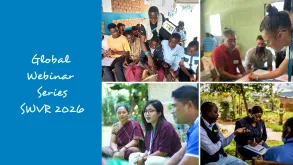
Every day, millions of volunteers hold communities together. They step in where systems fall short, respond when crises strike, and create opportunities where none exist. Yet much of that work remains unseen, uncounted, and undervalued. That challenge was at the heart of the fifth and final webinar in the 2026 State of the World's Volunteerism Report (SWVR) Global Webinar Series: “The Value of Volunteer Measurement Data to Policy and Planning.” The discussion explored a powerful question: If volunteers contribute so much, why are they still missing from the data that drives decisions?
Bringing together experts and practitioners from around the world, the webinar examined how stronger evidence on volunteering can influence policy, improve planning, and unlock greater impact for communities. Here are some insights from the conversation.
Opening the event, Tapiwa Kamuruko, Chief of the Volunteer Advisory Services Section at the United Nations Volunteers (UNV), reflected on the webinar series and its focus on understanding and measuring volunteerism.
Pedro Conceição, Director of the Human Development Report Office at UNDP and a member of the SWVR High-Level Advisory Group, emphasized the importance of data. He noted that ideas often gain influence when they can be measured. The Human Development Index, for example, helped bring new ways of thinking about progress into public policy because it provided reliable data. Volunteerism, he argued, can follow a similar path.
The discussion was moderated by Professor Matt Baillie Smith and Dr. Bianca Fadel from Northumbria University.
The first discussion focused on how the measurement of volunteering is changing. Dr. Ksenija Fonović, an independent researcher and one of the authors of the report, explained that measuring volunteerism should go beyond simply counting volunteer hours or estimating economic value. While these figures remain useful, they do not tell the full story.
Volunteering also helps build trust, strengthen relationships, develop skills, and increase confidence within communities. These benefits are often harder to measure, but they are just as important.
Dr. Fonović stressed that volunteer organizations need to play an active role in deciding how volunteering is measured. If they do not, others will define the standards for them. She highlighted the importance of collecting both data and stories in a consistent way so that local experiences can contribute to a stronger global understanding of volunteerism.
Dr. Maria Faina L. Diola, Professor of Public Administration and Governance at the University of the Philippines, brought the discussion closer to people's everyday lives. She explained that volunteering should not only be viewed by what it achieves, but also by how it brings people together. Volunteering can create networks, build trust, encourage participation, and strengthen communities. These outcomes may not always appear in statistics, but they can have a lasting impact. Dr. Diola also highlighted the importance of involving volunteers and communities themselves in collecting and producing evidence, particularly in developing countries.
Narendra Mishra, Policy Specialist and Team Lead on Integration at UNV, discussed how volunteerism can become part of formal planning processes. He pointed out that volunteering is often visible in communities but invisible in government systems. Volunteers may be praised publicly, yet their contributions are not reflected in budgets, workforce plans, or monitoring systems. This needs to change, he noted. When volunteering is included in national development plans and other planning frameworks, governments can better understand its contribution, allocate resources more effectively, and track progress.
The webinar then turned to a practical example from Togo. Edem Agode, Director of Operations at the National Volunteer Agency, explained how the country developed a system to track volunteer contributions, particularly in health and education. The system collects information at local, regional, and national levels, helping decision-makers understand where volunteers are working and what results they are achieving.
Importantly, the focus was not only on the number of volunteers. The government also wanted to know what changes resulted from their work and what happened to volunteers after their service ended. This information helped strengthen support for volunteer programmes and showed how volunteering contributes to national priorities. Agode noted that reliable data requires cooperation between governments, national statistics offices, universities, and volunteer organizations.
The final speaker, Juan Ángel Poyatos, Founder and CEO of Volies, shared a private sector perspective. He explained that companies are more likely to invest in volunteering when they can clearly see its value. Data can help businesses understand how employee volunteering benefits communities, supports sustainability goals, and improves staff engagement.
However, he stressed that measurement should not be limited to reporting results. Good data can help organizations improve their volunteer programmes, strengthen partnerships with community organizations, and ensure that volunteer activities respond to real local needs. Reliable information can also help create stronger cooperation between businesses, governments, and civil society organizations.
The webinar marked the conclusion of a global series that brought together more than 2,000 participants from around the world. Discussions will continue through regional launches of the 2026 State of the World's Volunteerism Report, where global lessons can be adapted to local contexts.
The final message from the webinar was clear: volunteers make a significant contribution to communities and societies, but their efforts too often remain a blind spot in the data that shapes public policy. When volunteerism is measured properly, it becomes easier to support, fund, strengthen, and include in future plans.
Evidence helps ensure that the work of volunteers is not only valued, but also recognized as an important part of social and economic progress.
Every three years, UNV produces the State of the World’s Volunteerism Report, a flagship UN publication designed to strengthen understanding on volunteerism and demonstrate its universality, scope and reach in the twenty-first century.
Please click below to access news about the previous four global webinars.