



Volunteers are first on the ground when crises hit—and they stay long after the headlines fade. From floods to conflict to climate shocks, they respond, rebuild and help communities prepare for what comes next. But in a world of overlapping crises, are we measuring their impact in the right way?
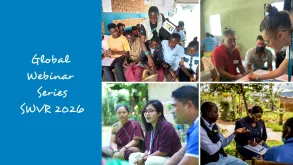
This was the focus of the global webinar series for the 2026 State of the World’s Volunteerism Report on 19 May. The webinar, titled “Measuring volunteering during multiple global crises,” explored how volunteer action can be better understood in crises.
Numbers are not enough. Measuring volunteering must go beyond hours and activities to show real change in people’s lives, communities and support systems.
The webinar opened with remarks by Olga Zubritskaya-Devyatkina, UNV Regional Manager for Arab States, and was facilitated by Professor Matt Baillie Smith and Dr Bianca Fadel of Northumbria University. Drawing on Chapter 6 of the 2026 State of the World’s Volunteerism Report, it brought together researchers and practitioners from crisis-affected contexts.
Looking beyond immediate response
During the first part of the discussion, Dr. Laura Hirst, Sumana Banerjee and Dr. Bianca Fadel reflected how volunteering doesn’t follow crisis timelines. Volunteers move from emergency response to recovery to everyday support—long after the headlines fade. This makes measurement more complex.
Too often, systems capture only formal or short-term action. But in crisis settings, much of the work is informal, local and continuous—driven by neighbours, youth and women’s groups, and communities responding to crises they are also living through.
Climate crisis volunteering can’t be reduced to activity counts
The climate crisis was one of the central themes of the webinar. Sumana Banerjee shared insights from research in the Indian Sundarbans, where communities face recurring climate-related shocks. Her contribution showed that climate volunteering cannot be measured only by counting activities. Volunteers may support adaptation, share local knowledge, help protect livelihoods and strengthen community ties—often while facing the same risks themselves.
To capture this, measurement must go beyond tasks. Storytelling, diaries and visual methods reveal the emotional, social and economic impact that numbers alone miss.
Ask communities what counts
Dr. Bianca Fadel shared an example of research with young refugees in Uganda that showed why definitions matter. When young people defined volunteering themselves, hidden forms of volunteering came into view—over 70 percent had volunteered since becoming refugees. The message is clear: ask communities what counts, don’t define it for them.
Stories as evidence
Tahiya Islam from the Aim Initiative Foundation in Bangladesh presented the Volunteer Stories platform. By capturing over 600 stories and engaging 10,000 people, the platform shows that measurement needs more than data—stories reveal dignity, resilience and real change that numbers leave behind.
A national framework in Jordan
The webinar also featured Ahmad Marei from the Crown Prince Foundation in Jordan, who presented National Volunteering Impact Assessment Framework. This national framework is aligning government, civil society, the private sector and youth around one goal: measuring volunteer impact. By linking individual, community and national levels, it shows how shared approaches can make volunteer contributions more visible in policy and practice.
Protecting volunteers matters too
The final case study focused on volunteer safety, security and well-being. Balthazar Bacinoni from the Red Cross and Red Crescent Movement shared experience from work linked to the 13 standards for volunteer safety, security and well-being, including in the Democratic Republic of the Congo. His contribution underlined that measuring volunteering should not only show what volunteers do for others. It should also show how crises affect volunteers themselves.
A different way to see volunteering
Across the discussion, one message stood out: Crisis volunteering is not simple—and measuring it shouldn’t be either.
Volunteers respond, recover and build resilience over time. To see their full impact, measurement must go beyond numbers to include lived experience and local voices.
Register for the next global webinar on 18 June by clicking here.
Every three years, UNV produces the State of the World’s Volunteerism Report, a flagship UN publication designed to strengthen understanding on volunteerism and demonstrate its universality, scope and reach in the twenty-first century.