



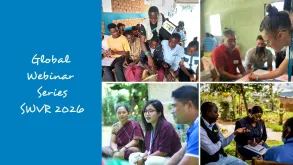
Volunteerism counts—but its true impact goes far beyond the numbers. How does it shape individuals and societies beyond how many people show up or how many hours they give? This question brought together more than 300 statisticians, researchers, National Statistical Offices and practitioners for the third session of the 2026 State of the World’s Volunteerism Report (SWVR) Global Webinar Series, focused on the Global Index of Volunteer Engagement (GIVE).
“When volunteering is measured well, it becomes visible in plans, policies and government priorities,” said Rafael Diez Medina, Chief Statistician and Director of the Department of Statistics at the International Labour Organization, at the webinar moderated by Yanchun Zhang, Chief Statistician at the Human Development Report Office of the United Nations Development Programme.
Why develop GIVE now?
The first segment of the webinar focused on the reasons behind the creation of GIVE. Professor Samuel Manda, Principal Investigator of GIVE at the University of Pretoria, explained that the approach was developed in response to ongoing challenges in measuring volunteering.
Volunteerism outside official organizations is overlooked altogether. He said that the Index seeks to move beyond the number of hours people volunteer, “It moves beyond counting volunteer hours to understanding how volunteering contributes to individuals, communities and economies.”
According to data presented during the webinar, approximately 2.1 billion people representing 34.5 percent of working-age adults globally engage in volunteer work each month, highlighting the growing need to measure volunteering.
Presenting on behalf of the University of Pretoria research consortium, Professor Sollie Millard, Harrid Nkhoma and Nada Abdulatif introduced the four dimensions of GIVE: benefits for people, value to the community, economic benefits and the support system for volunteering.
Speakers explained that these dimensions show the different ways volunteering helps—these include learning new skills, stronger community ties, trust, resilience, economic contributions and policies that support volunteers.
The balance between data and needs
Bringing together perspectives from academia, National Statistical Offices and civil society organizations, speakers shared that volunteerism takes many forms and that measurement must be flexible enough to reflect this.
Professor Sollie Millard of the University of Pretoria noted “the challenge is to preserve comparing data across countries while allowing countries to reflect local experiences and needs and cultural understandings of volunteering.”
From the perspective of official statistics, Desiree Manamela of Statistics South Africa spoke on the role of institutions, skills, and systems, and the need for funding of conducive national data systems. She shared, “National Statistical Offices have an important role in ensuring that volunteerism data becomes reliable and useful for policies.” Dr. Alok Rath of Voluntary Service Overseas added that civil society organizations are pivotal in supporting the collection and authenticity of data.
Professor Jin-Kyung Jung of Kwangwoon University highlighted the contribution academia can make in supporting evidence-based policies and improving research on volunteerism. “Better measurement creates stronger foundations for research, policy and public understanding of volunteer contributions,” she said.
Throughout the webinar, speakers spoke with one voice that GIVE is not intended to rank countries, rather to support better understanding of how volunteerism contributes to individuals, communities and economies.
Tapiwa Kamuruko, Chief of Volunteer Advisory Services Section at UNV, closed the session with a clear message: the global dialogue on measuring volunteerism must not stop here. “GIVE is ultimately about making the value of volunteerism more visible in the decisions that shape societies,” he concluded.
Register for the next global webinar on 19 May by clicking here.
Every three years, UNV produces the State of the World’s Volunteerism Report, a flagship UN publication designed to strengthen understanding on volunteerism and demonstrate its universality, scope and reach in the twenty-first century.