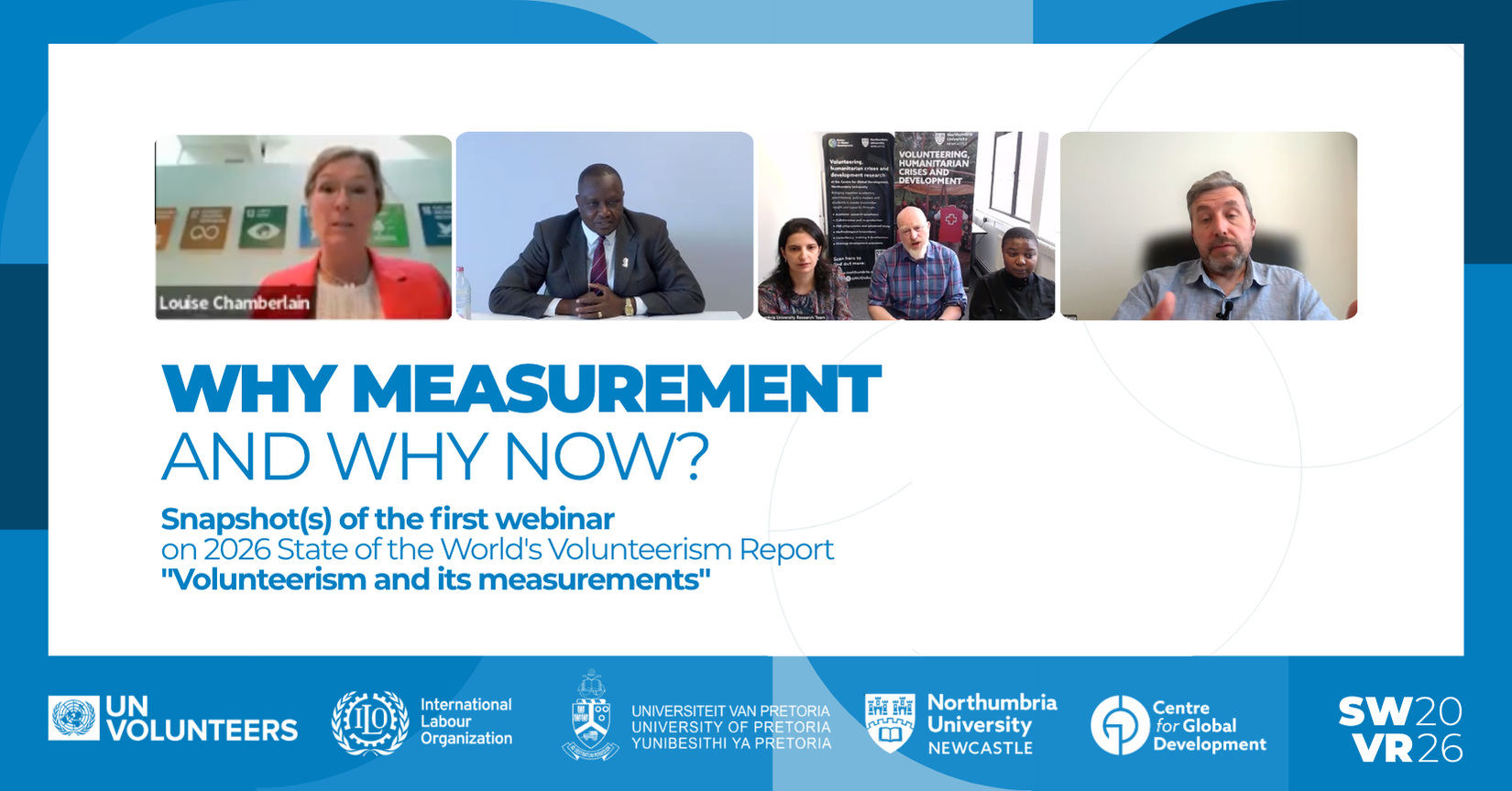
On 24 March, over 450 participants—a global audience of policymakers, researchers, practitioners and volunteers gathered online to tackle a question: how do we truly measure the impact of volunteerism? The discussion opened the Global Webinar Series for the 2026 State of the World’s Volunteerism Report (SWVR) 'Volunteerism and its Measurements' and was hosted by the United Nations Volunteers (UNV).
Louise Chamberlain, Deputy Executive Coordinator of UNV, opened the session by situating the discussion in today’s global reality: a world where volunteers continue to respond to crises, support communities and drive development, yet remain largely invisible in formal data systems.
The paradox of volunteerism: everywhere, yet not always visible
Throughout the webinar, speakers returned to a core argument: volunteerism is widespread, but much of its value remains invisible. Presenting key insights from the report, Professor Matt Baillie Smith, alongside Dr. Bianca Fadel and Maxine Mpofu from the Northumbria University Research Consortium, emphasized that existing measurement systems often fail to capture the full scale and diversity of volunteer work. As the SWVR highlights, volunteerism is everywhere.
Around 2.1 billion people volunteer each month. Yet much of this work remains invisible, especially informal and community-based efforts. This leads to a clear conclusion: If we don’t measure it, we don’t fully see it, and if we don’t see it, we don’t fully support it.
Moving beyond counting volunteers
The session introduced the Global Index of Volunteer Engagement (GIVE) presented by Professor Samuel Manda from the University of Pretoria. Rather than focusing solely on how many people volunteer, GIVE captures a broader and more nuanced picture of impact. Its dimensions examine how volunteering contributes to individual well-being and developing skills, how it strengthens communities and social cohesion, what economic value it generates, and whether the necessary conditions exist for volunteerism to thrive.
Strengthening the evidence base
Representing the International Labour Organization, Vladimir Ganta explained how improved methods are reshaping global estimates of volunteer work. He highlighted that recent increases in global volunteer figures do not necessarily reflect a surge in activity, but rather better measurement of previously “invisible” forms of volunteering, particularly direct, informal contributions within communities. This underscored one of the report’s central messages: improving measurement is not about inflating numbers, but about reflecting reality more accurately.
According to the latest data, around 2.1 billion people or 34.5 per cent of the global population aged 15 and above, engage in volunteer work each month, confirming that volunteerism is a widespread global practice rather than a marginal activity.
Participation rates vary significantly across regions, with the highest levels recorded in Africa (59 percent), followed by Asia and the Pacific (32 percent) and the Americas (30 percent), while Europe and Central Asia, and the Arab States report lower but still substantial engagement at 24 percent.
Why this matters now
The session was moderated by UNV—Dr. Tapiwa Kamuruko, Chief of Volunteer Advisory Services, with support from Emiliya Asadova, Policy Specialist on Evidence. Participants were invited to reflect on the challenges they face in measuring volunteer impact—from the lack of common tools and standards to severe constraints on time and resources.
The takeaway from this first global webinar was clear: improving how volunteerism is measured cannot rest with a single institution. It demands joint effort from governments, international organizations, researchers, communities and volunteers themselves.