



How do we truly measure the value of volunteerism—beyond hours served or activities delivered?
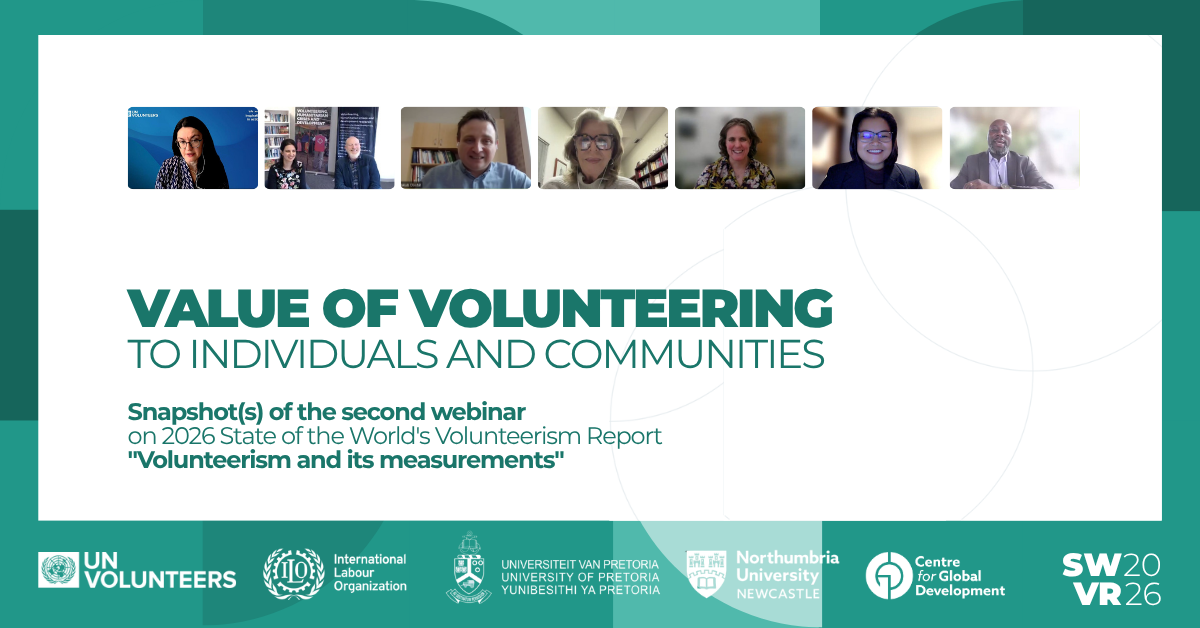
That question took center stage during the second session of the 2026 State of the World’s Volunteerism Report (SWVR) Global Webinar Series, held on 16 April 2026, which brought together more than 600 participants from across regions and sectors. Organized by United Nations Volunteers (UNV) in collaboration with the Northumbria University Research Consortium, the session explored how volunteerism affects individuals and communities—and how those contributions can be measured more meaningfully. The discussion drew on insights from Chapters 4 and 5 of the Report.
Why Evidence matters for Volunteerism
Opening the session, Emiliya Asadova, UNV Team Lead for Evidence, stressed the need for stronger and more inclusive data on volunteerism. Without solid evidence, the work of volunteers risks remaining invisible in national policies and development planning—valued in practice, but absent on paper.
In her remarks, Dr. Jessica Faieta, former United Nations Assistant Secretary‑General and member of the SWVR High‑Level Advisory Group, echoed the importance of consistent measurement—not only to show how volunteerism contributes to development outcomes, but also to inform better policy and funding decisions worldwide.
More than Participation: Measuring what Volunteering really means
A roundtable led by Northumbria University researchers Professor Matt Baillie Smith and Dr. Bianca Fadel brought together experts from across regions to examine how volunteering shapes individual lives.
Presenting findings from Chapter 4 of the Report, Dr. Egidius Kamanyi and Professor Sarah Mills highlighted volunteering’s wide‑ranging impacts—from skills and employability to health, confidence and resilience—while stressing that measurement must account for both benefits and risks. Dr. Kamanyi noted that less visible outcomes, such as well‑being and social connection, are often overlooked, and risks like burnout or exclusion rarely captured. Professor Mills spoke to the importance of pairing data with lived experience and adapting measurement to different contexts. Stronger evidence, they agreed, leads to better programmes for volunteers and communities.
Learning from grassroots experience
The conversation also reflected lessons from the field. Vanna Chomsavanh, co‑founder of the Don’t Stop Dream Team and President of the Association for Promoting Learning and Skills Development for Youth in Community in Lao PDR, shared how the organization measures volunteer impact in practice. Working with more than 100 youth volunteers, she described how participation tracking, interviews, and post‑activity assessments help capture changes in skills, confidence, and community engagement—grounding measurement in everyday practice.
Capturing community‑level impact
Shifting the focus from individuals to communities, Dr. Jakub Dostál, Dr. Jacqueline Butcher, and Professor Katy Jenkins examined how volunteering contributes to broader development outcomes. Dr. Dostál discussed methods for estimating economic value, including the International Labour Organization replacement wage approach, noting that counting hours alone falls short. Dr. Butcher stressed that measuring activities is not enough—"we must understand the changes volunteering brings to people’s lives." Professor Jenkins highlighted the importance of disaggregated, context‑sensitive data, warning that poorly designed measurement can reinforce inequalities instead of addressing them.
Bringing a global perspective, Cynthia Marquez Pugelj, Director of Education and Innovation at the World Organization of the Scout Movement, shared insights from the Scouts for SDGs Initiative. She showed how data from 112 million volunteers across 164 countries—and 2.7 billion service hours—are tracked using a mix of global indicators, case studies, testimonies, and digital tools. Her message was clear: volunteers are central to development outcomes, and measurement must capture both scale and community‑level change.
Looking ahead
Across discussions, speakers agreed on one key point: measuring volunteerism must go beyond counting activities. It must focus on impact—bringing together quantitative data and lived experience, applying approaches that are sensitive to context, and actively involving volunteers throughout the process.
What gets measured gets noticed. Yet gaps in volunteerism data keep millions of contributions invisible—leaving governments to design policies around what they can see, not what actually matters.
Measuring less visible outcomes—such as trust, social cohesion, and empowerment—is essential. Frameworks like the Global Index of Volunteer Engagement (GIVE) offer promising ways forward, balancing global comparability with local relevance.
As the SWVR Global Webinar Series continues, one message is clear: how we measure volunteerism shapes how seriously it is taken. Getting measurement right is not a technical exercise—it is fundamental to recognizing volunteerism as a force for peace and development.
Please click here to watch the webinar on YouTube.
To register for the next webinar on 6 May, please click here.
Every three years, UNV produces the State of the World’s Volunteerism Report, a flagship UN publication designed to strengthen understanding on volunteerism and demonstrate its universality, scope and reach in the twenty-first century.