



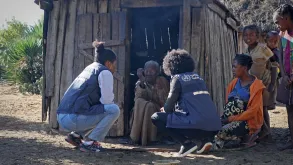
A volunteer stands in a village with no clinic, holding a box of vaccines that may or may not arrive in time. In another place, someone stays in a community everyone else has fled, trying to build peace one conversation at a time. These moments rarely resolve neatly. They resist slogans. And they refuse to be comforting.
That is where honest storytelling begins: not with neat conclusions, but with what is often softened, skipped, or buried—failure alongside progress, complexity instead of closure. The most powerful stories do not reassure. They unsettle just enough to demand reflection and accountability.
At the United Nations Volunteers, our stories come from more than 170 countries and across countless contexts. They are not one‑dimensional. They turn events from conflict zones into human experiences people can understand, feel, and remember. Not because they are dramatic, but because they are specific.
They live in close‑up testimonies: people refusing to be erased in the face of impunity; vaccines reaching places maps barely acknowledge; peace built piece by piece in communities where leaving would be far easier than staying. In each story, there is a protagonist—a volunteer trying to make a difference. There is context. And there is real tension, the kind shaping the world every day.
But not every volunteer story is told. Some remain unseen precisely because they are harder to package: volunteers stretched thin, working without enough support or recognition; volunteers who stay long after attention moves on; volunteers whose impact is real but undocumented, whose contribution is essential but quietly absorbed.
Storytelling only matters if it resists becoming synthetic. Perfectly worded, widely shared, and quickly forgotten posts already flood our feeds.
Volume is easy. Algorithms can replicate tone and scale output, but they cannot carry moral weight or lived consequence.
Stories endure because they insist on being human—specific, imperfect, sometimes uncomfortable. They break silences without becoming bitter, or as they say in Urdu تلخ (talkh).
So let’s not sugarcoat our stories. Let them surface inconvenient truths—the ones that disrupt, unsettle, and force people to think differently. Whether told on the margins of the Summit of the Future, within the mandates of Youth, Peace and Security, or anywhere else, storytelling must refuse neutrality. It must refuse fluff.
Hope is not fluff.
It is not naïve optimism or tidy endings.
Hope says: This is unfinished. This still demands action. There is a way forward—but only if we stop smoothing the edges.
So we wait less. We edit less. And we let the written word stand with those whose realities are too often edited out.
Because if our stories leave everyone comfortable, aligned, and reassured, what are they actually asking of us—and are we answering?