



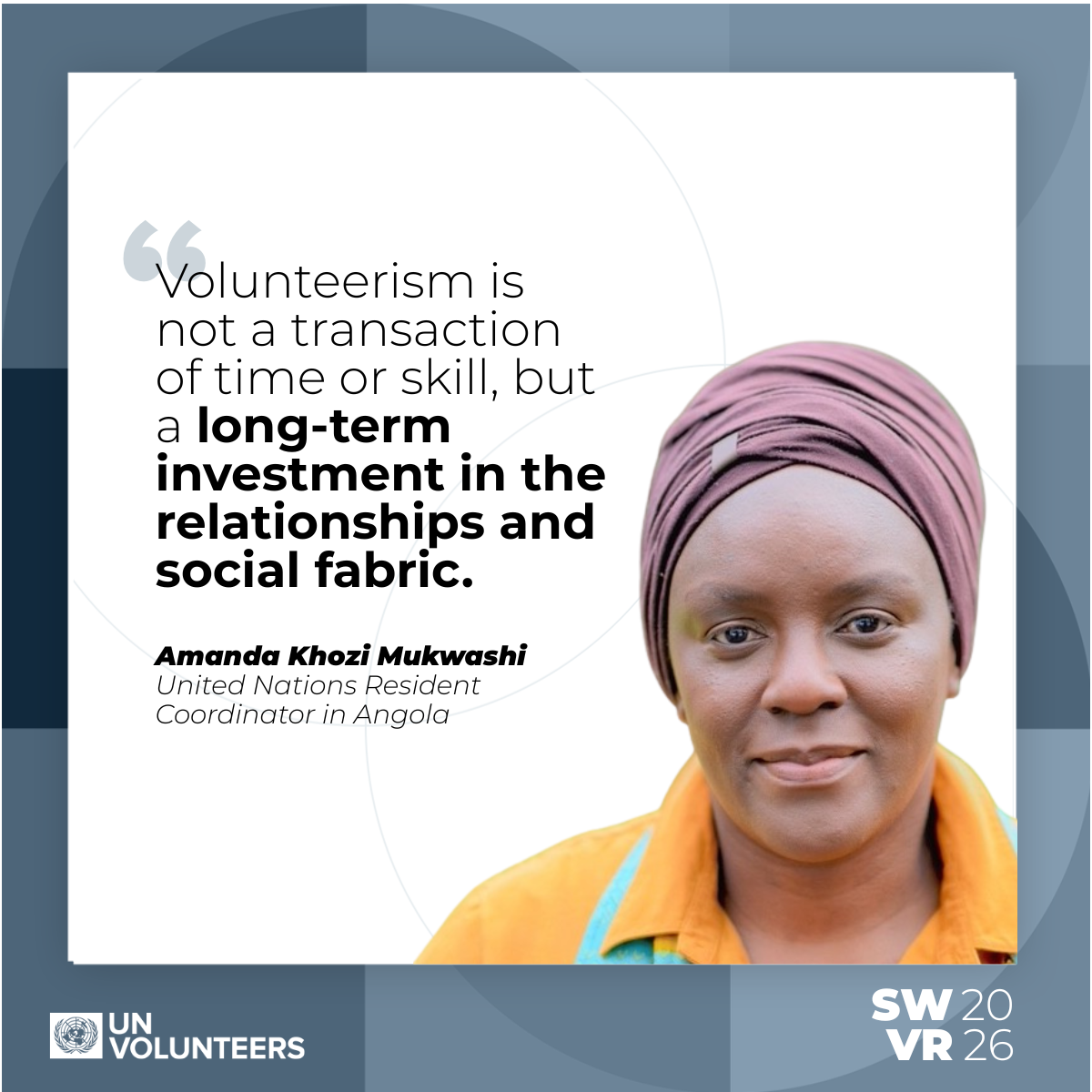
Volunteerism is not a transaction of time or skill. It is a long-term investment in relationships — in the social fabric that nurtures the spirit of ubuntu within communities, where giving and receiving come together to build trust, shared humanity, and collective empowerment. This understanding is particularly important in a world shaped by overlapping crises — protracted conflict, climate-related disasters, public health challenges, and deepening social divisions. Across these contexts, the capacity of people to trust one another and act collectively is under increasing strain, even as it becomes more essential.
Too often, however, volunteerism is still framed in narrower terms — as an exchange of time, skills, or resources from those who have to those who do not. This framing aligns neatly with conventional development metrics and reporting systems, but it misses something fundamental. At its core, volunteerism is relational. It reflects how individuals and communities remain connected to one another, particularly in moments of uncertainty and disruption.
This is not an abstract idea. In many communities, volunteerism is embedded in everyday life and becomes most visible when systems are under pressure. A neighbour checks in on an elderly resident during extreme weather. Young people organise to clean shared spaces after flooding. Local groups come together to support families facing sudden loss. During the COVID-19 pandemic, similar patterns of mutual aid emerged across regions, often filling critical gaps in formal response systems. These acts are rarely captured in official statistics, yet they are central to how communities sustain themselves.
Over time, such practices shape deeper patterns of relationship — ways in which people come to understand responsibility, care, and belonging. They cultivate a sense of mutual recognition and interdependence. In many contexts, this is expressed through the idea of ubuntu: the understanding that our humanity is bound together, and that giving and receiving are not separate roles but part of a continuous, shared experience.
While rooted in African philosophy, this idea resonates across cultures. It is reflected in concepts of interdependence found in Indigenous worldviews, in buen vivir traditions in Latin America, and in the growing recognition within development thinking that well-being is fundamentally relational. Increasingly, global policy discourse is beginning to reflect this shift, placing greater emphasis on social cohesion, trust, and belonging as essential dimensions of development.
Yet much of development practice continues to operate through a more transactional lens. Assistance is often structured around clearly defined roles: those in need are required to demonstrate vulnerability, while those providing support are positioned as external actors whose contributions are to be recognised and reported. Systems of planning and accountability tend to prioritise measurable outputs, often at the expense of relational dimensions that are more difficult to quantify.
Evidence from community-driven development and locally led humanitarian action suggests that this approach has limitations. Where individuals are engaged primarily as beneficiaries rather than as partners, interventions can struggle to sustain trust and ownership over time.
By contrast, approaches that prioritise participation and local decision-making tend to be more closely aligned with local priorities and more resilient in practice. Broader development research similarly highlights trust, networks, and relationships as key determinants of resilience and effectiveness.
At the same time, these insights point to a persistent challenge: what is not measured is often not fully recognised. Traditional monitoring systems are better suited to capturing what is delivered than what is built between people. Yet it is precisely those less visible elements — trust, reciprocity, and social cohesion — that enable collective action and sustain impact over time.
This is where the question of volunteerism measurement becomes central. Strengthening how volunteerism is understood and assessed is not only a technical exercise; it also requires a conceptual shift. It calls for approaches that move beyond counting activities to better reflect how volunteerism contributes to relationships, inclusion, and community resilience.
One enduring gap remains the limited visibility of informal volunteering, which continues to sustain communities across contexts but is often insufficiently captured in official data.
In a global context marked by uncertainty and fragmentation, this matters. The strength of relationships within and between communities is not a secondary outcome of development — it is a condition for it.
For the development and humanitarian community, this requires a shift in perspective. It means recognising that volunteerism is not an adjunct to formal systems, but part of how societies organise, support, and sustain themselves. It also means designing approaches that reinforce, rather than displace, the forms of solidarity that already exist.
If development is to be truly transformative, it must move beyond transactions and toward connection. Volunteerism reminds us that the most enduring change is not defined only by what is delivered, but by the relationships that are built.
Because in the end, it is these relationships — grounded in trust, dignity, and mutual responsibility — that determine whether communities can endure, adapt, and shape a shared future together.
Amanda Khozi Mukwashi is currently the UN Resident Coordinator in Angola. She was also part of the 2026 SWVR High-level Advisory Group.