



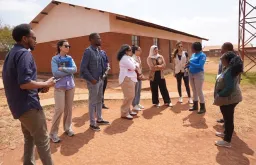
The first time I walked through Dzaleka Refugee Camp in Malawi, I felt the weight of time. This camp was never meant to be permanent, yet decades later, tens of thousands of people still call it home. Children are born here. Young people grow up here. Families live entire lives here. For many, there is no going back. At the same time, host communities around the camp share the same pressures—scarce resources, climate shocks, and the daily challenge of building a future with too little support.
My name is Zahra Vaziri. I am from Iran. I serve as a UN Volunteer Associate Programme Officer with the UN Refugee Agency (UNHCR) in Malawi. My role is to help ensure that humanitarian projects are not only implemented, but that they bring dignity, opportunity, and hope to both refugees and the communities that host them. I also make sure that the projects we design and fund are not only implemented but also carry meaning for the people who live here.
Every day I work with partners to track progress, review reports, and coordinate how programmes are being implemented. I contribute to proposals that secure resources. I monitor systems that make sure projects deliver. My focus is always on how these activities translate into dignity and self-reliance for both refugees and their Malawian hosts.
One of the initiatives I am most proud of was supporting the development of a climate-focused proposal to the Central Emergency Response Fund. It covers sustainable shelter, climate-smart agriculture, and livelihoods. These are not just technical projects. They are lifelines. They mean people can adapt to the changing climate, grow food in more sustainable ways, and earn income to support their families.
Another achievement was preparing and coordinating a proposal with the Embassy of Japan. That support is now expanding activities that give the local population more opportunities for sustainable livelihood, along with opportunities for education and for their access to health in Dzaleka. These are concrete steps towards the broader goals of peace and development. By linking livelihoods, education, and shelter with climate adaptation and social inclusion, the work contributes to sustainable growth, stronger communities, and more peaceful coexistence.
But the challenges are real. Resources are always limited. The needs are both urgent and long-term. Refugees require food, health care, and protection today. But they also need education, jobs, and opportunities tomorrow. Donor funding often covers the immediate, not the lasting. Climate shocks make everything harder—fields flood, crops fail, and families lose what little they had.
The greatest challenge I see ahead is sustainability. Humanitarian responses in protracted refugee settings cannot remain short-term forever. Solutions must bridge relief with development. That is where I see the greatest opportunity: co-creating with communities.
Refugees and hosts know their own realities. They have ideas. They have resilience. When we listen and plan together, the solutions become more durable. This is also the deeper meaning of volunteering for me. Volunteers bring presence, humility, and energy.
In Malawi, that presence builds trust. Communities see that someone is here to listen, to respond, to walk alongside them. That makes a difference. Throughout my service, I learnt that anyone can make a difference by showing up where their skills meet local priorities.
On a personal level, volunteering has reshaped me. I came to Malawi not knowing many people from my region. I had to rebuild my social support system from scratch. That tested my resilience. I also gained practical skills—managing multi-sector projects, negotiating with donors, writing technical proposals, and coordinating across diverse partners.
One moment stands out. I was leading a funding proposal while also facilitating dialogue between stakeholders with very different priorities. It could have fallen apart. Instead, by staying patient and keeping the community’s needs at the center, we reached an agreement and secured resources. That experience deepened my confidence, sharpened my communication, and showed me what it means to bridge divides for the sake of others.
As I end my assignment in Malawi, I think of the people of Dzaleka and the surrounding villages. Their lives are not defined only by crisis. They are defined by creativity and determination to build something better. Acting for humanity means standing in solidarity with them, not for a day, but every day. Humanity depends on such solidarity. For me, being a UN Volunteer is about joining that collective act—one proposal, one solution, one conversation at a time.
To world leaders: Act with Humanity. Protect those who serve, and more importantly, protect the people we serve. End the conflicts that create displacement in the first place. Support long-term solutions, not only short-term fixes.