



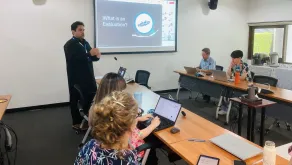
Ahmad Ullah Qazi, from Pakistan, serves as a UN Volunteer international specialist with the United Nations Educational, Scientific and Cultural Organization (UNESCO) Regional Office in Bangkok. He started his assignment in November 2024 as Regional Evaluation Associate for Asia and the Pacific region, where he supports the evaluation function of UNESCO across 6 regional and 14 field offices. His focus is to improve the quality of evaluations, enhance their use in programming and decision-making, and support the implementation of UNESCO’s evaluation policy and guidelines across field units and relevant programmes.
The United Nations Evaluation Group (UNEG) and United Nations Volunteers (UNV) collaborate on a programme where young professionals under the age of 35 serve as evaluators. Initiated by UNEG Young and Emerging Evaluators Working Group to provide learning and career growth for youth keen to join the UN, while also ensuring their voices are included in UN evaluation processes. The programme supports participants in building their skills, supporting national efforts, and growing as future leaders in evaluation.
The first cohort of this programme began their volunteer assignments in 2024 with 10 evaluators placed with six UN entities (UNESCO, UNDP, UNFPA, UNICEF, UNU and WHO) across eight cities: Bangkok, Budapest, Dakar, Doha, Montevideo, Nairobi, Panama and Tokyo—including Qazi in Bangkok.
"My volunteer assignment is both pioneering and deeply rewarding," says Qazi. "UNESCO has never had a dedicated evaluation presence in the region before, and I’m honoured to be the first.
In layman's terms, my job is to help teams improve how they plan, run, and use evaluations. Whether it’s reviewing reports, offering feedback, or guiding teams through UNESCO’s standards, my goal is simple: make evaluations clearer, more useful, and more impactful.
But my work goes beyond just reviewing documents. I deliver tailored training sessions, provide hands-on support, and help staff turn evaluation findings into real-world actions. I also serve as a bridge between the field and headquarters, making sure insights from the region inform global strategies—and vice versa. This includes improving how data is shared and understood across the organization.
Beyond UNESCO, I support the UN Resident Coordinator offices through the UNEDAP platform, helping strengthen evaluations of the United Nations Sustainable Development Cooperation Framework and training UN agency staff across the region. It’s a chance to contribute not just to my agency, but to the broader UN system.
Since starting this role in November 2024, I’ve seen real progress. Field offices now have a stronger grasp of evaluation practices, the quality of evaluations has improved, and UNESCO’s visibility in the UN evaluation space is growing. Headquarters is more informed about what’s happening on the ground, and that’s helping shape better decisions and future planning.
Of course, there are challenges. Change isn’t easy—especially when introducing a new role and new ways of working. Some offices were used to doing things independently, and adjusting to a more coordinated approach takes time. My assignment is currently set to end in December 2025. Long-term impact requires long-term commitment, and I hope funding will allow this work to continue.
Another challenge is perception. UNV roles are sometimes seen as junior. But I’ve learned that persistence, clarity, and collaboration go a long way in building trust and driving change.
Despite these hurdles, I see this as a huge opportunity. I’m helping build a system from the ground up—one that UNESCO can rely on for years to come. That’s exciting. And it’s a chance to apply everything I’ve learned over the years in a way that truly matters.
"To anyone dreaming of working in the UN or making a difference, my advice is: keep going," shares Qazi. "Rejection is often the first step toward success. Passion and persistence matter more than a perfect start. You grow, you learn, and eventually, you find your place.
As the world shifts—through funding cuts, changing priorities, and new global realities—I believe we’re entering a new phase. Just like after past crises, a new normal will emerge. And those of us working for the greater good will continue to adapt, contribute, and lead.
Volunteering, especially in developing regions, has a unique power. It’s driven by passion, not obligation. And that passion leads to real, lasting change.
This experience has already taught me so much—about countries beyond my own, about evaluation as a tool for peace and development, and about UNESCO’s unique role in the field. I’m grateful for the journey, and excited for what’s next."
Qazi's role as a UN Volunteer under the UNEG-UNV programme gives young evaluators a real voice in shaping how the UN learns and improves, and brings together youth and senior professionals to make evaluations more diverse, inclusive, and innovative. It's also in line with UNEG's 2025-2032 Strategy amidst growing global complexity, resource constraints, and demands for accountability.
Read another story of a UN Volunteer Evaluator under the UNEG-UNV partnership.
For more information about UN Volunteer assignments and how you can get involved, click here. To read our stories, click here.