



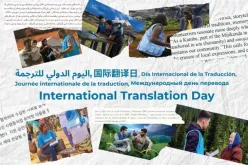
On International Translation Day, we look beyond words. Translators and editors shaping volunteer stories across continents carry a greater responsibility: to ensure meaning survives the journey from one language to another.
Literal translation can preserve words while losing culture, emotion and intent. Artificial Intelligence (AI) can make translation faster, more accessible and far-reaching, but speed is not the same as understanding. Human oversight remains essential. The strongest approach is not AI replacing translators, but supporting them, while human judgment provides the context, cultural sensitivity and nuance technology may miss.
Ultimately, the craft lies in reshaping language without rewriting experience, because the most literal translation is not always the most faithful one.
In this video, voices from United Nations Volunteers (UNV) come together in 12 languages, celebrating the richness of language and all that it carries.
From utu and umoja in Kenya to ayni in Bolivia, and sewa in Nepal, to asar or ashar in Central Asia to servir in Latin America—acts of service, humanity, humility, care, duty—are deeply rooted in local traditions. These words can be translated, but what they carry cannot always be contained in another word. Perhaps that is where translation truly begins.
Languages in the video: Arabic, English, French, Luo, Nepali, Portuguese, Quechua, Russian, Spanish, Swahili, Ukrainian, and Urdu.
This content was also posted on the United Nations website.