



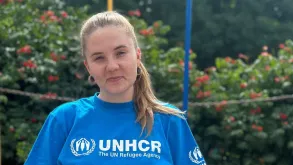
We think we know who volunteers are—until we look closer. They are not a single age, profession, or type of person. They are students, engineers, parents, activists, neighbours. Most pass through life unnoticed. Yet behind some of the world's toughest challenges are ordinary people doing extraordinary work—supporting those forced to flee, helping communities recover, protecting the environment, and creating opportunities where none existed before. As we approach World Humanitarian Day, we bring you the story of one of them.
For many people, opportunities to volunteer with the United Nations remain little known. Kateřina Rohanová understands that feeling. Before joining the United Nations, she volunteered in different settings, from summer camps to dance studios but never imagined that volunteering also existed within the UN. She certainly didn't expect that one day she would become a UN Volunteer herself.
Everything changed when the Czech Ministry of Foreign Affairs announced several funded UN Volunteer opportunities on Instagram. Curious about the opportunity, Kateřina submitted her application. A month later, the UN Refugee Agency (UNHCR) in the Republic of Moldova invited her for an interview and that's when her journey began as a UN Volunteer some six months ago.
For this UN Volunteer assignment I had to move to a new country, with no family or friends around and dedicate next year to refugee response efforts in Moldova,” says Kateřina.
Although she had visited the Republic of Moldova previously and possessed some language skills, adjusting to a new environment was still challenging. The greatest challenge was not translation, but restoring a sense of warmth, dignity, and reassurance to Ukrainian refugees as they coped with trauma and the unknown.
The challenge wasn’t just overcoming a language barrier but offering genuine comfort and empathy when you aren't fully fluent. Holding those deeply emotional conversations in a language other than your mother tongue requires a whole different level of sensitivity.”
In February 2026, when Kateřina arrived, it was cold and windy. But the support from colleagues warmed her heart, making even the coldest day seem welcoming. “In the first month, I already felt like a part of the team. Everyone genuinely wanted to hear my opinion,” she shares.
Before taking the role of a UN Volunteer in Protection, she worked as a research associate, focusing on social and environmental fields. She learned how to work with at-risk communities by conducting interviews and conducting evaluations.
While doing research, I focused on people who lived through abuse. The goal was to find applicable solutions for them and begin implementing those solutions.”
She continues, "They are not only people at risk—they are also refugees rebuilding their lives after being forced to flee." Empathy became the foundation of every conversation with those who fled the war. After four years of the refugee response—moving from the early emergency phase of registration and urgent shelter toward coordination with partners many UNHCR processes are now well put into practice. Kateřina focuses on working with local partners from civil society.
“I imagined that we would spend every day going out of the city to visit beneficiaries and interview them. We still do it, but the focus shifted,” she adds. “Core protection activities—like field visits, assessments, monitoring, and coordination—have been standard UNHCR practices from the very beginning, but now the focus includes more advocacy and policy work to strengthen a long-term, coordinated response with local government.”
Working and supporting refugees from Ukraine is also personally meaningful for Kateřina. Coming from Czechia, she understands how history can shape people’s experiences of displacement and uncertainty. “Our own history reminds me of why my work matters,” she adds.
Many days are filled with routine tasks, but some moments stay with Kateřina long after they are over. During one of the visits to the refugee accommodation center, she met people who had been informed that they would need to leave within two months, as these shelters are closing due to funding cuts.
People left their country because of war, trying to find a safer place for their children and older family members. Now, they had to leave that safe space and their newfound community again.”
What stayed with Kateřina most was not the displacement itself, but having to watch people rebuild their lives twice. As the accommodation center prepared to close, only the most vulnerable could move to another facility. Many others were forced to start over yet again.
They had to start their lives over again, in a new location. Some moved to other cities, as rent is extremely expensive in Chișinău.”
Kateřina and her colleagues did what they could, sharing information, guidance, and support. But the fear of the unknown was impossible to ignore. “I wished I had been able to do more to support them,” she says.
Humanitarian work is always double-sided—there are bad days, but there are good days too. “For refugees, the barriers lie even in small areas—from language to having access to a laptop,” shares Kateřina.
For refugees facing an uncertain future, a short online form meant the difference between stability and insecurity. Helping them extend their temporary protection status became one of Kateřina’s most rewarding experiences.
Kateřina helped with translations for those who applied in Russian. “There was a nice old lady; she kept thanking me. To me, it was an easy task—just ticking a few boxes on an online form. To her, it was a matter of safety.”
Thanks to our field visits, interviews and assessments, many refugees have access to the assistance they need. Being aware of the refugee needs allows raising awareness with the local government and helps keep as many people as possible safe and protected."
That is the lesson Kateřina carries from her first six months as a UN Volunteer: in a crisis, human presence can be as powerful as humanitarian aid. Her work may never make headlines, but for the refugees she supports, it means they are not facing uncertainty alone.
And sometimes, that is where rebuilding a life begins.
A Senior Child Protection Associate, Carolina Sclifos, at UNHCR in the Republic of Moldova shared: “Having UN Volunteers on the team is a significant asset to UNHCR, particularly in a dynamic context such as Moldova, where the team is responding to complex and evolving needs of refugees."