



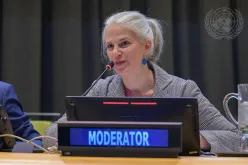
In a recent interview with the Kazakhstani media outlet KazPravda, Sandra Koch, Team Lead for the International Volunteer Year (IVY 2026), reflects on volunteering trends in Kazakhstan and discusses how volunteering can become more accessible, effective and sustainable across the region and beyond.
Julia Mager: "How long has UNV been working with Kazakhstan?"
Sandra Koch: "The United Nations Volunteers (UNV) has been operating in Kazakhstan since 1993. The engagement has increased in recent years, particularly in the context of regional cooperation and IVY 2026, where Kazakhstan played a leading role in its proclamation."
Julia Mager: "President of Kazakhstan, Kassym-Jomart Tokayev, announced the establishment of the UN Volunteers Subregional Office in Almaty in 2025. Why was the country chosen as a hub for the development of volunteerism in the region?"
Sandra Koch: "The number of the United Nations agencies establishing offices in Almaty has grown in recent years. The city became a strong platform for collaboration, further reinforced by the establishment of the United Nations Regional Centre for the Sustainable Development Goals for Central Asia and Afghanistan in 2025.
UNV seeks to be closer to its partners, as the organization serves the entire UN system. In this sense, Almaty offers the right mix of partnerships, infrastructure, and regional reach, making it an ideal base to expand UNV’s work across Central Asia.
We also see the growing interest in volunteerism across the region, with close to 400 UN Volunteers serving in Central Asia in 2025 and countries such as Kazakhstan, Kyrgyzstan, and Uzbekistan actively advancing activities under the International Volunteer Year 2026.
Central Asian countries are participating in UNV's Full Funding programme, allowing governments to finance volunteer assignments that match their thematic priorities and geographic focus. Kazakhstan was the first Central Asian country to join in 2019 and has since sponsored 17 nationals to serve as UN Volunteers around the world.
Julia Mager: "What are the objectives of IVY 2026? What are some of the flagship initiatives taking place?"
Sandra Koch: "IVY 2026 is more than a symbolic campaign. It is a global mobilization for structural change.
It aims to demonstrate the central role of volunteerism in achieving the SDGs. The Year has four key objectives: raise the visibility of volunteers and their contributions worldwide; build up institutional mechanisms that support volunteerism; mobilize greater investment in volunteers and volunteer infrastructure; and foster stronger partnerships among many actors, including academia and the private sector.
Public awareness is not the only goal. IVY's purpose lies in sustainable institutional change, ensuring volunteer practices to be fully integrated into national development strategies and operations of the United Nations.
Events are mainly organized by different stakeholders observing the Year, including Member States. Kazakhstan plans several international events, including the First CIS Volunteer Forum in August.
From UNV’s side, we have hosted the global opening of the International Volunteer Year in New York together with the Permanent Missions of Kazakhstan and Germany. The closing event, planned for December 2026, will be held there as well."
Julia Mager: "How would you assess the development of volunteerism and civic engagement in Kazakhstan in recent years?"
Sandra Koch: "These practices have become more organized and supported institutionally. Volunteers contribute across a broad range of sectors, from emergency response and environmental protection to education and search-and-rescue operations, with increasingly close collaboration between government institutions, civil society organizations, and volunteer networks.
Kazakhstan National Volunteer Network in partnership with the Ministry of Culture and Information developed a set of methodological guidelines. The main purpose is to raise the engagement of volunteers across areas such as social protection, education, healthcare, environmental sustainability, youth policy, and emergency response."
Julia Mager: "Which practices can be considered as good examples of volunteers' engagement in Kazakhstan and Central Asia?"
Sandra Koch: "Practices such as asar in Kazakhstan, and similar traditions across Central Asia, where communities come together to support those in need, continue to shape modern approaches to volunteerism. Over time, they evolved into a unique combination of informal community support and more structured forms of volunteer engagement."
Today, more than 70 percent of volunteers in the region are involved in education, environmental and social initiatives, contributing directly to the Sustainable Development Goals. Around 60% are young people under the age of 30, reflecting strong youth engagement and a growing desire to contribute to the development of their communities and countries.
The President of Kazakhstan has described volunteers as patriots of the country. This fact mirrors a broader recognition of the vital role volunteerism plays in strengthening human capital and supporting the country's long-term development. Additionally, such close alignment of volunteerism with national development priorities and strong engagement of youth can inspire other regions.
Julia Mager: "Which areas of volunteerism are most in demand today?"
Sandra Koch: "According to new estimates in the 2026 State of the World’s Volunteerism Report, more than 2.1 billion people volunteer each month worldwide. Their collective efforts support responses to environmental challenges, disaster recovery, and social inequalities.
The demand falls on those forms of volunteerism that respond to complex challenges – both globally and locally. Climate-related engagement is among the most rapidly expanding fields of volunteerism worldwide.
During humanitarian emergencies, volunteers play an inevitable role in stabilizing the situation and helping bridge critical gaps when existing systems are under pressure. Other key areas include the delivery of social services and support for communities at risk, education, and locally led initiatives."
Julia Mager: "What role do modern technologies play in the transformation of the volunteer movement?"
Sandra Koch: "They transform the very nature of volunteerism. Online platforms create new opportunities for people to contribute remotely. It is especially important at times of crisis. The exchange of professional knowledge and expertise across countries is making volunteer action more effective and better equipped to address complex challenges.
Technological progress also makes volunteers' involvement visible and measurable. It amplifies their recognition and encourages greater support. Additionally, hybrid models combine local presence with global expertise.
As the use of artificial intelligence grows, more challenges have been brought to light when it comes to volunteerism. One concern is the risk of losing human dimensions. If too many tasks are automated, volunteering can become more transactional and less about relationships, empathy and care—the core of volunteering. Another challenge is the deepening of existing inequalities, as access to AI tools remains uneven, leaving some communities behind."
The interview was adapted into English by the UNV Regional Office for Europe and Central Asia.