In the heart of the Democratic Republic of the Congo (DRC), childhood often vanishes before it even begins. Conflict and displacement have heavily impacted children—the United Nations Children's Fund (UNICEF)’s 2024 Humanitarian Action for Children report reveals a staggering 6.04 million people uprooted, including 3.5 million children. Amidst this crisis, a quiet force stands guard: UN Volunteers embedded within the United Nations Stabilization Mission in DRC (MONUSCO)’s Child Protection Section. Their task is as relentless as it is essential—transforming raw numbers into lifelines and turning voices into instruments of justice. Each violation they document is more than data; it’s a chance to shield the next child before the cycle of suffering repeats.
In Bunia, Ituri Province, UN Volunteer Ounteni Souobou is a Child Protection Officer (Database and Reporting) with MONUSCO. He is from Burkina Faso. Ounteni's work focuses on documenting violations regarding children's rights, abductions and sexual violence, under the United Nations Monitoring and Reporting Mechanism. Each verified case feeds into national reports used by MONUSCO and UNICEF to target high-risk zones and guide advocacy.
“Protection starts with presence, being there, listening, and acting with communities,” says Ounteni. “Each verified case brings us closer to justice. Behind every figure is not only a statistic, but a child who deserves safety.”
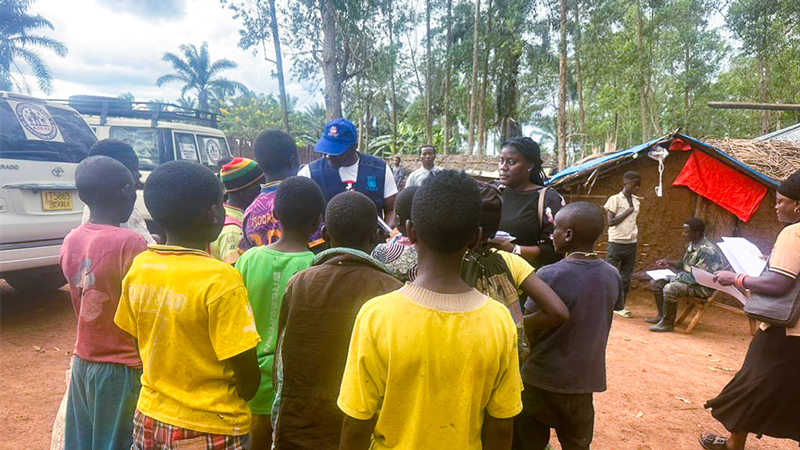
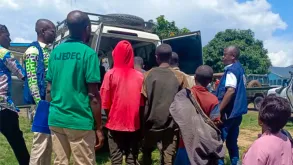
In one instance, Ounteni interacted with community members at the Dro Dro displacement site to discuss the mechanisms used for monitoring child protection. This builds on the work he had taken on back in 2023, when he helped document missions that led to the separation of hundreds of children from armed groups in Ituri. He also contributed to building a juvenile pavilion at Bunia’s central prison, allowing minors to be held separately from adults—a small but vital reform in child protection.
Security risks are constant. When based in Goma, Ounteni witnessed unrest and anti-MONUSCO demonstrations that restricted field work. Later redeployed to Bunia, he continued under frequent security alerts.
“The emotional weight can be heavy,” Ounteni shares. “But every verified report means one more step toward accountability.”
Access to certain territories can be suspended for weeks, delaying verification and response. The hardest part, he says, is knowing that some cases remain unconfirmed simply because teams cannot safely reach the children. MONUSCO's Child Protection Officer and Chief of Reporting Unit, Carolina Meroni, shares, “Ounteni has shown professionalism, adaptability, and integrity. Even under pressure, he ensured the continuity of child protection monitoring and reporting.”, Carolina Meroni, Child Protection Officer and Chief Reporting Unit.
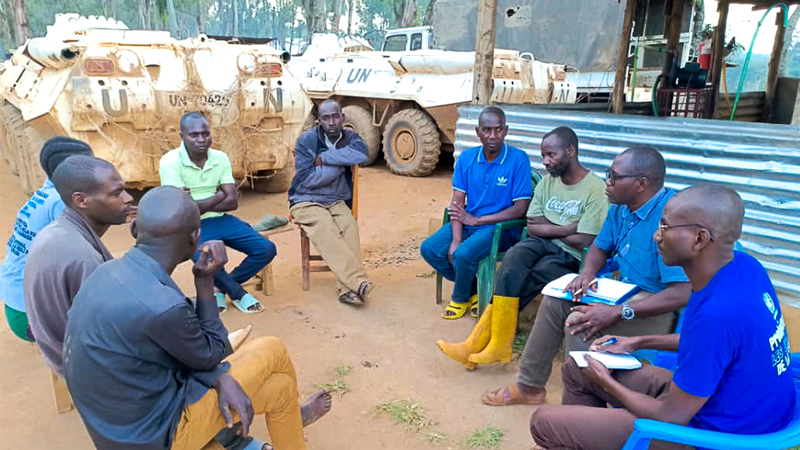
UN Volunteer Child Protection Officer, Gakehmi Edith Tema Watcona, is from Cameroon. She is based in Kinshasa and supports MONUSCO’s national coordination on child protection. She began her assignment in Beni, working directly with children formerly associated with armed groups, before moving to the capital to lead multi-agency coordination meetings, which are essentially technical working groups, with government, the United Nations system, and civil-society partners. Gakehmi also trains MONUSCO contingents and national security forces on international standards for protecting children in armed conflict.
“Keeping everyone focused on child protection requires persistence and partnership,” she says. “It’s not just about documents, it’s about children whose lives depend on our decisions.”
Funding shortfalls and shifting priorities make sustained protection difficult, but Gakehmi sees collaboration as the strongest defense. She also faces the challenge of maintaining momentum among partners across vast distances and competing agendas.
“Coordination only works when everyone feels responsible,” she says, a balance that often requires patience as much as persistence. “Even when budgets shrink, cooperation can still grow,” she adds. “That’s where volunteers make a real difference, connecting systems, people, and purpose.”
According to the UN Secretary-General’s 2024 report on Children and Armed Conflict, 8,208 grave violations were verified against 6,196 children in the DRC, with armed groups responsible for 98 percent of these violations. Every verification is more than a checkmark—it’s a commitment. A commitment that lives within MONUSCO’s child protection mission, strengthened by UN Volunteers who infuse hope and ensure that no child’s story fades into silence.