



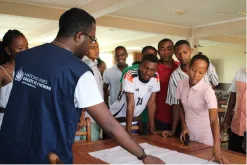
At first, the room is quiet—almost guarded. On a human rights training day in Madagascar’s Sofia region, people arrive with folded arms and measured words. Local leaders, youth activists, women’s groups, community representatives. They listen. They wait. Human rights, after all, can sound like something designed elsewhere, for someone else. And days like International Women’s Day can sometimes feel symbolic—marked on calendars, discussed in speeches, distant from daily realities.
Then the silence breaks. Someone talks about land taken without consent. A woman speaks of being shut out of a decision that shapes her family’s future—her voice steady, resolute. A young person admits they don’t know where justice begins, or whether it’s meant for them at all.
The atmosphere shifts instantly. Human rights stop being theory and start being personal. Legal language collides with lived reality. Hands go up. Voices sharpen. Stories connect. People begin to see themselves inside the concepts, not outside them. “That’s the moment everything changes,” reflects Pierre Yvan Miharisoa, a national UN Volunteer from Madagascar. “That’s when my real work begins.”
"As a UN Volunteer Specialist in Law, Gender, and Communication with the Office of the United Nations High Commissioner for Human Rights (OHCHR) in Madagascar, I spend much of my time creating spaces where these conversations can happen. My role sits at the intersection of law, community dialogue, and communication. It requires listening as much as teaching.
My path toward this work began years earlier through studies in law and political science. I was drawn to questions of governance, justice, and how institutions interact with communities. Internships with the United Nations Population Fund (UNFPA) and later with OHCHR exposed me to human rights monitoring and gender programmes. The United Nations Volunteers (UNV) became the bridge between theory and practice.
Most weeks take me far beyond the office. I travel across nine regions supporting a project that seeks to strengthen access to justice by connecting state institutions with traditional community justice systems known as the Dina. For many communities, justice does not begin in courts. It begins locally, through dialogue and mediation.
My work revolves around three main activities. I facilitate capacity-building sessions for civil society organizations, local authorities, young human rights defenders, women’s associations, and organizations representing persons with disabilities. We discuss human rights, gender equality, and inclusion in ways that reflect local realities rather than abstract principles.
I also monitor and document human rights concerns raised during field missions. Recording these experiences helps ensure that community voices inform institutional responses. Alongside this, I support communication efforts so that project achievements and lessons learned remain visible to partners and communities.
Human rights work rarely produces immediate results. Progress appears in small shifts. A local leader reconsidering a decision. A woman speaking confidently during a community dialogue. Young activists understanding how to engage authorities constructively. In 2024, becoming a certified human rights trainer marked an important turning point for me. Soon afterward, I began leading training sessions myself and developing learning modules on access to justice, gender inclusion, and the relationship between formal and traditional justice systems.
One experience that stays with me was facilitating leadership training for women under the Women, Peace, and Security agenda. Watching participants recognize their own influence within community decision-making processes revealed how knowledge can transform confidence.
Beyond my formal responsibilities, I continue to mentor students pursuing research in law and political science. This engagement allows me to stay connected to academic inquiry while supporting the next generation of public service professionals.
Balancing the multiple dimensions of my role remains challenging. Acting simultaneously as lawyer, gender specialist, and communicator requires constant organization and adaptability. The complexity of human rights issues also demands continuous learning. I approach these challenges as part of the growth that comes with service.
According to my supervisor, Sabine Lauber, my strength lies not in staying within one lane, but in crossing them—combining legal expertise, gender analysis, and strategic communication with clear motivation and professionalism. Her feedback encourages me: real impact doesn’t come from narrow specialization, but from the courage to work across disciplines.
Serving as a UN Volunteer has reshaped how I understand human rights work. Laws and policies matter, but change often begins when people feel heard and recognized. Looking ahead, I hope to continue contributing within the United Nations system while strengthening links between research and field practice.
Volunteerism, to me, represents commitment to humanity. It means choosing engagement even when progress is gradual. Human rights advances rarely arrive through dramatic moments. They grow through dialogue, patience, and trust built over time. And often, they begin exactly where that training session started: with one person deciding to speak."
This story was published on UN.org.