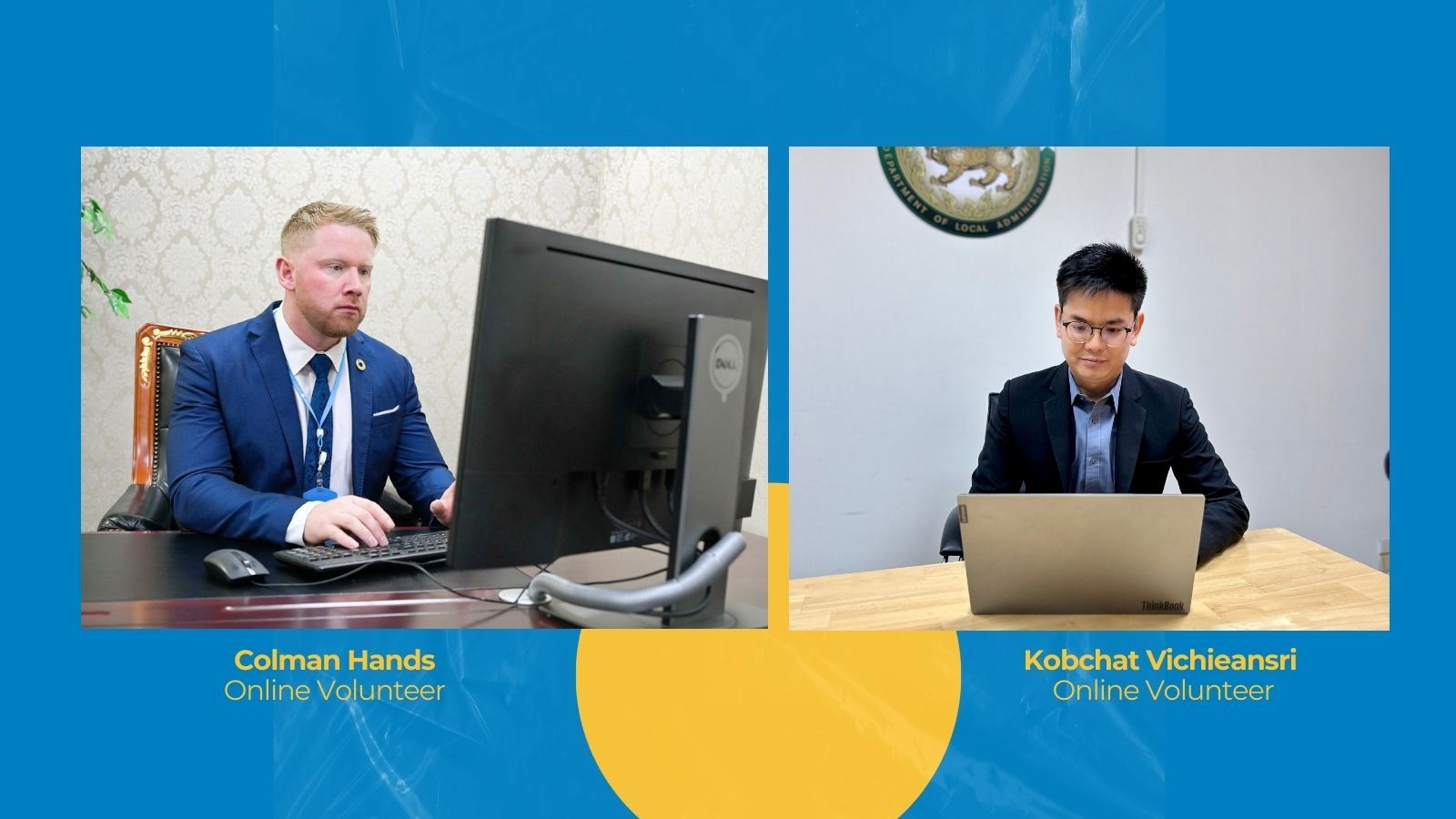
“Our laptops and tablets can be like a magic wand—transforming ideas into action and making our world more livable and hopeful,” says Kobchat Vichieansri, an Online Volunteer from Thailand. His words capture the essence of online volunteering: the ability to turn skills, time, and intent into real‑world impact, regardless of location. From analysing complex energy data to shaping cutting‑edge learning content, Online Volunteers are helping the United Nations Development Programme (UNDP) Sustainable Energy Hub scale high‑impact knowledge that supports countries in accelerating their energy transitions and advancing Sustainable Development Goal 7.
Working remotely across borders and time zones, Online Volunteers embed global expertise directly into UNDP’s daily work—proving that impact is no longer bound by geography. Like Kobchat, Colman Hands, is also an Online Volunteer. He is an accomplished energy and sustainability professional, with a graduate degree in Sustainability and Environmental Systems and a bachelor's in Project Management. Colman currently serves as Director of Sustainable Energy at The Al-Attiyah Foundation in Qatar and leads programmes on energy transition, climate policy, and sustainable development. He also chairs the Energy and Environment Commission at the International Chamber of Commerce (ICC) in Qatar.
Colman’s motivation speaks to a belief that expertise carries a responsibility—to be shared in service of others. He says that knowledge shared becomes a force multiplier.
“I found this Online Volunteering experience highly rewarding and aligned with my professional values” shares Colman. “It was a privilege to contribute to UNDP’s work on sustainable energy and support the Sustainable Energy Academy as a global public good.”
On the other hand, Kobchat Vichieansri is a Thai civil servant at the Ministry of Interior and works on policies relating to public health and the environment. He has a doctorate in Public Administration, a graduate degree in Public Policy and Environment, and a bachelor's in Political Science. He has also collaborated with the Japan International Cooperation Agency (JICA) on community-based waste management and served as an adviser to the Thai Parliament. He says, “Even though the UNDP collaboration was fully online, the experience felt just as meaningful and impactful as working onsite. It reinforced my belief that value comes from purpose and contribution, regardless of location.”
Online Volunteers described the working environment with UNDP as highly supportive, with well-scoped tasks, and timely guidance from focal points, Benjamin Keller and Farida Razaqi, who cultivated a team dynamic that felt “like one family, a family called our world.”
Over just three years, the Sustainable Energy Hub has tapped into a distributed workforce of over 100 Online Volunteers, mobilizing an estimated 6,000 hours of specialised technical expertise—without borders or offices.
Working seamlessly across regions and time zones, Online Volunteers have pushed the Hub’s work further and faster, expanding the scale, depth, and geographic reach of its initiatives—from data and analytics to learning content, design, translation, and communications.
One notable example is the Energy Cooling Preparedness Index, where Online Volunteers contributed to the systematic review and coding of national cooling policies across more than 100 countries. Their work went beyond identifying whether policies existed, but also capturing legal status, equity considerations, financing mechanisms, and alignment with international commitments. This strengthened the analytical depth of the index and enabled new analyses that would not have been possible within existing staff capacity or timelines.
“Initially we thought of Online Volunteers as a way to expand our capacity. However, what has impressed us most is that actually many of them are leading professionals in their fields such as energy, data, policy, and design, and when that expertise begins to converge it allows us to pursue ideas at a scale that would otherwise be impossible.” says UNDP focal point, Benjamin Keller.
UNDP notes that working with large groups of Online Volunteers—especially on technical tasks—can be challenging at the start to figure out how to balance management across time zones, quality assurance, deadlines, and communication. These challenges are reduced when assignments are clearly defined, supported by simple templates and standards, and guided with light coordination. When this foundation is in place, Online Volunteers consistently deliver high‑quality results.
The knowledge products developed with Online Volunteers now support UNDP’s learning, policy discussions, and capacity‑building work. By treating sustainable energy not just as a technical issue but as a people‑centred development pathway, these materials respond to diverse realities—from cities to remote communities, and across generations.
Online Volunteering proves that impact doesn’t begin with a plane ticket or a job title—it begins with the decision to contribute.
“I believe everyone can be a volunteer. Simply by being born into this world, we are already members of this global community. To anyone reading this story, I would say: please do not hesitate. Join the UNV community and be part of building a better world.” says Kobchat. “No matter where we are or what we are doing, we can still create good things together.”
In the hands of Online Volunteers, laptops and tablets become magic wands—turning ideas into action, skills into solutions, and distance into possibility. And with every click, a more livable and hopeful world comes into clearer reach.