



At the end of 2025, the fifth edition of the State of the World’s Volunteerism Report (SWVR) landed—and it did not arrive quietly. This was not a routine publication to skim and shelve. For me, as a member of the High Level Advisory Group, it marked the culmination of intense intellectual work, difficult questions, and an unambiguous challenge to how we understand power, participation, and solidarity in today’s world. This Report demanded attention, which may I say, it so rightfully deserves.
I was among the very first to open its pages. At the #WEARETOGETHER International Forum in Moscow, our Chief Expert, Vyacheslav Ivanov, and our Director, Irina Mersianova, received a freshly printed copy directly from Dr. Tapiwa Kamuruko, Chief of the Volunteer Advisory Services Section from the United Nations Volunteers (UNV).
Holding that Report, I felt the weight of shared responsibility. This was the result of sustained collaboration between our Center and international experts who refused to settle for easy answers. It is precisely why this work matters to me—and why it should matter to anyone serious about understanding where civic engagement is headed next.
Since 2011, every edition of the SWVR has featured substantive contributions from the Center for Studies of Civil Society and the Nonprofit Sector at the Higher School of Economics, and the 2026 edition is no exception. What sets this latest edition, Volunteerism and its Measurements, apart is its ambition: to deepen global understanding of volunteering while demonstrating both its universality and its vital role in local communities. It also arrived at a highly symbolic moment—the 55th anniversary of UNV, the UN's designation of 2026 as the International Volunteer Year, and, most significantly, the halfway point of the Sustainable Development Goals. As the world enters the second half of the Decade of Action, the need to assess the impact and integration of volunteering into the 2030 Agenda has entered a decisive phase.
Preparing the 2026 SWVR edition required a truly international and interdisciplinary approach. UNV brought together leading scholars in a broad research consortium. After nearly three years of collaboration, this collective effort matured into a resource of genuine depth and scope.
Since 2007, the Center for Studies of Civil Society and the Nonprofit Sector at the Higher School of Economics has been tracking Russian civil society with rigor and consistency—mapping the rise of volunteering and philanthropy, and the changing role of nonprofit organizations.
We don’t just observe trends; we measure impact. Through tools such as social accounting, social return on investment, and social auditing, we have helped redefine how the economic and social value of volunteering is understood and evaluated.
That expertise runs throughout the 2026 Report. Our work is cited directly, from our textbook on volunteer management for socially oriented NGOs (developed with support from the Ministry of Science and Higher Education of the Russian Federation), to detailed explanations of our methodologies in chapters nine and ten, to references to our earlier research on the UNV Knowledge Portal. The Report also draws on key statistical sources we recommended, including data from the Ministry of Economic Development and the national Dobro.RF platform.
The Report advances beyond narrow, quantitative measures and calls for a paradigm shift toward multidimensional qualitative indicators. Its perspective is international and inclusive, challenging the myth that volunteering is primarily a feature of the Global North and highlighting the importance of informal practices and diverse voices from across the Global South.
The Report also places volunteerism in the context of urgent global challenges, including climate change, migration, and contemporary social crises.
One of UNV’s most compelling breakthroughs is the launch of a new Global Index for Volunteer Engagement: GIVE. Built in response to longstanding critiques of narrow, one-dimensional assessments, the index breaks new ground. It captures not only how volunteering affects people, communities, and economies (2026 SWVR, p. 94), but also the wider conditions that make volunteering possible—or impossible—in the first place. The name itself is no accident. GIVE speaks to action, agency, and purpose. Designed for everyone from policymakers to volunteers on the ground, the index goes beyond measurement: it offers clear, practical recommendations aimed at strengthening volunteerism worldwide.
These innovations are not academic exercises; they are proof of the Report’s refusal to stand still. They reflect a clear commitment to pushing both theory and practice forward—and to doing so with evidence, discipline, and ambition.
To see our Center’s work so deeply embedded in this Report, and to know that I helped shape its direction, is more than a professional milestone. It is a confirmation that the long years of research, debate, and collaboration mattered.
As the world presses ahead on the path to sustainable development, one thing is clear: volunteerism can no longer be measured lightly. These new approaches to understanding its impact do more than inform policy—they give volunteerism the weight it deserves, strengthening it as a decisive force for positive, lasting change.
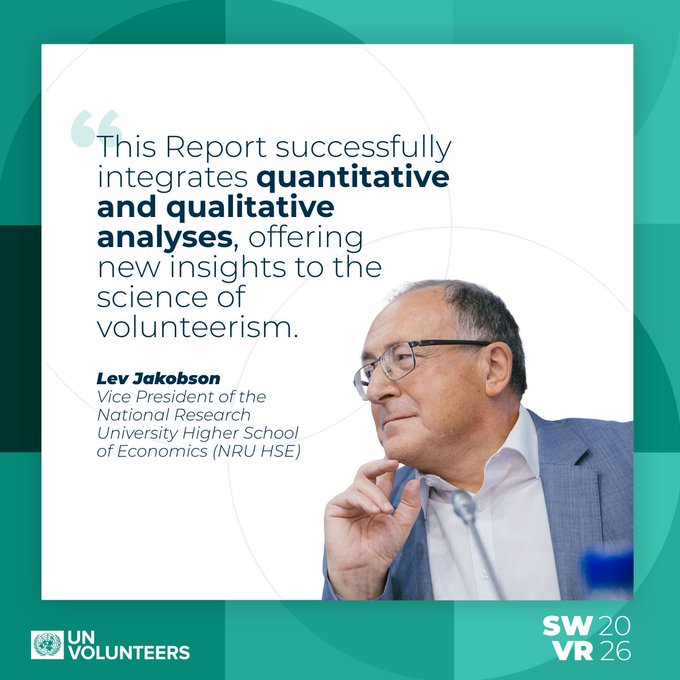
Professor Lev Ilyich Jakobson is Vice President of the Higher School of Economics and Academic Supervisor of the Center for Studies of Civil Society and the Nonprofit Sector. A Doctor of Economics, he served on the UNV High-Level Advisory Group for the 2026 SWVR.