



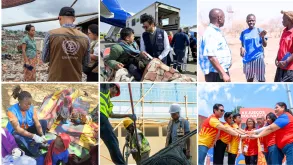

For more than half a century, several traditional development partners have been among the most consistent backers of global solidarity through the United Nations Volunteers (UNV), quietly supporting, funding and sustaining it. Since UNV’s creation in 1970, traditional development partners have remained among its most consistent supporters. For example, Europe’s imprint on UNV is visible in leadership, participation, and policy influence. Four of UNV’s ten Executive Coordinators have come from European countries. Between 2007 and 2025, around eleven per cent of all UN Volunteers originated from the European Union or traditional European donor countries. European governments have also consistently spoken in support of volunteerism at the UNDP Executive Board and backed global commitments such as the declaration of 2026 as the International Volunteer Year.
The contribution of traditional partners to UNV is not symbolic. It is practical and strategic.
Through the Full Funding programme, governments directly finance volunteer assignments aligned with their thematic priorities and geographic focus. They are also among the largest and longest-standing contributors to the Special Voluntary Fund, an unearmarked mechanism that allows UNV to respond rapidly to crises, support inclusion and diversity, and promote volunteerism globally.
In concrete terms, this means volunteers can be deployed where needs are most acute and where global challenges intersect with national priorities—whether in humanitarian emergencies, development contexts, or fragile settings.
Taken together, the elements point to an underlying pattern of investment through the collaboration with UNV, including a deliberate choice to invest in people, institutions, and global cooperation. That commitment, however, is not a given. Government contributions are scrutinised annually amid competing domestic priorities, fiscal constraints, and political realities.
At the same time, something more subtle is changing. While earlier partnerships focused primarily on technical assistance, today’s discussions increasingly revolve around co-creation, inclusion, and global solidarity. UNV is a platform to shape the future multilateral workforce—strengthening employability, building intercultural competence, and deepening mutual understanding of development challenges.
UN Volunteers themselves echo this shift. On one side, they contribute skills, knowledge, and capacity to the UN and the communities they serve. On the other hand, their testimonials consistently describe meaningful experiences with greater understanding of complex contexts, strengthened professional skills, and a two-way exchange of knowledge that benefits both institutions and individuals.
UNV’s partners in Europe have continued to expand their support. In recent years, countries including Germany, Iceland, Ireland, Luxembourg, Sweden, and Switzerland have sponsored UN Volunteer assignments for candidates from a wide range of nationalities.
Dedicated placements for persons with disabilities, supported by Finland, France, Germany, Sweden, and Switzerland, are also helping make the UN a more inclusive workplace. Switzerland is further supporting marginalised youth in Tunisia through targeted volunteer opportunities.
Contributions to the Special Voluntary Fund in 2025 have enabled volunteer deployments in crisis settings such as Gaza, Myanmar, Syria, and Ukraine, while also supporting global initiatives focused on youth, women, persons with disabilities, and Indigenous peoples.
These are values and principles translated into practice, but did you know about them?
In an era of growing global economic pressure, geopolitical tensions, and questioned multilateralism, what is the best form to highlight the message of global solidarity and get more support?
If the outcomes aren't visible, they will be written off, no matter how real they are. In a tightening scenario, visibility is what allows good work to translate into continued support. It is what keeps volunteerism on the agenda, internally and beyond.
At a time like this, the choice matters: Actively advocate the impact or let its quiet consistency speak for itself. A decision that will shape how far this model of solidarity travels beyond its borders.