


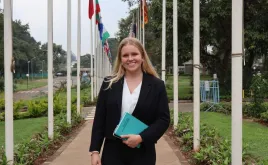
Long before she joined the United Nations, service was already part of Inka Hyttinen’s story. Born in Finland and raised in Hong Kong, she grew up between cultures, never quite belonging to one place yet feeling connected to many. By eight, she was raising money for charities. At 17, that instinct to serve took her to Nepal, where she founded a small nonprofit focused on women’s empowerment, youth development and microfinance. Years later, that journey would continue through a UN Volunteer assignment funded by Finland.
Inka studied human diversity, exploring societies, cultures and development. Then came an unexpected detour. Curious about the rapidly changing digital world, she pursued a master's degree in cyber ethics and briefly entered the technology sector. It did not take long to realize something was missing.
"The focus was often on investors and profits," Inka recalls. "I wanted to be closer to people and the issues that matter." That search led her to the United Nations Volunteers (UNV) and ultimately, to Kenya.
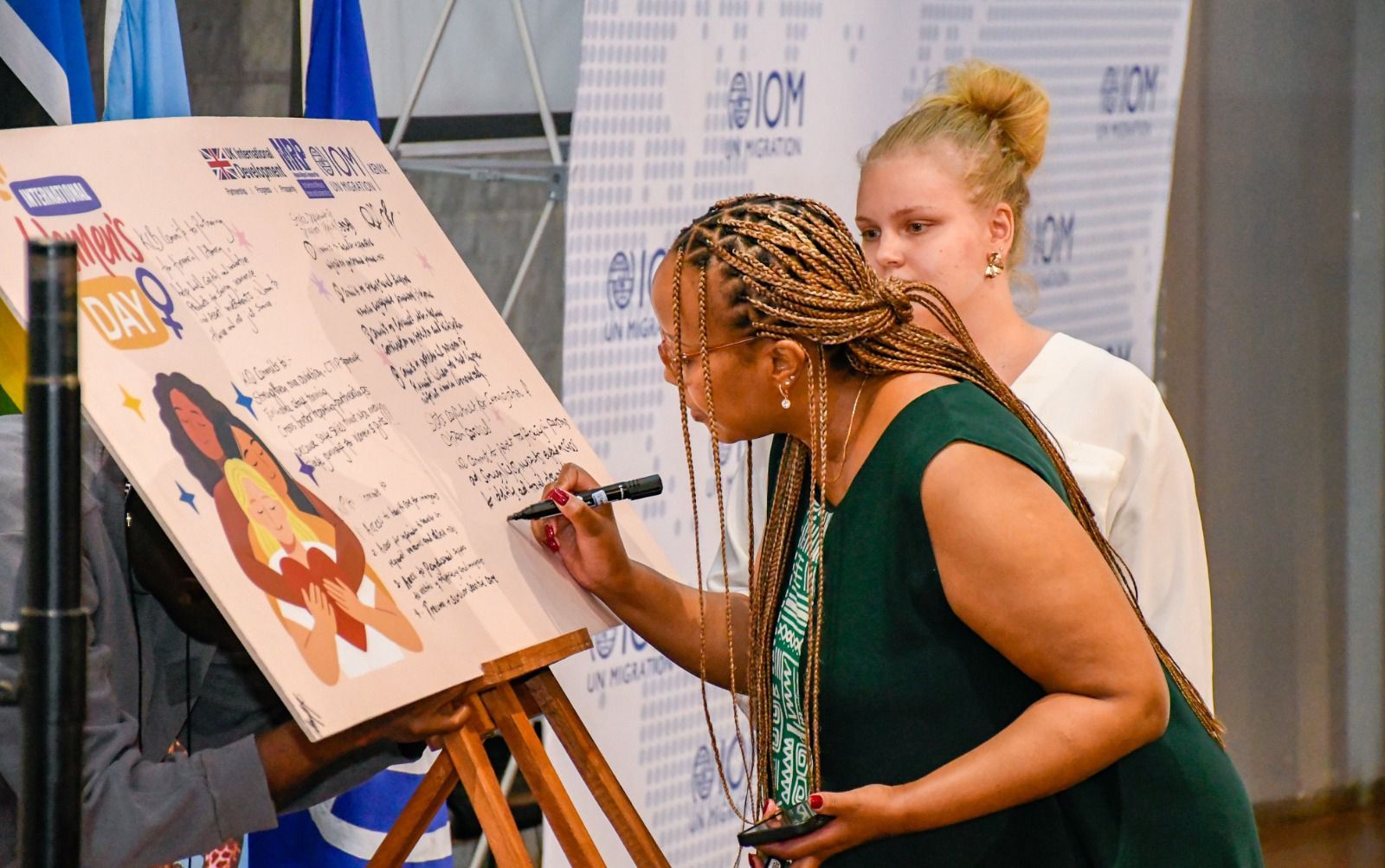
The assignment as a UN Volunteer felt almost destined. She had long been fascinated by East Africa, particularly Tanzania and the Swahili language. When an opportunity opened in Kenya, everything seemed to fall into place.
From 2024 to July 2026, Inka served as Programme Officer for Youth, Prevention of Radicalization at UN Women in Kenya, working at the intersection of some of the country's most complex challenges: youth unemployment, violent extremism, election-related violence and gender inequality. "It's impossible to look at these issues in isolation," she says.
Kenya has one of the youngest populations in the region. While that presents enormous potential, it also creates risks when young people feel excluded from economic and civic life. In some communities, extremist groups exploit those frustrations. In drought-affected regions near the Somali border, where access to services can be limited, armed groups sometimes step into gaps left by the state, providing basic assistance and gaining influence in the process.
"People are often looking for opportunity, purpose and belonging," Inka explains. "That's what makes prevention work so important." Her role spanned three areas: supporting programmes, helping shape policy and building partnerships.
Together with civil society organizations, government agencies and fellow UN partners, Inka helped develop initiatives that relied more on expertise and collaboration. She introduced more innovative, technology-based approaches to peacebuilding and prevention work while preparing concept notes that could later attract donor support.
At the same time, Inka became part of a historic effort: helping develop Kenya's first National Action Plan on Youth, Peace and Security. She contributed to drafting, reviewing and refining the policy, working closely with government counterparts, civil society organizations and fellow UN agencies. The process involved months of consultations, countless meetings and endless revisions. But for her, that is where real change begins. "You sit in a room listening to people talk about what's happening in their communities," she says. "That's when policy stops being a document and starts becoming something real."
Another passion has been bringing to the fore grassroots voices, particularly those of young women peacebuilders working far from the national spotlight. Inka developed communication initiatives that helped bring their stories to wider audiences through social media and online platforms. Many of these women are doing remarkable work in their communities, she says, but rarely receive recognition. "Their stories deserve to be heard."
Along the way, she also found herself unexpectedly leading. As staffing changes and resource constraints reshaped the office, she gradually assumed more responsibilities, eventually serving as Officer-in-Charge of the Women, Peace and Security unit. The experience came with challenges. New supervisors, shifting expectations and evolving priorities sometimes created uncertainty.
One lesson stood out above all others: communication matters. "Not just at the beginning," she says. "You have to keep managing expectations and having honest conversations throughout."
Looking back, Kenya has taught her far more than policy and programme management. It has given her a front-row seat to how governments, civil society organizations and the UN work together.
It has taught her the importance of partnerships, adaptability and patience. It has shown her how complex change can be, and how much progress depends on relationships. Most of all, it has reinforced something she has known since childhood: meaningful work is built around people.
While Inka remains open to continuing with the UN system, she is also drawn to more field-based work, closer to the people and places where change happens.
In some ways, Kenya brought Inka closer to home. Growing up abroad, she had often felt she was not quite “Finnish enough.” Her Finland-funded UN Volunteer assignment with UN Women gave her a new connection to those roots, while allowing her to remain true to the international identity that shaped her.
"It felt like a sweet spot," she now reflects. "I can be connected to Finland while still being international, because that's who I am. I've always felt like I belong everywhere in the world."