



Ecuador is a country of remarkable natural beauty and rich cultural heritage. Yet, beneath this diversity lies a deepening need for the inclusion of Indigenous Peoples and local communities. Indigenous Peoples have endured marginalization, and while the Constitution enshrines the principle of interculturality, genuine dialogue remains fragile and uneven. Within this complex context, Noémie Dreux assumes a pivotal role. She is a UN Volunteer Conflict and Violence Prevention Specialist with the United Nations Development Programme (UNDP). Her volunteer assignment is funded by the Government of France.
“Ecuador is marked by a long history of exclusion of Indigenous peoples and fragile intercultural dialogue, which continues to generate tensions,” Noémie explains. “Despite the Constitution recognizing the country as intercultural and plurinational, there is still a limited understanding of what these concepts truly mean, both in principle and in practice”.
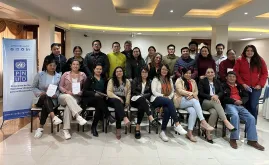
To help bridge this gap, as part of a broader portfolio on dialogue and conflict prevention, Noémie designs and leads capacity-building on interculturality and conflict prevention for local government, academia, and civil society. She also conducts vulnerability analyses for social cohesion and to address the root causes of conflict.
Each day with UNDP can be very different. Our work is highly dynamic, adapting to changing priorities and the range of processes we engage in”, says Noémie. “One day might involve meetings with the Ministry of Interior, the Ministry of Government, and actors from the international cooperation to build on joint efforts for security and social cohesion; another could take me on field visits into remote communities.”
Noémie’s work is firmly anchored in the UN’s peace and development pillars: “Conflict prevention and social cohesion sit at the heart of both,” she reflects, “strengthening peace is a prerequisite for sustainable and inclusive development, just as inclusive and participatory development is essential for lasting peace.”
Currently, she and her team, in partnership with the Inter-American Development Bank, are supporting the Ministry of Interior in developing a National Plan for Citizen Security. Ecuador is facing its worst insecurity and violence crisis in recent history, with an increased presence of organized crime. Yet, even in this challenging context, opportunities for solutions and prevention remain. “One of the challenges of this work”, she explains, “is to promote a balanced approach that combines crime control with preventive interventions targeting the structural drivers of violence and insecurity, including exclusion, limited access to basic services and socioeconomic opportunities, and governance gaps”.
Her two-year UN Volunteer assignment provides a clear benefit: continuity on the ground. “Unlike short-term or uncertain funding mechanisms, this assignment enables continuity in engagement with national and local counterparts and a deeper understanding of the country’s institutional and political dynamics,” she explains. “Such continuity strengthens partnerships and reinforces the institutional anchoring of our work.”
International development efforts are sometimes perceived as not being fully aligned with realities on the ground. Spending two years here allows me to develop a deeper understanding of national priorities, local voices, territorial dynamics and existing challenges, alongside more sustained engagement with actors across levels,” she shares. “In turn, this enhances the effectiveness of technical support.”
Noémie is one of many volunteers worldwide who embody the spirit of the Professionals with Purpose campaign. Her work reflects a deep commitment to the UN’s core mandate.
To me, being a UN Volunteer with UNDP means contributing to an organization whose values and mission I strongly identify with,” she says. “It is about promoting social justice, social cohesion and addressing exclusion, inequalities, and discriminatory dynamics.”
Addressing the root causes of conflict is where change begins—and where volunteers like Noémie plant seeds of hope for inclusion and peaceful coexistence.
The story was also published on UN.org