



You do not forget places like Mbire—a remote district in northern Zimbabwe. The heat. The dust. The quiet between the homesteads. But more than anything, you remember the people. Their strength. Their stories. Their steps forward, even when the odds are against them.
I recently travelled to Mbire with the United Nations Development Programme (UNDP) Zimbabwe communications team. As a UN Volunteer, my job was to help tell the stories of women and families we met. We were documenting the impact of a One-stop Centre provided by UNDP in collaboration with the Zimbabwe Gender Commission. The initiative started in response to alarming findings from a national inquiry on child marriages and abuse of young girls, including those with disabilities.
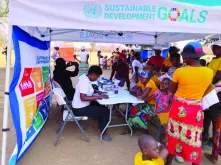
The centre is a mobile hub offering access to essential services that many in rural areas cannot easily reach. Here, more than 200 women receive sexual and reproductive health support every day. More children were issued birth certificates. Numbers on paper, but each one a story. And a moment of progress.
During my visit to the district, I met Chipo (name changed to protect her identity). She arrived at the centre with a month-old baby and left with milk supplements and a birth certificate. A survivor of gender-based violence, she walked away with more than papers. She had taken her first step toward a safer, more secure life for her child. That one piece of paper meant access to healthcare, education, and protection.
But Mbire also opened my eyes to the realities that so many girls live with. Teachers and local leaders spoke to us about early marriage and school dropouts. At one primary school, 16 girls had already left without finishing the seventh grade. Most of them were either married off or pregnant. One story hit hard. A 12-year-old girl, Muchaneta, had dropped out after becoming pregnant. She lived on her own. She stole food to survive. Another girl, Nyadzisa, was married at 17. She returned home after being rejected and starved by her husband’s family.
These are not isolated cases. In 2023, more than 4,500 girls across Zimbabwe dropped out of school due to pregnancy. Most of them were from rural districts like Mbire.
Even so, there is hope. People in Mbire want change. They want to be heard. They want their children to have better options.
Working in communications, I see storytelling as a way to advocate for that change. We captured photos, videos, quotes—whatever would help amplify the voices of the community. We were not there to speak for anyone. We were there to help make sure people could speak for themselves.
One photo of Chipo holding her baby quietly went far. It helped people connect with the reality on the ground. It reminded our audience that behind every statistic is someone trying their best with what little they have.
The mobile centre is part of a wider set of efforts by UNDP in Zimbabwe, integrating into initiatives that advance legal reform, promote gender equality, strengthen healthcare access, and empower communities. By delivering essential services directly to underserved areas, it bridges critical gaps—especially for women and girls—where formal support systems are limited or nonexistent.
For me, volunteering with UNDP means more than just telling stories. It means being part of something that connects people to the systems meant to serve them. It is about asking real questions, not just collecting quotes. It is about making sure voices like Chipo’s do not disappear into silence.
I left Mbire with mixed emotions. The challenges are real, and the road is long. But I also saw signs of something shifting. I saw mothers determined to protect their daughters. Girls ready to speak out. Teachers refusing to give up.
These stories matter. They show us where the gaps still are. But they also show us where things are starting to change. And as a UN Volunteer, I am proud to help carry those stories forward.