



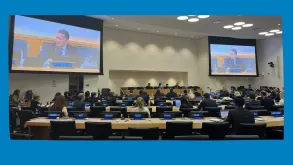
Toily Kurbanov, Executive Coordinator of United Nations Volunteers (UNV) presented the 2024 Annual Report of the Administrator at the Executive Board in New York on 5 June 2024. The Executive Board consists of the United Nations Development Programme (UNDP), the United Nations Population Fund (UNFPA) and the United Nations Office for Project Services (UNOPS).
Distinguished Delegates,
It is always an honour to address the Executive Board. Though I must confess—summarizing the annual report of United Nations Volunteers is a bit like trying to tweet War and Peace. But I will try to do it justice. I also look forward to your guidance and questions from the board members and the observing delegations afterward.
In previous sessions, answering the delegations’ queries felt like being on a quiz show—just you don’t get a chance to phone a friend. On that note, I thank the presence of the Associate Administrator, Mr. Haoliang Xu, in the audience as well.
I’ll structure my remarks around five frequently asked questions that we often hear about the work of the United Nations Volunteers and the answers, which are provided in this year’s UNV Annual Report.
- The most frequently asked question that we get is: What exactly do UN Volunteers do—and are they really needed? As well as acknowledged by the Associate Administrator a few minutes ago. In 2024, almost 15,000 United Nations Volunteers served in 169 countries. Their roles were shaped by the local context—ranged from community development and women’s empowerment, and from human rights to humanitarian coordination. They were not support staff. They are the frontline actors. So, yes—United Nations Volunteers are needed. More importantly, they are relied upon.
- The second frequently asked question is: Who are these volunteers? Some still think volunteering is something people from the Global North do for the Global South. However, UNV proves otherwise. In 2024, United Nations Volunteers represented a record 181 nationalities. Two-thirds served in their own countries, meeting local challenges with local knowledge. 57 percent were women, and there were more youth, older citizens and persons with disabilities than ever before. So we can say that the engagement of United Nations Volunteers is not just capacity building but it's the national ownership beginning from the grassroots level. And in every respect, UN Volunteers represent the world’s talent and determination.
- Third question is How quickly can UNV respond to crises and emergencies? In 2024, we made new breakthroughs in our operational agility. A national volunteer could be deployed in 23 days. An international one in 72. In a crisis, getting there fast can be the difference between impact and irrelevance. When urgency calls, UNV answers.
- Question number four: Is UNV adapting to the digital age? Absolutely. As the Report presents, over 20,000 Online Volunteers supported the UN system, governments, and the civil society in 2024. Their contributions ranged from data analysis to graphic design, from translation to public advocacy campaigns. This is not simply digitalization of volunteerism. It is democratization—because we remove the geographic barriers, expand access, and enable volunteer talent to serve wherever they reside.
- Ladies and gentlemen, a lot has changed since the report’s writing. So the fifth question most frequently asked question is: Can UNV withstand the financial turbulence that is shaking much of the United Nations system? Indeed, while UNV started 2025 building on the momentum of the Strategic Framework in recent months, many doors closed. Funding cuts across the UN system resulted in the termination of hundred UNV assignments, several UN partners have paused recruitments.
Yet UNV is meeting the challenge with calm resolve. We are reinforcing our field presence, strengthening teams in high-demand locations and decentralizing support functions. We are streamlining our processes, deepening digitalization, and staying laser-focused on agility and efficiency. And we are building new partnerships—with IFAD, PAHO, the World Bank group—expanding vital system-wide networks of UNV.
And so if I were to recap the five questions:
- Are United Nations Volunteers needed?
- Do they represent the world?
- Can they act fast?
- Are they future-ready?
- And will they weather this storm?
This report's answer is yes, yes we can, yes we are, and yes, we will.
Mr. President, Members of the Board, this year is not just about resilience—it is also about forward momentum. In 2025, we’ll work on UNV’s next Strategic Framework in consultations with the Executive Board. And we’ll also support all Member States in preparing for the 2026 International Volunteer Year.
Ladies and Gentlemen, in conclusion: Contributions most essential to long-term peace and development are also those that are the least likely to command immediate attention. Volunteerism is one of them. And therefore, even in this difficult year, UNV remains as committed as ever to enable thousands more United Nations Volunteer stories—similar to that you’ve watched at the beginning of the presentation on video.
Because volunteers are the human face of the United Nations.
Because volunteers deliver results at the grassroots level, the close last mile to the communities.
And, above all, because every United Nations Volunteer embodies the values on which our Founders created the United Nations 80 years ago.
Thank you.
______________
Please read the 2024 Annual Report of the Administrator here. Annexes here.
Please click below to see the UNV video shown to the Board before the Executive Coordinator's remarks.