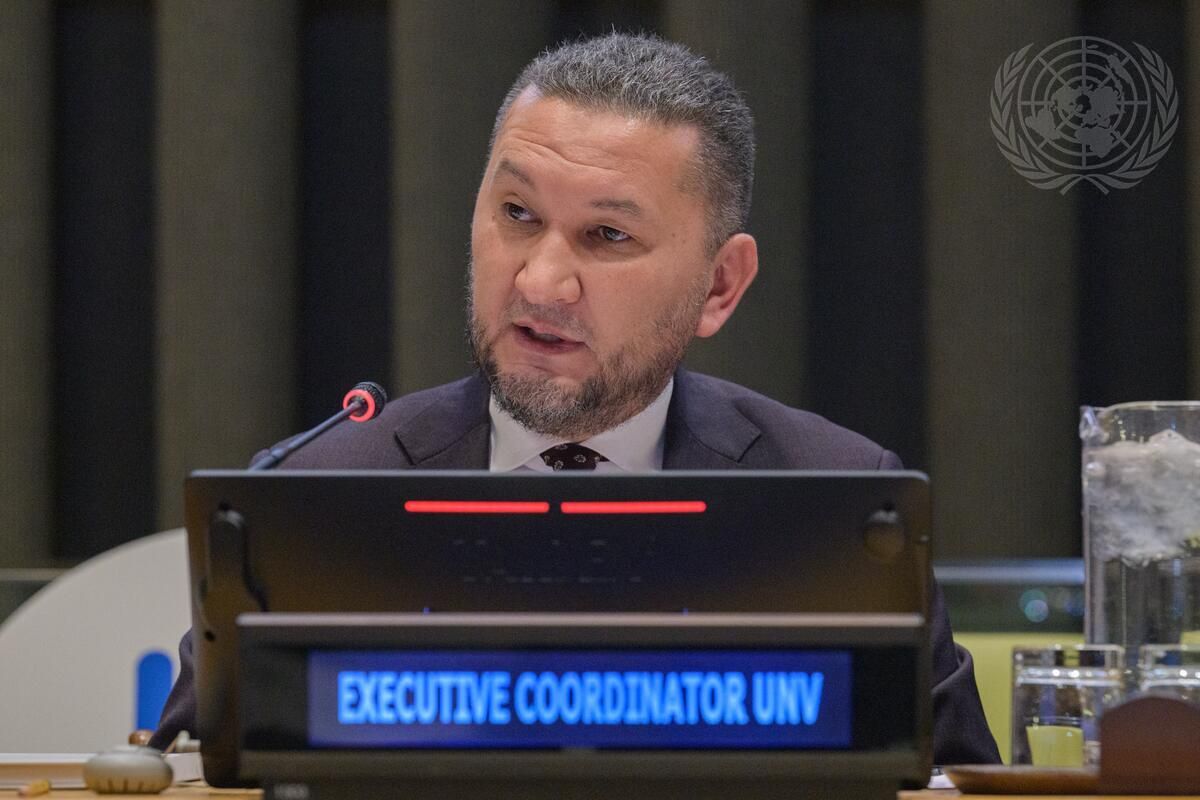
Toily Kurbanov, Executive Coordinator of the United Nations Volunteers (UNV), delivered remarks at the global launch of International Volunteer Year 2026 and the State of the World’s Volunteerism Report at the United Nations in New York. Speaking on International Volunteer Day on 5 December, he highlighted the global impact of volunteers in peace, development, and human rights.
Madam President of the General Assembly, my fellow co-conveners, Excellencies, distinguished delegates, ladies and gentlemen,
I stand here with the International Year 2026 logo in one hand and the 2026 report in the other.
This means either of two things:
First: it must be January somewhere.
Second: someone has decided to start the International Year a little early.
Frankly, this is exactly what you would expect from volunteers.
They are the first to arrive, the last to leave, and occasionally show up before the calendar allows them to do so.
⸻
Today, we pause to applaud volunteering for sustainable development—a quiet force that helps societies far more than we admit.
Volunteers are our invisible stabilizers. And as with all stabilizers, we notice them only when they are missing.
We did not realize that in Afghanistan—until a woman volunteered to teach math to young girls barred from formal schooling. One woman, one room — and suddenly the future looked less impossible.
We did not realize that in Ukraine—until a retired shopkeeper began delivering medicine to elderly neighbours. No funding, not even a press release—just a man with a list, a bag, and a sense of duty.
We did not realize it during the pandemic—when millions volunteered in nursing homes. They cared for the most vulnerable. And if you ask them why, they’ll say simply: “Someone had to.”
And we barely realize it now: in New York and Novosibirsk, Geneva and Jakarta, Maputo and Milano—where, through thousands of acts, volunteers prevent small stresses from becoming big crises.
Today is indeed the moment to see them, to stand with them, and to support them.
⸻
Volunteers face three persistent challenges: recognition, empowerment, and measurement.
Recognition: as moral capital may eventually become moral fatigue. Volunteers may not demand applause—but they do need visibility.
Empowerment: as goodwill cannot substitute for structure. Volunteers need tools, training, protection, support—and yes, a degree of authority to act. Imagine a volunteer in a flood delivering relief supplies rather than filling out a form. A radical idea in the UN—I know.
Measurement:
Because what we don’t measure, we don’t fund;
what we don’t fund, we don’t sustain;
and what we don’t sustain becomes, at best, a heartwarming story we repeat at next year’s “UN side event”.
Measurement is not a technical debate. It is the difference between intention and impact.
⸻
That’s why today we also launch the State of the World Volunteerism Report — a flagship knowledge product by UNV and researchers worldwide.
You will notice the cover is white. No, the printers did not run out of ink. And yes, AI could have designed a fancy cover, something with a handshake, a glowing heart, and a UN logo above it.
But the blank cover symbolizes something important: the unseen labour of volunteers and the gaps in our data. Perhaps this report should be judged by its cover.
Among the findings: researchers estimate that one-third of the world’s working-age population volunteers at least once a year. Given the co-conveners of today’s event—Germany, Kazakhstan, and UNV—I can confidently say at least one of us is part of that statistic. I will not specify who. But maybe all three will engage in a volunteering act next year. No pressure!
Another finding is less surprising but more urgent: volunteer activity is enormous, but global data remains patchy, inconsistent, and not often comparable. We have stories everywhere—but reliable data almost nowhere.
That is why the report’s main recommendation is simple and practical: integrate standardized volunteering modules into household and labour surveys; and embed volunteering indicators into national development plans and budgets.
And another recommendation: establish a Global Index of Volunteering — one that reflects both the impact of volunteers and the enabling environment they require.
In other words: let us finally measure what we’ve been applauding for years. And let us celebrate the global impact volunteers will be making.
⸻
The International Volunteer Year 2026 should be a year of gratitude, of course — but also a year of structural change.
A year in which solidarity is given tools, protection, and measurable support.
A year in which volunteering is understood not as charity at the margins, but as an asset at the core of peace, development, and human rights.
And as the UN embarks on its ninth decade, let us reflect: institutions change, political winds shift, budgets grow and decline—but the human impulse to help persists.
You will see: for the volunteers of our planet, even the sky will not be the limit.
Thank you.
Merci beaucoup.
Xie xie.
Shukran.
Muchas gracias.
Спасибо.
And, on behalf of the co-conveners:
Vielen Dank and Көп рақмет.