For more than two decades, development policy and practitioners have returned to the same unresolved question: how do we measure volunteering in ways that make it visible without losing sight of what it truly is?
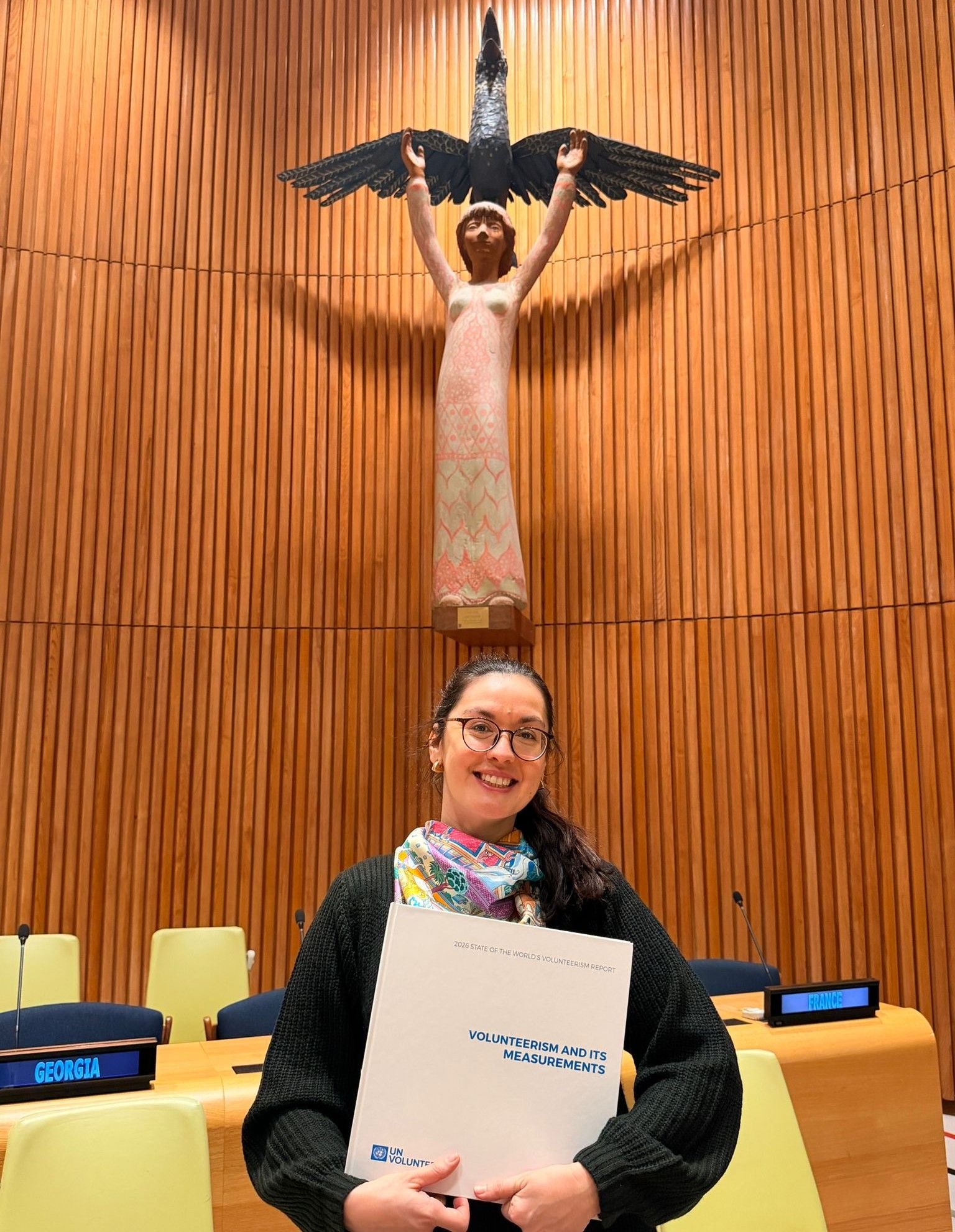
Working together with the team of researchers on the 2026 State of the World’s Volunteerism Report (SWVR) “Volunteerism and its measurements”, as well as listening to governments, practitioners and volunteers around the world did not resolve that question for me. Instead, it sharpened my understanding of why it sits at the heart of broader debates on how we define progress. What is the value people create for each other and for society every day?
In line with the UN Secretary-General’s Our Common Agenda, the discussion reflects growing efforts to complement Gross Domestic Product (GDP) with measures that better capture wellbeing, social cohesion, and sustainable development. Volunteerism sits squarely within that gap between what matters and what is measured. However, volunteering, mutual aid, and civic participation are largely absent from traditional economic metrics.
This debate is a familiar one. What we choose to count reflects what we value. For years, volunteerism has struggled to fit within development’s dominant measurement frameworks precisely because it produces value that is relational, collective, and often informal.
A key focus of the Report was estimating the scale of volunteering despite the scarcity of reliable and comparable official data. Saying that approximately 2.1 billion people volunteer every month was undeniably important. It challenges the idea that volunteering is incidental to development processes.
At the same time, headline figures can obscure as much as they reveal. Such figures convey magnitude, but not meaning—presence, but not agency, or inclusion.
Headline numbers can signal scale, yet they are easily misunderstood when read without context. This tension informed the development of the Global Index of Volunteer Engagement (GIVE). Rather than focusing solely on participation rates, GIVE seeks to capture how volunteerism contributes to individuals, communities, economies, and the systems that enable people to act. The intent was not to “solve” the measurement problem, but to shift the conversation—away from narrow counts and toward multidimensional value.
Still, informal volunteering remained the hardest to capture. Neighbours helping neighbours, families supporting one another, communities responding to crisis long before formal institutions arrive—these are the forms of action most closely linked to social cohesion and resilience, and yet they resist standard metrics. Each attempt to measure them exposed the limits of our tools, and, at times, our assumptions.
In that sense, the volunteerism measurement debate mirrors the broader Beyond GDP agenda. Both challenge us to acknowledge that some of the most important aspects of development are not easily quantified, and that insisting on precision can sometimes come at the cost of relevance. The task, then, is not to abandon measurement, but to approach it with greater humility.
It is not easy to arrive at a definitive way to measure volunteerism. The more meaningful challenge is to develop measurement approaches that combine data with context, quantitative evidence with lived experience, and indicators with listening.
Seen this way, the 2026 State of the World’s Volunteerism Report is less an answer than a challenge. It calls on governments, institutions, and practitioners to treat measurement not as a technical fix, but as a political and social choice—one that must be co created with volunteers, grounded in local realities, and used to strengthen the systems that enable people to act for the common good.
The policy consideration it ultimately raises is this: If volunteerism underpins social cohesion, measuring it should be standard for guiding public investment, designing inclusive institutions, and setting development priorities. The time to act is now—governments must lead this change.