



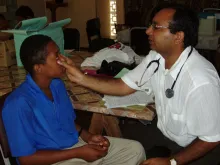
Dr. Mukeshkumar Prajapati may have stopped carrying the UN Volunteer title years ago, but he never stopped carrying its spirit. Across earthquakes, cyclones, Ebola and COVID-19, his instinct has remained the same: when others step back, he steps forward.
In 1999, a cyclone struck Odisha in eastern India.
Mukeshkumar Prajapati was thousands of kilometers away in Jamnagar, Gujarat, completing his medical training in pediatrics. When a call went out for medical specialists willing to help, he volunteered. His dean hesitated to send him alone. Mukesh never made the trip. But something had already revealed itself, something that would repeatedly shape the next quarter-century of his life—the impulse to step forward.
The impulse did not come from nowhere. Growing up, Mukesh remembers his maternal grandfather telling him that he should become a doctor so he could serve communities. Years before UNV entered his life, the idea that medicine and service belonged together had already taken root.
“I see volunteerism as something like a reflex,” Mukesh says. “It is a spirit inside you, pushing you to serve wherever you can make a difference.”
Two years later, that reflex would be tested again.
An earthquake, two weeks and a changed direction
On 26 January 2001, a devastating earthquake struck Gujarat. The city of Bhuj was among the places hardest hit. By March, the first surge of volunteer doctors had begun returning to their regular lives and medical practices. But people still needed care. A makeshift hospital in Bhuj needed a paediatrician.
Mukesh volunteered for two weeks. At the hospital, his path crossed with a doctor working with the World Health Organization (WHO) as a UN Volunteer. The doctor had come to check disease surveillance and reporting. “Why can’t you join us?” Mukesh recalls being asked. The World Health Organization (WHO) needed doctors for disease surveillance and coordination. His fellow volunteers encouraged him to take the opportunity. What began as two weeks was about to become much more.
In 2001, Mukesh joined WHO as a national UN Volunteer doctor in Bhuj, supporting relief and recovery after the earthquake. He remained a UN Volunteer for around a year and a half, moving beyond clinical medicine into disease surveillance, coordination and public health. He could not have known it then, but that assignment was laying down the blueprint for much of the work that followed.
From Bhuj to Trinidad and Tobago
His next UN Volunteer assignment would take him much farther from home. In October 2003, Mukesh travelled halfway around the world to Trinidad and Tobago as an international UN Volunteer doctor. The country faced a shortage of doctors, and UN Volunteers were supporting the public health system through the United Nations Development Programme (UNDP) and the Ministry of Health. Mukesh was among a large group of UN Volunteer doctors serving there. He stayed until 2007.
By then, volunteering had done more than take him from one country to another. It had widened his understanding of what a doctor could do. His work was no longer only about treating the patient standing in front of him. It increasingly meant thinking about entire health systems: surveillance, outbreaks, coordination and how health services reach people during crises.
Going where others hesitate
The UN Volunteer assignments eventually ended. The habit they had reinforced did not. When difficult places needed people willing to go, Mukesh stepped forward. He then joined the WHO team as a public health officer and epidemiologist in South Sudan, based in Wau and covering Western Bahr el Ghazal and Northern Bahr el Ghazal. His work included disease surveillance, outbreak management and coordination. It felt familiar. “It was the same thing I was doing after the Bhuj earthquake,” he says.
Cyclone Nargis brought Mukesh to Myanmar in 2008. From there came Nepal, Abyei, South Sudan and eventually Myanmar again with the United Nations Population Fund. Different countries, different crises, but a familiar pattern: when communities faced disease, displacement, conflict or disaster, Mukesh went.
And then Ebola came—the United Nations was calling for people willing to respond. Mukesh put his hand up. Putting his hand up did not always mean being without fear. Some assignments carried risks that were impossible to ignore.
But for Mukesh, fear was never quite enough reason to stay back. He travelled to Sierra Leone in 2015, where he worked on the Ebola response, including surveillance, case management, water and sanitation, community engagement and coordination. His decision followed a pattern that had begun long before he had a UN contract. “When I see there is no way,” he says, “one door is opening and saying, ‘Go and volunteer there.’”
The title changed. The spirit did not
By 2018, another emergency was unfolding in Cox’s Bazar, Bangladesh, following the arrival of Rohingya refugees. Mukesh was deployed through a Norwegian non-profit to the United Nations Children's Fund as an emergency health officer. He managed health emergency programming and worked through major disease outbreaks, including cholera and diphtheria. He later returned to WHO in Cox’s Bazar, eventually working on the COVID-19 response as the pandemic emerged. In November 2020, the road took him back to South Sudan, this time as a WHO Health Cluster Coordinator. He remained with WHO until June 2026.
After two decades of responding to emergencies, Mukesh's focus has also turned to building connections before crises strike. He launched an initiative linking health expertise and institutions across Africa and India and now serves as a Strategic Advisor, strengthening partnerships among institutions, businesses and governments.
Mukesh does not draw a sharp line between his years as a UN Volunteer and everything that came afterwards. “Irrespective of whether I had a staff, consultant or volunteer position, it was the volunteer spirit that pushed me to serve communities,” he says.
Feeling. Thoughts. Belief. Action.
Over the years, Mukesh has found four words to explain the progression: feeling, thoughts, belief, and action.
“You feel it, then it comes into your thought, and then thought becomes belief,” he explains. And belief becomes action. For him, that action has meant repeatedly being willing to go: Gujarat after an earthquake. South Sudan. Myanmar after a cyclone. Remote Nepal. Sierra Leone during Ebola. Cox’s Bazar during one of the world's largest refugee emergencies and then COVID-19.
At 55, he is still going.
Where the road leads
In October 2026, the road is set to lead somewhere familiar.
South Sudan.
There, Mukesh is expected to work as a case management specialist supporting Ebola preparedness. The work will include assessing capacity and training needs and helping strengthen readiness through training, simulations and practical skills development.
South Sudan has appeared repeatedly in Mukesh's career. This time, he is returning not because an outbreak has already taken hold, but to help people prepare in case it does.
For 25 years, life has taken him through earthquakes, cyclones, epidemics, displacement and conflict. But perhaps Mukesh was never simply following where life led. Volunteering had taught him something else, he shares: when someone is needed, you do not wait for the world to call twice. You step forward.
He concludes the interview reciting a verse from a classic Indian song from the early sixties: “Main zindagi ka saath nibhata chala gaya”, or “I kept moving forward, embracing life as it came.”
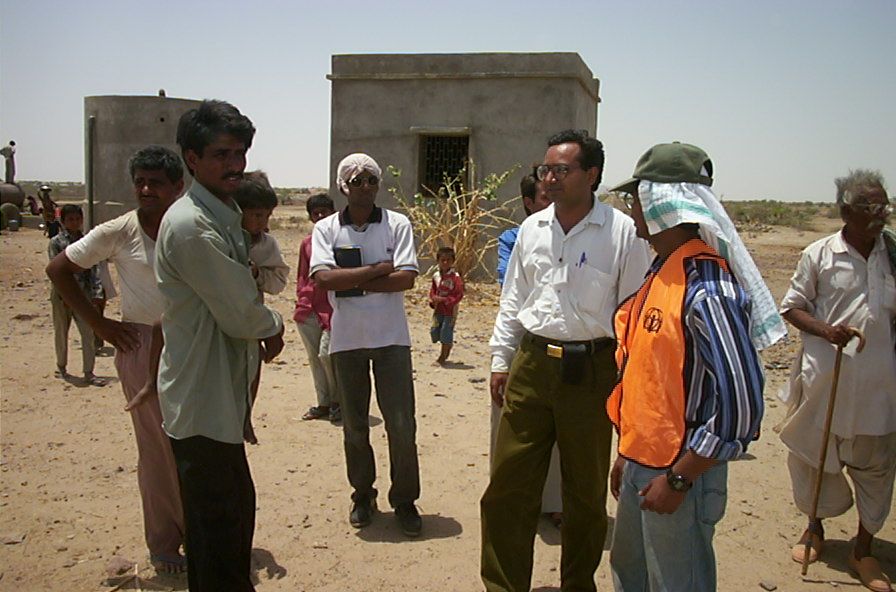
UNV interviewed Dr. Mukeshkumar Prajapati on 30 September 2026 as he was preparing to leave for South Sudan.