On why I volunteer: The circles of peace

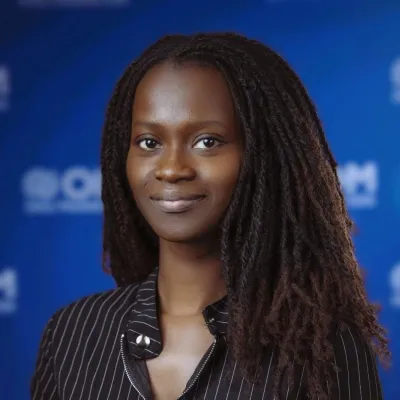
The circle is small but tense. We are sitting under a tree in a village in Unity State, South Sudan. Men, women, and youth lean forward on low stools. Some carry anger in their voices as they speak of cattle taken in raids. Others speak quietly about children forced into early marriages. A young man stands to confess he fears retaliation for a revenge killing.

In moments like this, my role is not to lecture or impose. It is to listen, to ask questions, to remind the group that within their own customs and traditions lie paths to peace. I have learned that people want solutions to come from themselves. My job is to create the space where that feels possible. By the end of that day, nothing dramatic had shifted. No handshake sealed a deal. But the room felt lighter. Neighbours who had stopped speaking to each other had looked one another in the eye. And for me, that was enough to keep going.

Reporting peace from the minefields of South Sudan

The lead deminer raised his hand—and silence swept across Amadi. A dog stepped forward, nose trained to detect danger buried deep in the soil. Children watched from a distance, eyes wide with fear, hope, and curiosity. We were in Durupi, Central Equatoria State—a community that had long abandoned its fields due to explosive remnants of war. Farming had stopped. Life had paused. But on this morning, the United Nations Mine Action Service, the National Mine Action Authority, and their partners showed what reclaiming safety looks like. With protective gear, precise steps, and canine partners, they turned fear into farmland.

I stood among the community and colleagues from the Mission and across the UN agencies, watching hope return. My work often happens behind a desk—drafting reports, shaping data, telling South Sudan’s story. But moments like this remind me: the words I write carry the weight of real lives. And this is why the work matters. 

Peace begins with people: A UN Volunteer's story from Guinea-Bissau

In Guinea-Bissau, communities are navigating daily uncertainty caused by instability and crime. Standing with them are UN Volunteers—one of them, Christian Menin, is from Brazil. He is a Project Manager with the United Nations Development Programme (UNDP), through the United Nations Peacebuilding Fund (PBF)—a key UN mechanism for supporting peacebuilding efforts in fragile settings.   

Christian works hand in hand with local institutions to rebuild trust and empower communities. He collaborates with police and justice officials, providing training to combat organized crime, corruption, and money laundering. In remote border areas, he helps install solar-powered systems so police posts can stay connected and equipped. These efforts are part of a broader peacebuilding initiative aimed at building trust in public institutions and making communities feel safer.

Information that saves lives—UN Volunteers with emergency response

When emergencies strike, having the right information can mean the difference between life and death. For Ahmed Anas Awad, an Egyptian, this belief drives his work every day. Since July 2024, he has been using his skills to support relief efforts in Gaza and Sudan as a UN Volunteer Information Management Officer with the World Health Organization’s Country Office in Egypt.

Anas's job is to make sure people get the information fast. He builds dashboards that show who’s doing what, helps collect and analyze data, and ensures it’s easy for everyone to access. His mission is simple: give decision-makers, responders, and communities clear, reliable information they can trust. 

Evaluating the UN system amidst growing global complexity

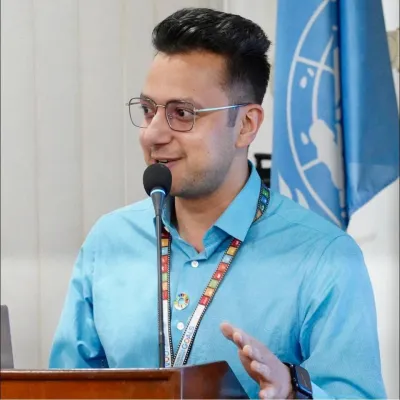
Ahmad Ullah Qazi, from Pakistan, serves as a UN Volunteer international specialist with the United Nations Educational, Scientific and Cultural Organization (UNESCO) Regional Office in Bangkok. He started his assignment in November 2024 as Regional Evaluation Associate for Asia and the Pacific region, where he supports the evaluation function of UNESCO across 6 regional and 14 field offices. His focus is to improve the quality of evaluations, enhance their use in programming and decision-making, and support the implementation of UNESCO’s evaluation policy and guidelines across field units and relevant programmes.

The United Nations Evaluation Group (UNEG) and United Nations Volunteers (UNV) collaborate on a programme where young professionals under the age of 35 serve as evaluators. Initiated by UNEG Young and Emerging Evaluators Working Group to provide learning and career growth for youth keen to join the UN, while also ensuring their voices are included in UN evaluation processes.

Bringing not only vaccines, but trust and hope

At the Integrated Health Center of Birnin Gueza in Maradi, a young mother named Amina stood uncertain as health workers approached. Her daughter, Salamatou, had never received a vaccine. Fear and hesitation lingered—until a conversation with Nana Nazifa Hamissou Garba, a UN Volunteer nurse deployed with the World Health Organization (WHO), changed everything. “I feel more confident now to protect my daughter against polio,” Amina said, her voice filled with relief. Amina’s story is just one of many unfolding across Niger, where the fight against polio rages on in the communities most at risk.

In June 2025, Dr. Mahamadou Nouri Kassimoune Tago and Nana Nazifa Hamissou Garba joined a cohort of 40 UN Volunteer Specialists supporting WHO's vaccination drive under the emergency response framework. Together, they work in districts where reaching children is both most urgent and most challenging—bringing not just vaccines, but trust and hope. 

"Disability is not a limitation"—voices that shift systems

Ekaete Judith Umoh’s arrival at the United Nations House in Abuja marked more than just a new job—it signaled a shift. She is the first Inclusion Coordinator in the United Nations Resident Coordinators Offices (UNRCO). As she rolled through the gates, a wheelchair user, Judith, was greeted by a gesture of respect. She is one of many persons with disabilities across West and Central Africa, who are taking on volunteer assignments for key roles within the UN system, turning inclusion from theory into practice

Meet Judith from Nigeria

Refusing to be erased—a volunteer’s voice from Gaza

“We are not just numbers or headlines. We are people: mothers, fathers, children—trying to survive and protect one another in impossible conditions. The world must see us, hear us, and stand with humanity. Support humanitarian work. Advocate for safe access. And most importantly, don’t let Gaza be forgotten.” Twenty-seven-year-old Tasneem Aboalkomboz, a general physician, shares the realities of serving as a UN Volunteer in the besieged coastal strip. Tasneem is from Gaza and started her assignment with the United Nations Development Programme (UNDP)’s Programme of Assistance to the Palestinian People as a Project Coordinator Assistant on 5 June 2025.

“The levels of death and destruction in Gaza are without parallel in recent times. Day after day, our efforts are being blocked, delayed, and denied. This is unacceptable.” UN Secretary-General António Guterres says, while highlighting the clear obligations for the occupying power, Israel. He calls Gaza a man-made disaster, a moral indictment, and a failure of humanity itself. “People are starving.

Hitting the right notes with communication

Meet Liu Shanshan, a postgraduate student from China specializing in Hindi literature at Guangdong University of Foreign Studies. In September 2024, Liu traded textbooks for hands-on experience in international development, joining the UN system as a UN Volunteer with the United Nations Office on Drugs and Crime (UNODC) at the Regional Office for South Asia. Her volunteer assignment was funded by the Chinese Young Volunteers Association (CYVA) and aimed to highlight youth voices in peace and justice.
 

Liu served as a Communications Assistant with UNODC from September 2024 to March 2025, focusing on Sustainable Development Goal 16: Peace, Justice, and Strong Institutions. Originally assigned to New Delhi, Liu faced unexpected visa delays that kept her working remotely for several months. Undeterred, she continued collaborating across borders until she finally landed in Kathmandu, Nepal—her first experience of UN life on the ground.