Online Volunteer brings clarity to spatial data

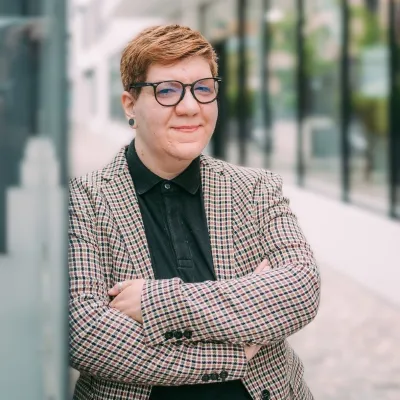
A Geographic Information Systems (GIS) Specialist, Andrii Nahornyi, transforms complex data into sharp, visual stories that drive real-world decisions. He has a degree in Geomatics and a background in spatial data analysis, cartography, and remote sensing. In 2025, Andrii joined the United Nations Development Programme's City Experiment Fund as an Online Volunteer, helping cities across Europe and Central Asia reimagine urban life. His GIS skills-powered projects are enhancing urban development—one map at a time.

Andrii began his assignment by designing a strategic plan focused on the geospatial component of the project, researching each participating city’s geographic, historical, and socio-economic context. This helped him gain a deeper understanding of the forces shaping urban development.  

"Once the groundwork was laid, I began sourcing data—vector, raster, and statistical—while organizing everything in a way that would support efficient geospatial analysis. This step was more than just data management; it was about building a foundation for meaningful insights," shares Andrii.

Peace in pixels: Digitizing Timor-Leste’s history

The Republic of Korea’s path to peace has taught it a powerful lesson: rebuilding isn’t enough—remembering matters. The Korean International Cooperation Agency (KOICA) supported an initiative in Timor-Leste to digitize the Chega National Center for Conflict Reconciliation and Peacebuilding. In partnership with the United Nations Educational, Scientific and Cultural Organization (UNESCO) Jakarta and INFORDEPE, the project turned painful history into a tool for learning, helping ensure the trauma of the Indonesian occupation is never forgotten—or repeated. Dayoung Jeong, a young Korean professional and fully funded UN Volunteer, helped carry this mission forward—combining personal growth and a commitment to peace through education.

Dayoung served as a UN Volunteer Education Associate in Timor-Leste from August 2023 to August 2024. She was driven by her dedication to UNESCO’s mission and the strength she admired in the Timorese people. 

Dayoung reflects on how preserving the past can breathe new life into a place once defined by trauma. 

From crops to confidence: Women planting the future

In Colombia’s rural heartlands, where women make up nearly half the agricultural workforce, the Raíces, mujeres sembradoras del cambio project is helping them grow—not just crops, but confidence, leadership, and independence. Led by UN Women with support from the United Nations Population Fund (UNFPA), Korea International Cooperation Agency (KOICA), and Colombia’s Ministry of Equality, the initiative equips women with the tools to earn more, lead their communities, and rebuild lives shaped by hardship and conflict. Ae Young Jung is a Korean national who completed a six-month assignment with UN Women Colombia through a fully funded volunteering opportunity from September 2024 to March 2025.

Growing up in Ecuador, Ae Young saw Latin America’s social struggles up close—and they stayed with her. She’s driven by a commitment to support vulnerable communities and promote gender equality. This opportunity didn’t just connect her to a cause—it brought together her Korean roots and the place that shaped her worldview.

From UN Volunteer to serving at the International Criminal Court

Yoojeong Jeong’s journey into refugee protection did not begin in the field—but in the pages of her Master’s thesis on Rohingya refugees. Yet even as she researched, a deeper calling stirred. “I kept thinking—this isn’t where I’m meant to be. I need to be out there, with the people."

After she graduated, Yoojeong discovered that being a Korean national, she could apply for the fully funded UN Volunteer opportunities with the Korean International Cooperation Agency (KOICA). She sent in her application for the role of a UN Volunteer Operational Data Management Associate with the UN Refugee Agency (UNHCR). 

With every word, a world: A Korean volunteer's voice from MENA

In the Middle East and North Africa (MENA) region—where conflict, displacement, and environmental challenges intersect, Korean researcher Sihyun Park volunteered for sustainable development with support from Korea International Cooperation Agency (KOICA). As a fully funded UN Volunteer based in Jordan, she relied on research to develop practical solutions. Her assignment, which lasted a year and concluded in September 2025, offers insights into the impact of volunteerism in complex settings. Let’s take a closer look at her journey.

Sihyun's volunteer journey began after earning a degree in Science Education in the Republic of Korea. She volunteered through a KOICA project at a youth center in Takeo, Cambodia. Witnessing the health gaps faced by young people inspired her to pursue a Master of Public Health in the United Kingdom. Immediately after graduating, she joined the United Nations Children's Fund (UNICEF) MENA Regional Office in Amman as a UN Volunteer Health Officer.

Landing in the heat of history

The wheels of the dark grey Australian military aircraft kissed the tarmac—no, slammed it—sending a tremor through the ground. A shudder rippled outward, kicking up a furious halo of dust. The aircraft, all muscle and menace, rumbled to a halt beneath the brown cloud, its fuselage gleaming like a predator freshly landed in hostile territory. “Welcome to East Timor,” blurted out Paul Guering, an Irishman and United Nations Volunteer (UNV) official, as the scorching heat of Dili, the capital greeted us on a sunny afternoon in late June 1999. Paul was overseeing the deployment of the first batch of UN Volunteers from a temporary staging base in Darwin, Australia, to East Timor. Nearly 100 of us were on that plane, a motley crew of veteran UN peacekeepers, civilian police officers, and bright-eyed volunteers from across the globe.

We had all answered the call to serve in the historic United Nations Assistance Mission in East Timor (UNAMET), a political mission, established by the UN Security Council on June 11, 1999. Our task: to help organize and conduct a UN-sponsored referendum in which the Timorese people would vote on whether to remain under Indonesian autonomy or pursue full independence. 

UN Volunteer from Japan spotlights inspiration in action at Expo 2025

Half of the people on our planet are 30 or younger, and this is expected to reach over 57 by the end of 2030. Today, on International Youth Day, we highlight the absolute need to include young people as equals in development solutions, not afterthoughts. Want to shake the system? Start by handing them the mic. In this story, the mic is with Haruki Ume, who spoke to UN News at the UN Pavilion at Expo 2025, currently being held in the Japanese city of Osaka. Let's hear it from Haruki.


As a 17-year-old, I travelled to the United States on an educational exchange programme and my main motivation was to play baseball and experience American culture.

I met a lot of other people from Africa and Asia as well as Europe and I was taken aback and then impressed by their passion and motivation to support their villages and communities back home.

When the world breaks, humanitarians show up

In war zones, where fear and destruction dominate, humanitarians and volunteers bring something powerful: courage. Often among the first to reach those in need, volunteers—including UN Volunteers—step into danger not for glory, but to save lives and ease suffering. Their work is urgent and essential. They deliver food under fire, set up shelters in rubble, and offer hope where there’s none. Through volunteering, they embody solidarity and compassion. Humanitarians are not a target, but often they are. On World Humanitarian Day, we pay homage to the fallen heroes, and salute the rising wave of humanitarians—under the theme Act for Humanity, recognizing those who step forward when it matters most.

Humanity in action

Inclusion isn’t a side note—it’s a strategy

In Chad and Niger, three national UN Volunteers are flipping the script on inclusion—by living it. Meet Kadiatou Moumouni, Damba Kalki Zoua, and Bekoutou Junior Masra. They’re part of a bold initiative placing UN Volunteers with disabilities in Resident Coordinator Offices across West and Central Africa. The idea is simple but powerful: if you want to build an inclusive system, start by including those who know what exclusion feels like. 

In Niger, Kadiatou Moumouni is more than a UN Volunteer; she’s part of what defines the new normal in the UN system—inclusion. At the Resident Coordinator’s Office (RCO), she connects government, UN agencies, and civil society to champion gender equality, human rights, and disability inclusion. One of her standout contributions? A simple attendance sheet—redesigned to track the participation of persons with disabilities.