



Imagine a world without digital. No smartphones, no laptops, no Zoom, no internet—just silence between continents and communities. Now picture the moment digital arrives and accelerates at lightning speed. But pause and ask: Does every country share the same resources? Can everyone benefit equally from this revolution? Is every voice included? You already know the answer—digital progress is not universal. And that’s where the real story begins. Let’s hear from Arita Arania Phillip, a UN Volunteer from Antigua and Barbuda.
“The first of January 1983 is the internet’s birthday. At that time, Antigua and Barbuda, where I call home, had only been independent for a little over a year. Many Small Island Developing States (SIDS), due to our small country size, population, and our separation by water, struggled to develop economically and therefore transform digitally. On the other hand, countries with economies of scale, developed infrastructure and high capital were able to transform at a rapid pace and at a lower cost. Over time, these compounding differences resulted in a digital divide, where many countries and governments still need support with their digitalization processes, and this is where I come in.
In my role as a UN Volunteer Associate Programme Specialist for Youth and Digital Transformation within the United Nations Educational, Scientific and Cultural Organization (UNESCO) Regional Office for the Caribbean, I support Small Island Developing States as they undergo digital transformation. I collaborate with the government, the UN system in the Caribbean, the civil society and the academia to coordinate and host workshops, prepare reports and create content that promotes media and information literacy, digital inclusion and digital skills development with a focus on youth and people with vulnerabilities.
Volunteerism is a lifelong commitment for me. In marginalized communities, you often rely on each other for survival. Once you’ve lived in, or observed this, it is natural to want to be a part of the solution.
Inspired by the observation of a woman with a listening disability carrying a baby with three other small children, who struggled to navigate the public transportation system and often relied on her children to communicate, I grew increasingly concerned about the ability of hard-of-hearing and nonverbal people to navigate daily life. I questioned whether there was equal access to public services. Or was information to manage emergencies or extreme climate events, such as tropical storms and hurricanes, easily accessible when the going got tough? On other occasions, I've even questioned if governments have the resources or capacities needed to support persons with disabilities.
Research has shown that sign language users are often excluded in communications for election campaigns, disaster preparation and in sharing news about the government’s work.
Keeping this exclusion front and center, during my first year as a UN Volunteer with UNESCO in 2023, I worked with the government to ensure communications for sign language users were prioritized in the UN Digital Readiness Assessment Public Infomercial campaign. This effort led to the production of 18 sign language videos featuring voices from the UN, government, and civil society, all emphasizing the importance of digital transformation. These initiatives make me incredibly proud—they signal a strong commitment to the principle of 'nothing about us without us.'
In addition to filming and editing, I provide voice-overs and collaborate with sign language interpreters to create scripts that capture the essence of the original dialogue. I’m also learning sign language to ensure accuracy and catch errors, such as skipped words.
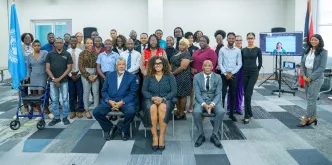
I’ve also supported the government in delivering key initiatives under the Youth, Media, and Information Literacy Engagements, such as a Digital Skills Training Workshop for educators at the School for the Deaf. Here, staff were introduced to online class management tools such as Miro and Canva. Picture the scene: laptops open, teachers at the first table—hearing impaired—learning through sign language interpretation. It was a powerful moment of inclusion and empowerment. Also, a youth stakeholder workshop brought together 500 plus Caribbean youth to explore misinformation, digital footprints, media and mental health, and cybercrime protections.”
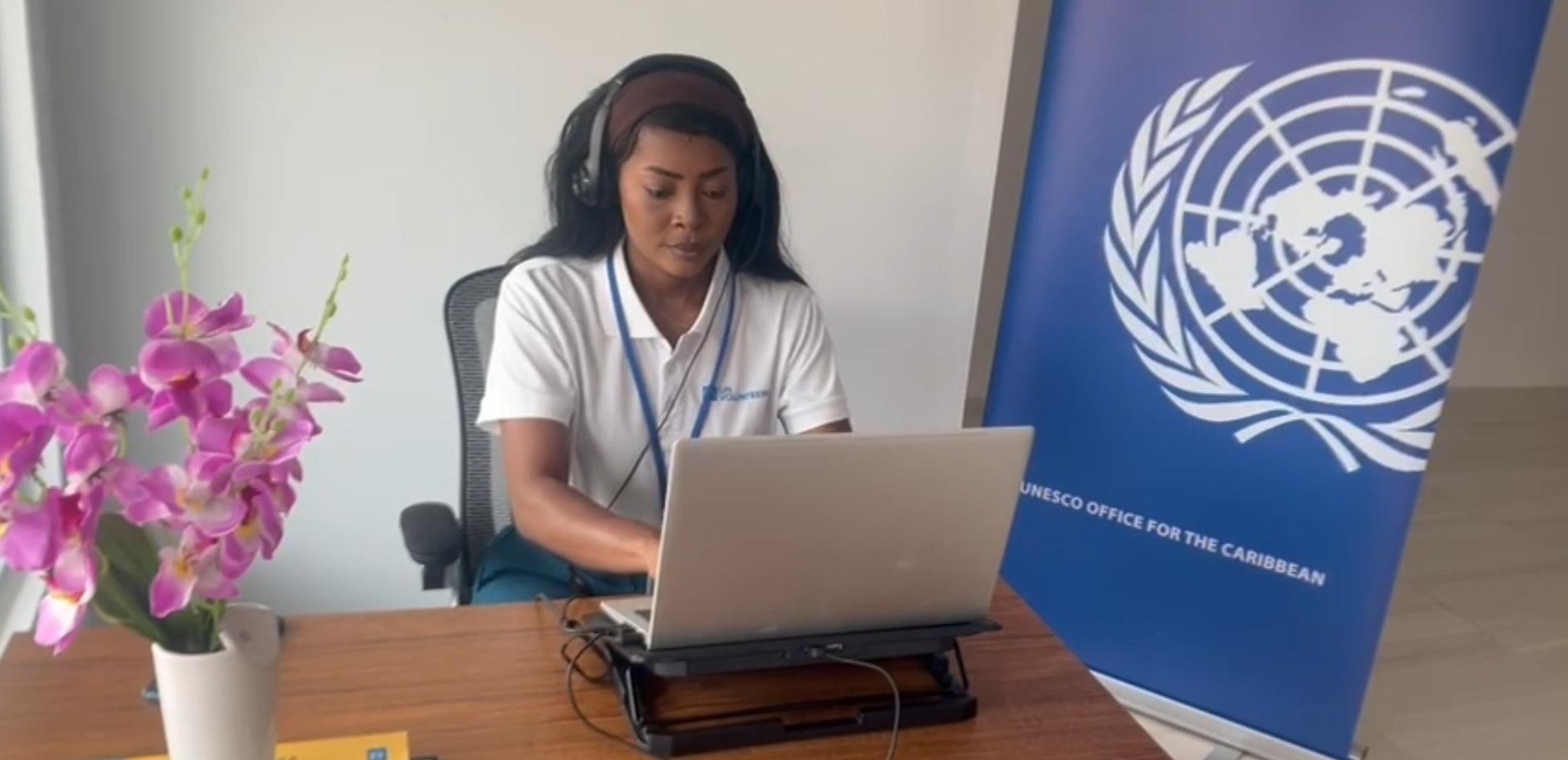
Arita looks forward to what's ahead. She reflects that in a world racing toward digital transformation, not everyone moves at the same speed—or with the same access. That’s why charting the next steps to the upcoming launch of Antigua and Barbuda’s Digital Transformation webpage matters. It’s more than a resource; it’s a commitment to inclusion, with accessibility features for people with hearing and vision impairments. Because progress that excludes is not progress at all. She shares:
In 2026 and new year resolutions, let’s celebrate what we’ve achieved together—across islands and continents. Every effort and every contribution builds a world that is more resilient, peaceful, and inclusive. Together, we’re proving that the digital dawn doesn’t have to be unequal—if we choose to leave no one behind.”
Arita spoke about her UN Volunteer assignment during the UNV Voices of Change webinar. To watch the session, please click here.